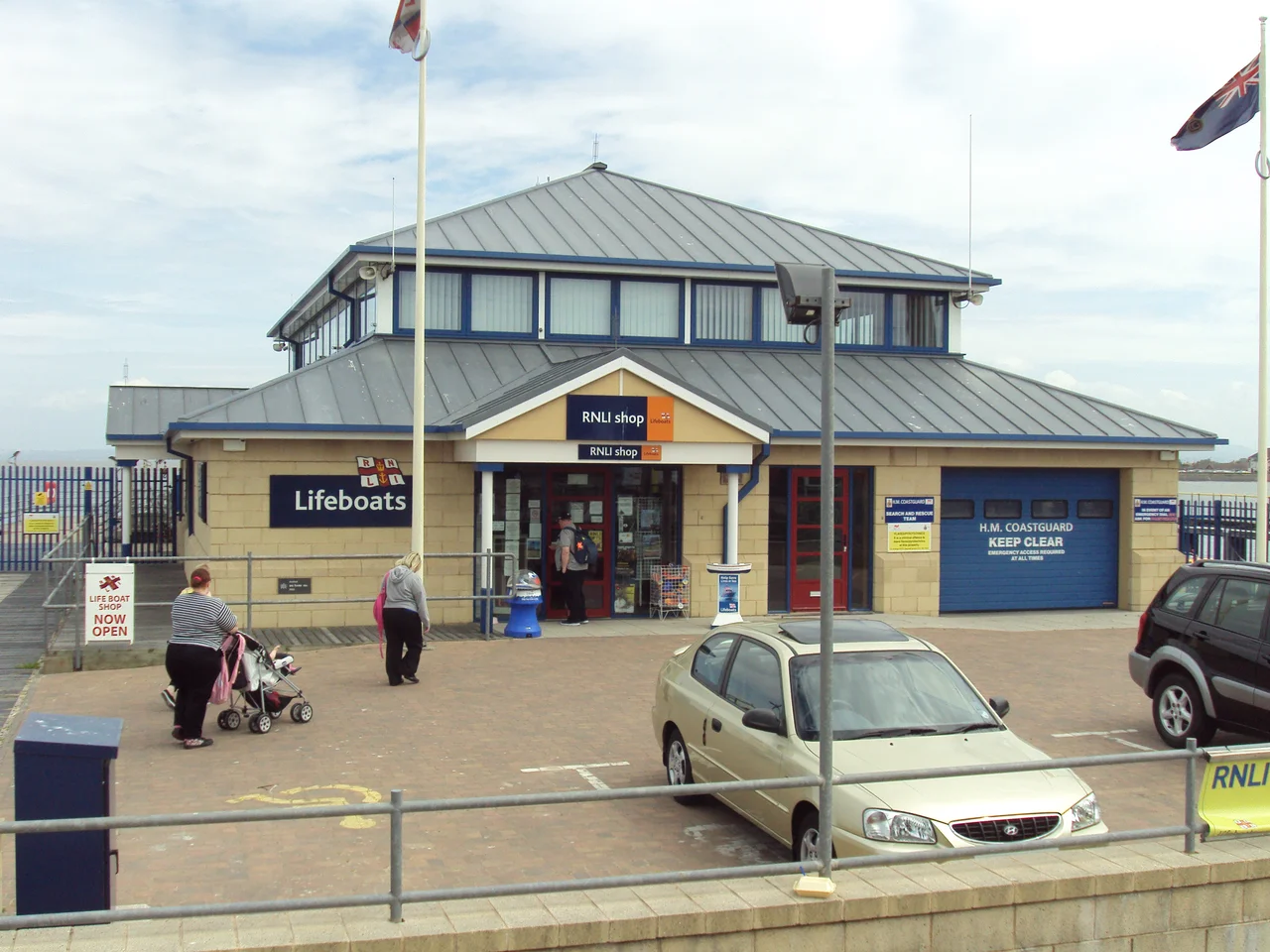

Fleetwood Lifeboat Station
Three medal rescues in a single year. That was the record set by John Fox, Coxswain, and Captain Edward Frodsham Noel K. Wasey, RN, of HM Coastguard in 1860 - the lifeboat's very first year on station at Fleetwood. On 22 January a steam-tug towed the boat over four miles to the Ann Mitchell, and on the seventh attempt the single survivor was lifted clear. Fox and Wasey were each awarded the RNLI Silver Medal. Over the next nine months Wasey earned two more clasps to his medal - for saving four men on 19 February, then fifteen men and the pilot on 20 October. A captain does not collect three Silver Medals in twelve months unless his coastline is brutally hard on ships.
A Letter That Saved Lives
It started with a letter. In November 1858 Captain Wasey wrote to the Royal National Lifeboat Institution requesting a boat for Fleetwood, a busy port at the north end of the Fylde where the River Wyre meets Morecambe Bay. The RNLI agreed. A boathouse was built opposite the North Euston Hotel for £174 18s 6d. A 30-foot Peake-class six-oared rowing lifeboat was constructed by Forrestt of Limehouse, London, for £140 and arrived on station on 20 March 1859. John Fox took charge as Coxswain. Captain Wasey served as Honorary Secretary. Within ten months the boat was earning medals. Two years later, Miss Mary Wasey gave £340 toward a new boat. The 32-foot ten-oared self-righting Edward Wasey arrived in November 1862, carried free of charge from London to Fleetwood by the London and North Western Railway.
Four Boathouses and a Storm
The original 1858 boathouse was almost washed away in a storm of 1863, so a new brick-built one went up at Pharos Place next to the Pharos Lighthouse for £161 17s 10d. It is now a private house. Col. William Blackburne's £900 gift funded a new boat in 1879, Child of Hale, with the leftover money paying for a third boathouse and slipway near the present site. A larger 46-foot Edith arrived in 1887 as the No.2 boat. In 1893 the railway companies needed to extend their harbour moorings right over the slipway, and a fourth boathouse with a longer slip was constructed in 1894, funded by the railways themselves. By then Fleetwood had only one boat in service. Maude Pickup, a 46-foot Watson, served from 1894 to 1930. The station then closed for three years for reconstruction.
The First Engine
When Fleetwood reopened in 1933, it had its first motor lifeboat - the 38-foot self-righting Sir Fitzroy Clayton, with a 35-horsepower engine giving 7 knots. She was named after Col. Sir Fitzroy Clayton, who had chaired the Institution from 1908 until his death in 1915. She had previously served in Sussex, where she had been credited with saving 108 lives before coming north. The transition from oar power to engine was not merely a matter of speed. It was the difference between fighting wind and tide every metre and going where you were needed. A boat that could be sent into the teeth of a storm and brought back changed the maths of survival for everyone in trouble in the Irish Sea.
Kenneth James Pierpoint
Fleetwood's current all-weather lifeboat is the 13-14 Kenneth James Pierpoint, ON 1321, a Shannon-class boat that arrived on station at 13:14 on 26 June 2016. She cost £2.2 million and is one of the most capable lifeboats in the world - water-jet driven for shallow-draft work, self-righting, capable of 25 knots. She was paid for by the legacy of Miss Kathleen Pierpoint of Altrincham, Cheshire, who died in 2012. She named the boat for her brother Kenneth, a young RAF pilot killed in the Second World War in 1942. The boat is therefore a memorial. Every launch is a brother's name being carried back out to sea, into the same dangerous water that killed him, in the service of someone else's brother or sister or child.
Volunteers, Still
Alongside the Shannon, Fleetwood operates a smaller inshore lifeboat, the Harbet (D-853), on station since 2021. Both crews are volunteers, as RNLI crews have been since the Institution was founded in 1824. They go out in weather most people will never voluntarily set foot in. They go out at night. They go out because somebody else needs them. There is no roll of honour on this article - no Fleetwood crew has been lost - but every lifeboat town in Britain knows that this can change in a single shift. Captain Wasey's letter from 1858 was answered 166 years ago, and the answer keeps being given, one launch at a time.
From the Air
Fleetwood Lifeboat Station sits at 53.93 N, 3.01 W on The Esplanade at the mouth of the River Wyre, north end of the Fylde Peninsula. From altitude, look for Fleetwood as a dense urban patch at the river mouth, the Pharos Lighthouse a distinctive in-street tower, and the Beach Lighthouse near the lifeboat station itself. The North Wharf sandbank extends north into Morecambe Bay and shows clearly at low tide. EGNH Blackpool is 7 nm south. Manchester (EGCC) 40 nm southeast, EGNL Barrow/Walney Island Airport (private) 25 nm north across Morecambe Bay. Best viewed at low tide when the river channel and offshore banks are most visible. Heavy weather - the reason this station exists - frequently rolls in off the Irish Sea from the southwest; even in summer, visibility along this coast can drop quickly in a westerly.
Nearby Stories
- RAF Cark 3.1 km away
- Bolton Steam Museum 3.2 km away
- Clitheroe Castle 4.5 km away
- Scarisbrick Hall 4.5 km away
- Hawes Junction Rail Crash 24 km away
- Abergele Rail Disaster 37 km away
- Egremont Castle 38 km away
- Celtic Array 60 km away