
Bolton Steam Museum
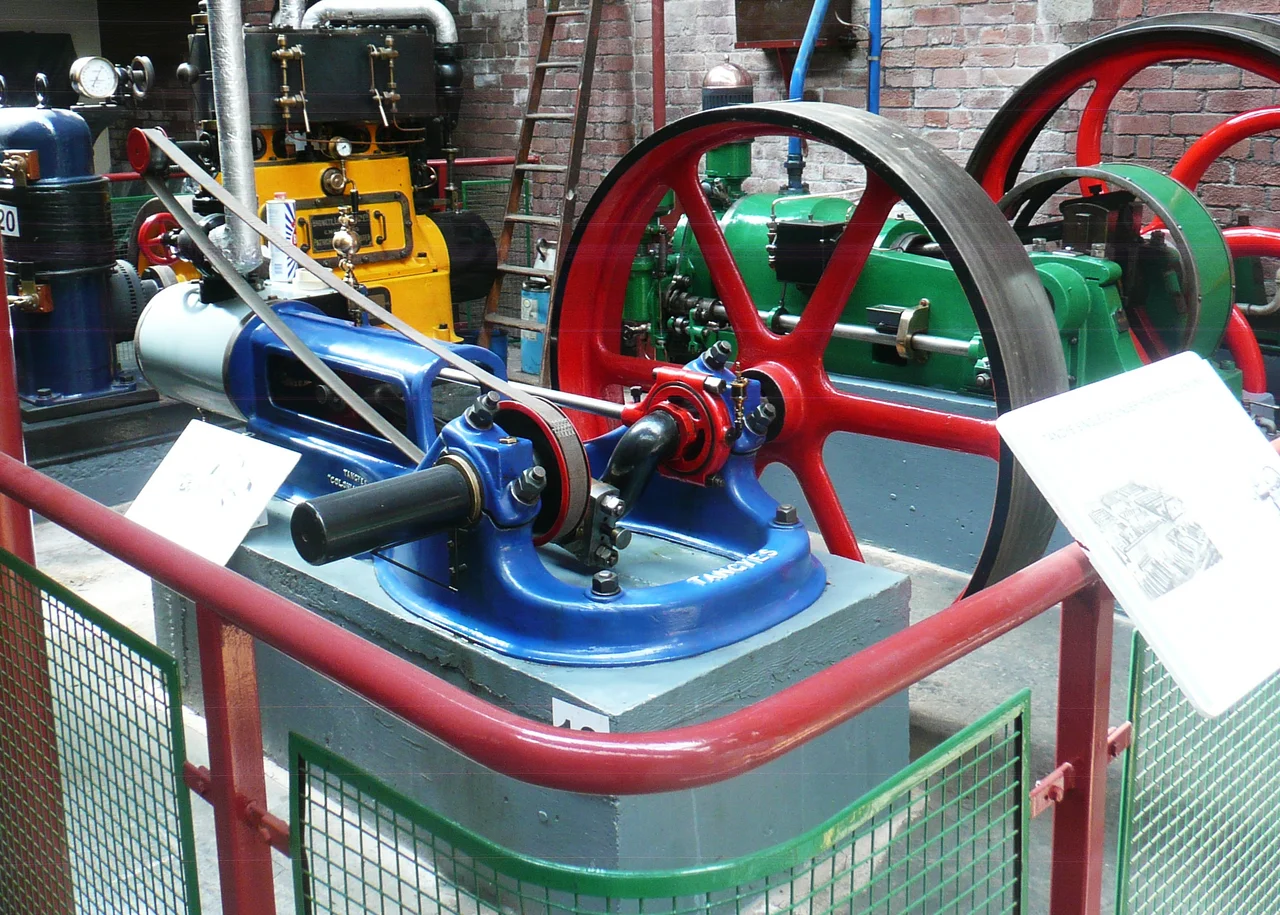
On Bank Holiday weekends in Bolton, a strange noise drifts across the Morrisons car park: the hiss and chuff of a 1902 tandem compound engine breathing live steam again. Inside the cotton store of the former Atlas Mill on Mornington Road, the Northern Mill Engine Society keeps the heart of Lancashire's industrial age beating - not as a static display, but actually running, flywheels spinning, governors hunting, brass fittings polished to a mirror. Most of these engines were built within a few miles of where they now sit.
The Engines That Ran the World
By 1900, Lancashire's cotton mills powered nearly half the cloth on the planet. The engines that drove them - vast horizontal compounds, towering vertical condensers, ingenious patents like the Musgrave non-dead-centre - were as specialised and as British as the cloth they produced. Scrap dealers melted thousands of them down between the 1950s and the 1970s as electricity supplanted steam. A small society of enthusiasts, the Northern Mill Engine Society, decided to save a handful. They chose Bolton because it had been a heart of mill engineering: the firm of John Musgrave and Sons built engines here for export to mills across the world. One of the museum's pride exhibits is the Parks Street Mill engine, a Musgrave non-dead-centre design built in Bolton in 1893 for a mill in nearby Radcliffe.
Home Ground
The museum's location is more than convenient - it is symbolic. The Atlas Mill complex was once one of Bolton's largest cotton spinning sites, and the cotton store where the engines now live still has the soaring ceilings the original goods required. The Crossfield Mill beam engine of about 1840 is one of the oldest in the collection, a twin-beam machine with a gear-driven flywheel that would have looked archaic even when it was new. The Wasp Mill Tandem, built by J & W McNaught of Rochdale in 1902, used Corliss valve gear, the high-precision technology that gave late-Victorian engines their famously even running. The Diamond Rope Works inverted vertical, built by Scott and Hodgson of Guide Bridge in 1914, was rescued from a rope mill in Royton, near Oldham. Some of these machines were retired only in the 1970s.
Other Voices
Not everything is a Lancashire compound. A Robey Uniflow from Lincoln, built in 1926 for sawmills in Ammanford, South Wales, sits beside a 1935 Robey cross-compound that once powered laboratories at the University of Manchester Institute of Science and Technology. A Joseph Barraclough single-cylinder A-frame engine from a Barnsley glassworks of about 1860 represents Yorkshire engineering. A Walker steam fire pump from Radcliffe, of around 1890, could be wheeled out to fight a mill fire - the kind of disaster that destroyed whole industries in a single windy night. There are also barring engines - small auxiliary engines used to turn enormous flywheels into starting position - and four diesel and gas engines from Ashton-under-Lyne, the technology that would eventually displace steam.
Special Open Days
On most Wednesdays and Sundays the engines stand silent, oiled and polished, while volunteers work around them. But on Bank Holiday weekends the boilers are lit, and the museum becomes something genuinely rare: not a model railway running clean compressed air, not a museum diorama, but Victorian heavy machinery actually doing the thing it was built to do. The slow nodding of a beam engine, the breathing of a Uniflow, the smell of warm oil and hot iron - these are the sensory facts of the world that built modern Britain. The Northern Mill Engine Society is a registered charity. Most of its members are unpaid volunteers in oily overalls. They are quietly keeping faith with their grandfathers' fathers.
From the Air
Located at 53.5849 degrees north, 2.4546 degrees west, on Mornington Road in west Bolton, about 12 miles north-west of Manchester city centre. The Atlas Mill cotton store is a long red-brick rectangle adjacent to a Morrisons supermarket. Bolton's mill chimneys and church spires are characteristic landmarks. Manchester Airport (EGCC) is roughly 18 miles south-south-east. Liverpool (EGGP) is 30 miles south-west. The West Pennine Moors rise immediately north of town, with Winter Hill's TV mast a useful visual reference. Recommended viewing altitude is 2,500 to 4,000 feet AGL.
Nearby Stories
- National Science and Media Museum 0.2 km away
- Jodrell Bank Observatory 3.2 km away
- Siege of Lathom House 5.6 km away
- Chester Zoo 6.2 km away
- Whalley Abbey 8.9 km away
- Haddon Hall 10 km away
- Wentworth Castle 16 km away
- Blackpool 16 km away