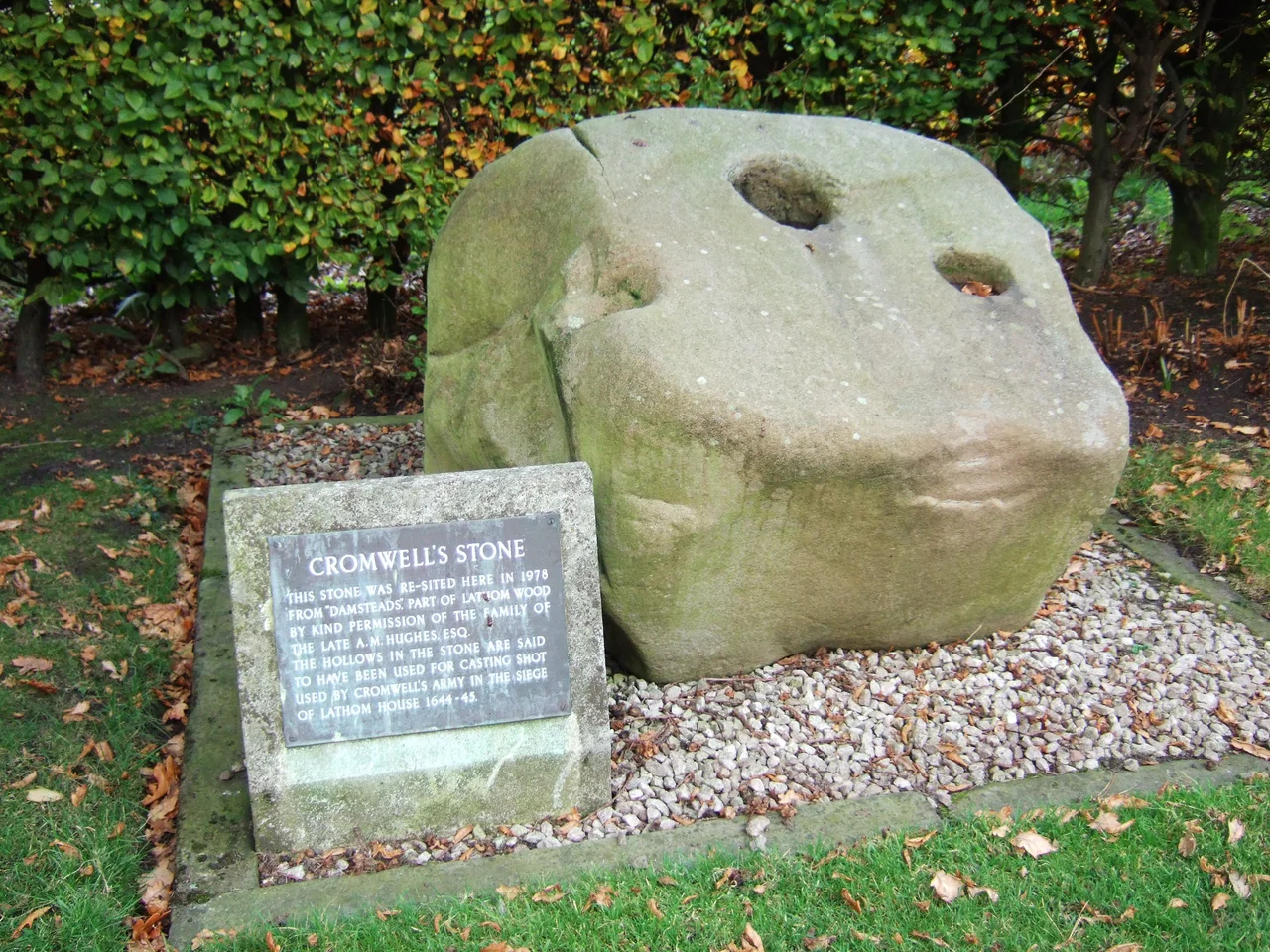

Siege of Lathom House
Charlotte de la Tremoille was French, forty-four years old, the granddaughter of William the Silent, and the wife of a man who had been ordered to the Isle of Man and could not come home. When Sir Thomas Fairfax rode up to Lathom House in February 1644 and asked her to surrender, she asked for a week to think about it, then invited him in for further negotiation, then politely showed him the door. What followed was three months of sniping, sorties, prayer days, and stone-throwing rage in which two thousand Parliamentary soldiers tried and failed to crack open one of the most heavily fortified houses in northwest England, defended by three hundred men and one resolute woman who had decided that surrendering her husband's house would dishonour him beyond bearing.
The Last Royalist House in Lancashire
James Stanley, the seventh Earl of Derby, was the dominant Royalist figure in northwest England when the Civil War broke out in 1642. The Stanleys had been at Lathom House for generations. In 1643 King Charles ordered Derby to the Isle of Man, fortifying that strategic point against possible Scottish invasion. He left his French wife in charge of Lathom, which by early 1644 was the last fortified Royalist position in a county that had otherwise fallen to Parliament. Sir Thomas Fairfax, future commander of the New Model Army, saw the opportunity. After taking Warrington he marched on Lathom and demanded the countess submit to Parliament's authority. She refused on the grounds that submitting would dishonour her absent husband. She offered, with some firmness, to confine her activities to the defence of her home, which postponed the inevitable assault by some weeks.
What She Built to Hold
Charlotte had spent her postponed weeks well. The fortifications of Lathom House, which Fairfax had assumed were ornamental, turned out to be formidable: outer walls and embankments six feet thick, an eight-yard moat, nine towers each mounting six cannons, and the Eagle Tower providing a commanding overview of the surrounding ground. The house sat at the lowest point of an open expanse, paradoxically an advantage because it gave the defenders unobstructed sight lines for marksmen against any attacker trying to approach. Charlotte had a militia of skilled shots inside, and she used them. Parliamentary engineers who came forward to site artillery batteries were picked off one by one. Cannon and mortar fire did almost nothing to the walls. Royalist sorties, sudden sallies out of the gates by parties of horse, broke up the besiegers' positions and spiked their guns. Morale on Fairfax's side cracked badly.
The Countess and the Messengers
What survives most strongly from the contemporary accounts is Charlotte's tone. She received Fairfax courteously, then dismissed his terms. She rejected an emissary scornfully two days later. She refused even when her husband sent a letter from the Isle of Man asking for safe passage out for her. Colonel Alexander Rigby tried his own approach, sending Captain Hector Schofield with an offer of honourable surrender. Charlotte threatened to hang Schofield from the tower gates, tore up Rigby's letter in front of him, and sent him back with a message in her own hand. To another Rigby ultimatum on 23 May she responded: 'The mercies of the wicked are cruel.... unless they treated with her lord, they should never take her or any of her friends alive.' These were people willing to die for what their words said they would die for. On the night of 27 May, Prince Rupert of the Rhine arrived at the head of thousands of cavalry and infantry, and the siege was lifted.
The Second Siege, and the End
Charlotte and her household withdrew to the Isle of Man, leaving Colonel Edward Rawstorne in command of the house. The wider war turned against the Royalists at Marston Moor on 2 July 1644, and by 1645 Lathom was an isolated pocket of resistance in a Parliamentary north. Four thousand Parliamentary troops returned that July under Colonel Peter Egerton, who made Ormskirk his headquarters and encamped on Aughton Moss. The second siege was less dramatic than the first because the outcome was no longer in doubt. The garrison held until famine made holding impossible. On 2 December 1645 Rawstorne surrendered at discretion. The House of Commons ordered the London ministers to give public thanks to God the following Sunday for the fall of so famous a Royalist house. Twelve cannon and a large store of weapons fell to Parliament. The house was slighted, that is, deliberately damaged so it could never again be used as a stronghold, and the Stanleys later moved their principal seat to Knowsley Hall.
What Remains, and Who Remembered
Lathom House as Charlotte knew it is gone. The site near Ormskirk holds only fragments now, a few earthworks, and a place name that endures in maps and local memory. Charlotte herself escaped to the Isle of Man and survived to see the Restoration of 1660, nine years after her husband had been beheaded at Bolton in 1651 for his loyalty to Charles II. Her courage during the siege made her a figure of Royalist legend for generations afterward; Letitia Elizabeth Landon wrote a poem about her in the nineteenth century, and Steeleye Span took the chaplain's chosen Jeremiah verse, 'They called her Babylon,' as the title of a 2004 song. The siege is one of the best-remembered episodes of the war in Lancashire, partly because Charlotte's voice survives so clearly in the accounts and partly because the brave defence of a doomed cause has a long shelf life in English memory.
From the Air
Coordinates 53.576 N, 2.817 W near Ormskirk in West Lancashire. Recommended viewing altitude 2,500 to 4,000 feet to take in the flat ground around the original Lathom site between Ormskirk and Skelmersdale. Nearest airports: Liverpool John Lennon (EGGP) 14 nautical miles south, Blackpool (EGNH) 21 nautical miles north, Manchester (EGCC) 22 nautical miles east. The historic site is east of Ormskirk; the modern Lathom Park lies north of the original house location.
Nearby Stories
- Blackpool Pleasure Beach 4.4 km away
- Whalley Abbey 4.8 km away
- Worsley 5.4 km away
- Second Battle of Middlewich 7.7 km away
- Chester Zoo 7.9 km away
- Llanrwst 23 km away
- Abergele Rail Disaster 27 km away
- Sea Lion Rocks railway station 73 km away