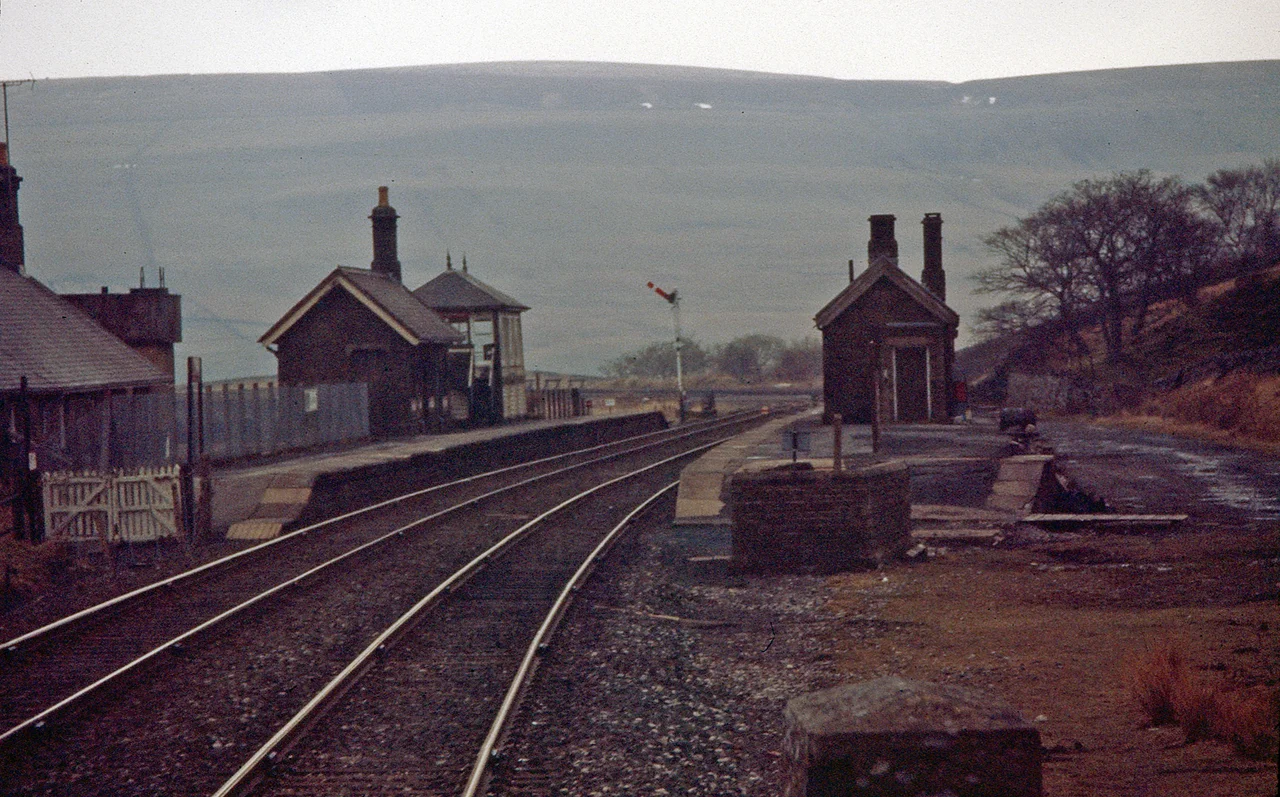

Hawes Junction Rail Crash
Go to Bunce and tell him I am afraid I have wrecked the Scotch Express. Those were the words of signalman Alfred Sutton to his relief, Simpson, just as Simpson arrived to start his shift at Hawes Junction on the morning of 24 December 1910. By then the glare of fire was already visible to the north. Sutton had been on duty for over ten hours. In the busy hour before the accident he had handled nine light engines and a heavy load of holiday traffic. Twenty minutes before he spoke those words, he had cleared the signals for the midnight sleeping car express from St Pancras to Glasgow - not realising that two locomotives, Engine 448 and Engine 548, were still standing on the main line he had just opened. Twelve people died in the next few minutes. Most of them burned to death in the wreckage. It was Christmas Eve.
The Geography of the Mistake
Hawes Junction was a small station high on the Settle and Carlisle line, the steeply graded route that the Midland Railway had built across the Pennines in the 1870s. It sat about three and a half miles south of the Ais Gill summit - the highest point on any main line in England. The Midland Railway operated a small-engine policy: rather than using larger locomotives, they regularly added pilot engines at the foot of the gradient to help express trains up the climb. At Ais Gill the pilots were uncoupled and ran south to Hawes Junction, where there was a turntable. After being turned, the light engines were usually coupled together in pairs and run back to their depots at Leeds or Carlisle. This system worked when traffic was light. On Christmas Eve 1910, with holiday specials thickening the timetable, it overwhelmed the signalman in his small wooden box at the centre of it all.
Twenty Minutes That Should Have Been Five
At 5:20 am Sutton signalled two coupled light engines, driven by Edwin Scott and George William Bath, onto the down main line. They were heading north to Carlisle. They stopped at the advance starting signal, 270 yards from the signal box, waiting for a down express to clear Ais Gill. Normally this took between four and six minutes. Then the express ahead of them was delayed. Scott and Bath waited. And waited. While they waited, Sutton handled two express up goods trains, dispatched three light engines south, and accepted the midnight express from St Pancras. At 5:44 am he pulled all his signals to clear - completely forgetting that the two light engines were still standing on the line outside his window, with rain blowing hard against the box and the engines' whistles muffled by the distance to the advance signal. They had been waiting twenty minutes. Sutton thought he had sent them on long before.
The Collision
The express was running sixteen minutes late and travelling at sixty miles per hour. It consisted of four timber-bodied coaches, two sleeping cars and two brake vans - hauled by two locomotives under drivers Richard Oldcorn and Henry Wadeson. The two light engines had cleared Moorcock Tunnel and were rolling across Lunds viaduct at an easy twenty-five miles per hour. Driver Bath looked back at exactly the wrong moment and saw the express emerging from the tunnel behind him. He opened his regulator. On the express, driver Oldcorn saw the red tail-light on Bath's tender and applied the continuous brake. Oldcorn estimated the gap between them as six yards. Neither action had time to make any difference. The express struck the light engines from behind. Bath's locomotive was derailed but carried on for two hundred yards before coming to rest against a cutting wall. The express locomotives derailed and the coaches piled up behind them. The first two coaches were badly telescoped. The twelve passengers who died were inside those two coaches.
Fire from the Lights
Most of the coaches were lit by the Pintsch oil gas system - a pressurised gas held in cylinders beneath each carriage, piped to the lamps overhead. The main gas pipe on the leading coach was broken in the impact, and the entire contents of the cylinders escaped in under two minutes. The gas then ignited in a single flash. The Lunds viaduct sits exposed on open moorland. A strong wind was blowing. Driver Bath, injured in the leg, walked a mile and a half to Ais Gill signal box to summon help. Driver John William Judd brought another light engine and tried to put out the fire by bucketing water from his tender. A light engine from Hawes Junction tried to drag the rear coaches clear but managed only to move the brake vans at the back. The six leading coaches could not be moved. Engine crews, the express train's guards, the sleeping car attendants, some platelayers from a nearby hut, and a shepherd whose home stood close by - they all tried to reach the trapped passengers. The smoke drove them back. The wind kept the fire alive. All six coaches burned out. The bodies were carried to the nearby Moorcock Inn, where the Board of Trade Inquiry would open three days later.
What Pringle Found, and What Changed
The investigation was led by Major John Wallace Pringle of His Majesty's Railway Inspectorate. The primary cause was clearly Sutton's lapse of memory - he had cleared signals without verifying the line was clear, and the Midland Railway had not adopted the simple mechanical reminder collars that many other railways used to prevent exactly this kind of error. Pringle also faulted Scott and Bath for not sending a fireman to remind the signalman after waiting too long, as Rule 55 required. But Pringle's deeper conclusions targeted the system. Track circuits, invented in the 1870s and proven repeatedly in service, would have made the accident impossible by detecting the stationary engines and locking the signals. The Midland Railway had refused to install them. After the inquiry the company rapidly fitted reminder collars at Hawes Junction and nine hundred other locations. Pringle also recommended that electricity replace Pintsch gas for coach lighting nationwide, although he acknowledged the change would take decades. The lessons of Hawes Junction were almost exactly repeated at Quintinshill in 1915, where a signalman forgot another train on the main line and 226 people died - the worst rail crash in British history. The mechanisms Pringle had recommended were not yet universal. The signalman Sutton was held responsible but lived. The twelve passengers who died had names, families, journeys interrupted at the end of a long climb in the dark.
From the Air
The crash site is at the Lunds viaduct, located at approximately 54.34 degrees north, 2.33 degrees west, on the Settle-Carlisle railway line about a mile north of the former Hawes Junction (now Garsdale) station. From altitude, look for the viaduct crossing a remote section of high moorland between Mallerstang Common and the headwaters of the River Ure. Best viewed from 3,000-4,500 feet AGL. Carlisle (EGNC) lies approximately 35 nautical miles north-northwest; Leeds Bradford (EGNM) is about 40 nautical miles southeast. The Yorkshire Dales National Park dominates the landscape; expect mountain weather and rapidly changing visibility.
Nearby Stories
- Richmond Castle 1.3 km away
- Upper Teesdale 2.1 km away
- Morecambe Bay Cockling Disaster 3.8 km away
- Crook, County Durham 5 km away
- Windermere Jetty: Museum of Boats, Steam and Stories 8 km away
- Malham Cove 11 km away
- Fountains Hall 12 km away
- Caldbeck 17 km away