
Windermere Jetty: Museum of Boats, Steam and Stories
There is a small steam launch in the main building of Windermere Jetty that is, according to the Guinness Book of Records, the oldest mechanically propelled boat in the world still carrying its original machinery. Her name is Dolly. She was built in 1850. She had been moved to Ullswater in 1894, where she sank at her moorings in 1895 when ice pressure stove in the hull. The wreck was discovered in 1960 and raised in 1962. Today she sits ashore in a low-lit gallery beside other survivors of Windermere's long steam history - boats that were once commuter vessels, cargo barges, and luxury yachts, now restored, displayed, and in some cases still able to run.
A Collector's Vision Becomes a Museum
The Windermere Steamboat Museum opened in 1977 on the former Sand and Gravel Wharf on the eastern shore of the lake, built around the boat collection of George Pattinson - a local builder who had been quietly buying historically important vessels for years. It was run by the Windermere Nautical Trust, a charity. Most of the steamboats in the collection were not just preserved but afloat and in working order, which gave the original museum a particular character: machinery alive, not stuffed. In 2007 the Lakeland Arts Trust (now Lakeland Arts) took the museum over, and the site closed to the public. Eleven of Pattinson's boats came across to Lakeland Arts in 2007 under Acceptance in lieu arrangements, and the Nautical Trust merged with Lakeland Arts in 2009. The closure would last twelve years.
Carmody Groarke's Copper Sheds
In December 2011, Lakeland Arts announced a redevelopment, hiring architects Carmody Groarke with engineers Arup. The brief was a series of new buildings to house the boats, a conservation workshop, and a public-facing museum that worked at the scale of the lake itself rather than dominating the shoreline. The defining material is oxidised copper, used on the external surfaces - a green-bronze that weathers further with the Cumbrian rain. The museum reopened in March 2019 under its new name. The Prince of Wales officially opened it on 8 April that year. The buildings were shortlisted for the 2021 Stirling Prize and won the RIBA North West Award, RIBA North West Building of the Year Award, and RIBA North West Client of the Year Award for 2021. Filming for BBC One's Antiques Roadshow was done at the museum in 2020 and broadcast in February 2021.
Four Boats in the National Historic Fleet
Four of the museum's boats are listed in the National Historic Fleet. SL Branksome, launched as Lily in 1896, was built by George Brockbank with a carvel teak hull, fitted out with velvet upholstery and walnut panelling and a brass Windermere kettle - a device that used boiler steam to boil water for tea in about ten seconds. She is just under fifty feet long. SL Dolly, the 1850 carvel-built launch already mentioned, may have been the first screw-propelled vessel to operate on Windermere. SL Esperance was built of wrought iron in Scotland in 1869, moved to Windermere by train from Barrow-in-Furness, and used by industrialist Henry Schneider for his daily commute from Belsfield House to his Barrow business via the Lakeside railway station. She was converted to a houseboat in the 1920s and became the model for Captain Flint's houseboat in Arthur Ransome's Swallows and Amazons. The steam barge Raven, built in 1871 in Scotland for the Furness Railway Company, hauled cargo the length of the lake.
Boats, Steam, and Stories
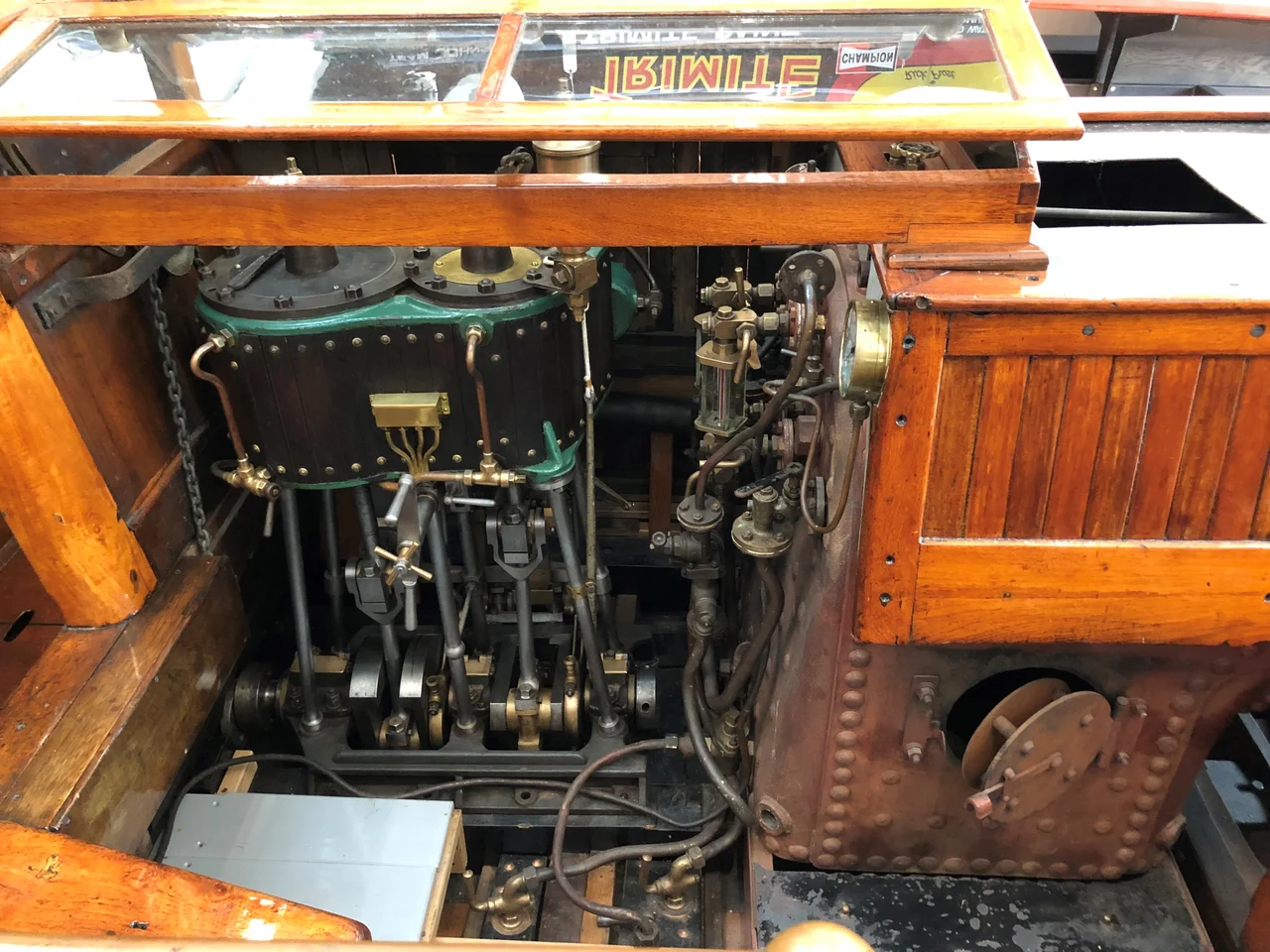
The full collection numbers around forty vessels, covering Windermere's boating life from the late 18th century to the present. The museum's official three-part name - Boats, Steam and Stories - is unusually accurate. Boats: the launches and barges and yachts themselves. Steam: the working machinery, including engines that still turn. Stories: the lives that ran on them. Henry Schneider's commute. Pattinson's decades of collecting. The Windermere kettle. Dolly's long sleep on the lake bed. Esperance's accidental literary afterlife as Captain Flint's houseboat. The conservation workshop is part of the visit, not hidden away - the work of keeping these boats running is the museum's continuing argument. The Pattinson collection arrived under tax law in 2007, but the boats themselves are still doing what they were built to do: floating, and occasionally, in summer, going out on the lake.
From the Air
Windermere Jetty stands on Rayrigg Road at 54.37 N, 2.92 W on the eastern shore of Windermere, between the town of Windermere and Bowness-on-Windermere. From altitude look for the long ribbon of Windermere (11 mi / 18 km) running north-south, with the museum's copper-clad sheds on the eastern shoreline north of Bowness. The lake itself is the dominant landmark. Nearest airfield is Carlisle Lake District (EGNC), about 60 km north; Walney Island (EGNL) lies 35 km south-west. Recommended viewing altitude 2,500-4,000 ft AGL. The Lake District's prevailing south-westerly winds funnel up the lake; expect strong gusts and rapid weather changes at low altitude.
Nearby Stories
- Morecambe Bay 4.1 km away
- Caldbeck 8 km away
- Pendragon Castle 8.1 km away
- Egremont Castle 8.5 km away
- Upper Teesdale 13 km away
- Solway Firth 13 km away
- Malham Cove 21 km away
- Santon Railway Station 70 km away