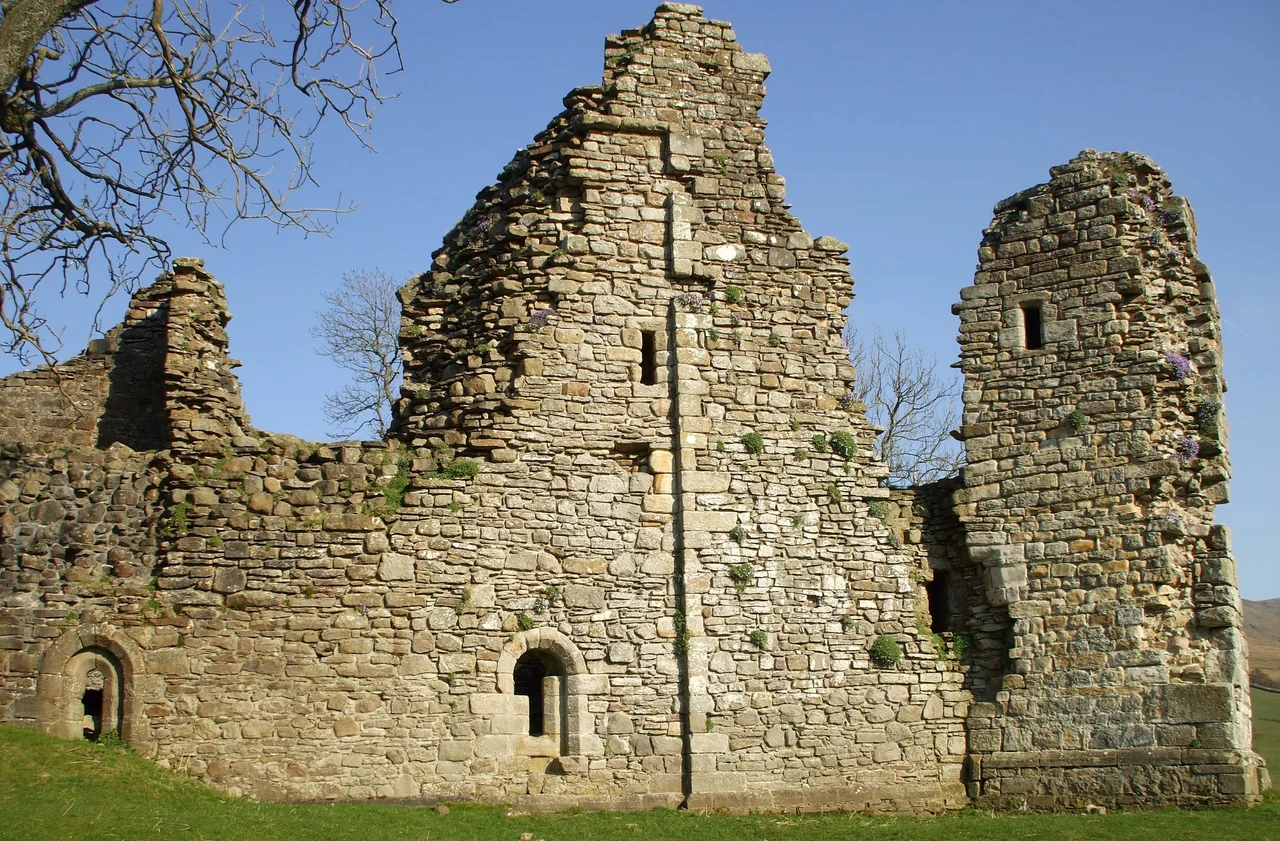

Pendragon Castle
Let Uther Pendragon do what he can, Eden will run where Eden ran. So says the old Mallerstang couplet, mocking the legendary king who tried to bend a river to make his moat. The story is almost certainly fiction. The castle was not built until the 12th century, six or seven hundred years after Uther's supposed lifetime. But the legend stuck so firmly that by 1309 the place was already being called Pendragon, and ever since, visitors climbing the meadow toward the broken keep have half expected to find Arthurian ghosts among the stones.
The Real Builders
Strip away the romance and the castle has a perfectly plausible Norman pedigree. Ranulph de Meschines raised the keep in the 12th century during the reign of William Rufus, planting a fortified outpost in Mallerstang Dale to guard the southern approach up the River Eden. The square Norman keep stood three storeys tall above a vaulted basement, with walls thick enough to absorb arrows and weather. A garderobe turret was added in the 14th century, the medieval equivalent of indoor plumbing. The Roman coin found nearby suggests passing visitors in the imperial era, but no buried foundations link the site to anyone before the Normans. The legend filled the gap that history left empty.
Owners with Histories
The castle's medieval owners had stories of their own. Sir Hugh de Morville, Lord of Westmorland, held it in the 12th century. He is remembered as one of the four knights who murdered Thomas Becket in Canterbury Cathedral in 1170, acting on what they took to be Henry II's furious wish. A high point on Mallerstang Edge is still called Hugh Seat after him. Later, Lady Idonea de Veteripont made Pendragon her home after the death of her husband Roger de Lilburn, living quietly in the dale until she died in 1334. She founded the small church of St Mary in the hamlet of Outhgill about 1311. Then the Scots came. Raiding parties hit the castle in 1342 and again in 1541, and after the second sacking it stood abandoned and roofless for over a century.
Lady Anne's Castles
Lady Anne Clifford was nearly seventy when she rebuilt Pendragon Castle in 1660, and it was only one of several she restored across Westmorland and Cumbria. A formidable woman who had fought decades of legal battles to inherit her father's estates, she finally won and spent the rest of her life riding between her castles in a sedan chair, holding court like a medieval baron. She added a brewhouse, a bakehouse, stables and a coach-house to Pendragon, and made it one of her favourite residences. She died in 1676 at the age of 86, having outlived almost everyone who tried to deny her what was hers. The Earl of Thanet inherited next, found the place inconvenient, and stripped the lead from the roof. By the 1770s the upper storeys had collapsed, and Pendragon has been decaying gently ever since.
What Stands Today
The ruin sits on a low knoll above a bend in the River Eden, framed by Wild Boar Fell to the south-west and Mallerstang Edge climbing east toward the sky. The Grade I listed walls survive to varying heights, their masonry weathered to soft greys and ochres. The castle is privately owned, sold at auction in 1962 by the Appleby Castle Estate to Raven Frankland for £525. His cousin John Bucknall now owns it. Visitors can walk around the outside on a footpath, but signs warn against entering the walls, which have been stabilised but not made safe. The river still runs where it always ran, exactly as the old couplet promised, and the legend of Uther still hangs about the dale like mist that never quite burns off.
From the Air
Located at 54.4187°N, 2.3377°W in Mallerstang Dale, a few miles south of Kirkby Stephen. The ruin stands on a low knoll above a bend in the River Eden, with Wild Boar Fell rising to the south-west and Mallerstang Edge running along the eastern skyline. The hamlet of Outhgill is just south. Nearest airports: Carlisle (EGNC) about 38 nm north-west, Leeds Bradford (EGNM) about 52 nm south-east. Best viewed from 2,500-4,000 ft AGL flying north along the Mallerstang valley. The B6259 road threads the dale and provides a navigation reference.
Nearby Stories
- Richmond Castle 1.3 km away
- Upper Teesdale 2.1 km away
- Morecambe Bay Cockling Disaster 3.8 km away
- Crook, County Durham 5 km away
- Windermere Jetty: Museum of Boats, Steam and Stories 8 km away
- Malham Cove 11 km away
- Fountains Hall 12 km away
- Caldbeck 17 km away