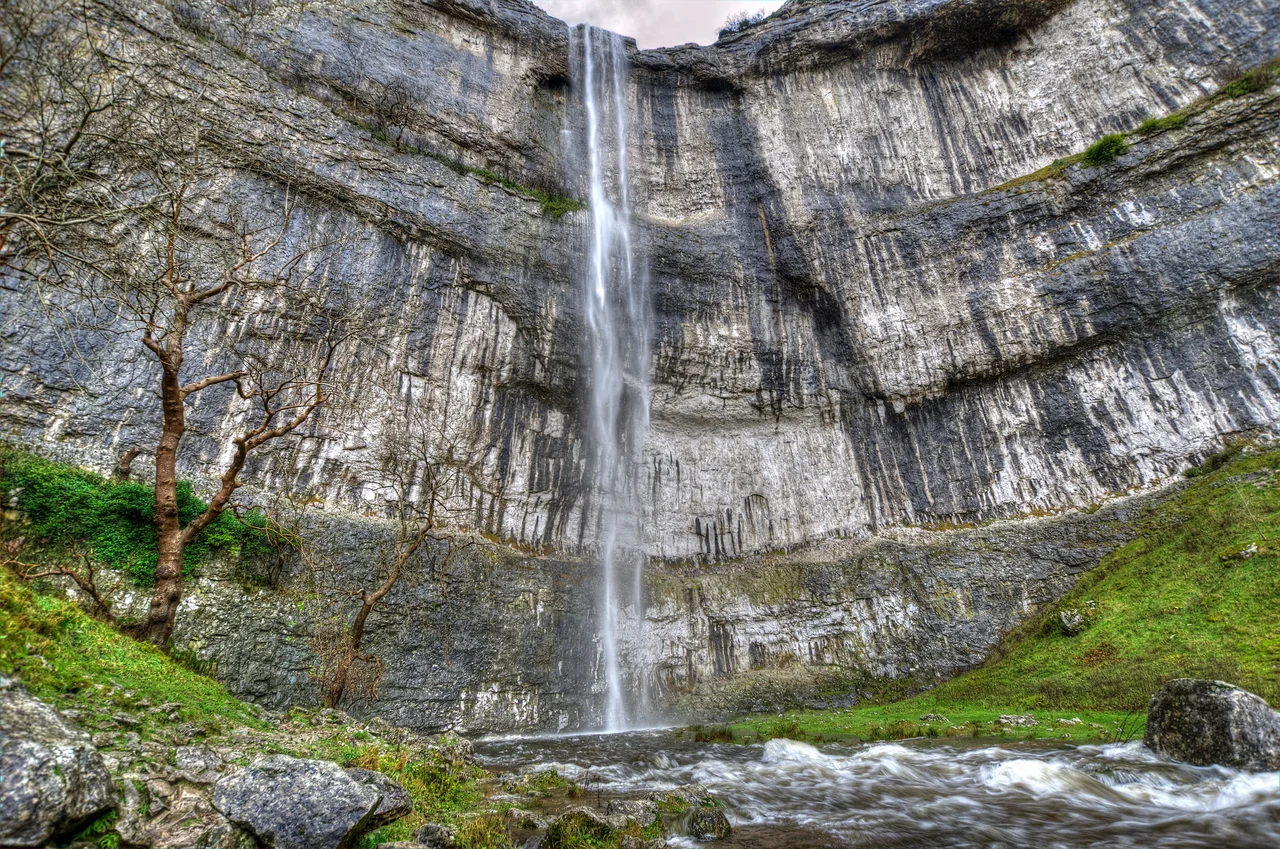

Malham Cove
For one afternoon in December 2015, after Storm Desmond dumped its catastrophic rainfall across northern England, water poured over the top of Malham Cove for the first time in 191 years. For a few hours it became one of the highest single-drop waterfalls in England: an 80-metre veil over a cliff that had stood dry since 1824. Then the cave system beneath the limestone pavement caught up with the deluge, swallowed it, and the cove returned to silence.
The Ghost of a Waterfall
Malham Cove is what a waterfall leaves behind when it dies. At the end of the last Ice Age, more than 12,000 years ago, glacial meltwater poured over this lip in a cataract 80 metres tall and more than 300 metres wide. The water carved the cove's distinctive curve, eroding the central lip more aggressively than the sides until the cliff curled inward like the inside of a shell. When the glaciers retreated and the surface flow vanished into the porous limestone, the waterfall vanished with it. What remained was the amphitheatre, a great pale stage facing south, where climbers now hang from ropes and walkers gather at the bottom to crane their necks.
The Streams That Don't Mix
Malham Beck emerges from a cave at the foot of the cove, but this stream is not the one that disappears underground at Water Sinks, a mile north near Malham Tarn. For centuries people assumed they were the same waterway. Dye experiments proved otherwise. The two streams pass through the limestone via separate channels, their paths crossing somewhere behind the cliff without their waters touching, and they re-emerge miles apart, in different river systems. Cave divers have explored about a mile of the system through the cave at the cove's base. Stalagmite deposits inside the rising have been dated to at least 27,000 years old, meaning the cave was dry during the Devensian glaciation and must have formed before it.
A Wall of White
The priest and antiquary Thomas West described the cove in 1779: "This beautiful rock is like the age-tinted wall of a prodigious castle; the stone is very white, and from the ledges hang various shrubs and vegetables, which with the tints given it by the bog water gives it a variety that I never before saw so pleasing in a plain rock." The white he saw is carboniferous limestone, laid down in shallow tropical seas some 330 million years ago when this part of Yorkshire sat near the equator. On the west side, around 400 irregular stone steps climb to the top of the cliff. They form part of the Pennine Way and lead to a limestone pavement that runs flat across the top, a checkerboard of clints and grikes that looks engineered but is entirely natural.
Rainman and the Climbers
The cove's south-facing wall has become one of Britain's most demanding climbing crags. Routes here range from gentle traditional climbs near the edges to extreme sport climbs up the overhanging central wall. In June 2017, Steve McClure completed Rainman, graded 9b, becoming Britain's first route at that grade. In winter, the south face catches what sun there is and warms the rock enough to climb. In summer, the rock can grow uncomfortably hot. Climbers share the cove with peregrine falcons, whose nesting season closes parts of the wall each spring.
Hermione, Heathcliff, and the BBC
The limestone pavement above the cove served as the setting where Hermione and Harry camped while on the run in Harry Potter and the Deathly Hallows Part 1, filmed here in November 2009. The pavement also appeared in the 1992 film adaptation of Emily Bronte's Wuthering Heights, in an episode of Steve Coogan and Rob Brydon's The Trip, and in the BBC's Seven Natural Wonders, where it was named one of the natural wonders of Yorkshire. The cove draws walkers from the village of Malham along a gentle one-kilometre path that gives no warning of what is about to appear around the final bend. The reveal still works after thousands of years.
From the Air
Malham Cove sits at 54.07°N, 2.16°W in the Yorkshire Dales National Park, about 1 km north of Malham village. The curved 80-metre cliff and the limestone pavement above it are visible from altitude as a distinctive pale arc set in green pasture. Best viewed at 2,000-3,000 feet AGL. Nearest airports: Leeds Bradford (EGNM) 20 nm southeast, Manchester (EGCC) 35 nm south, Blackpool (EGNH) 30 nm west. Gordale Scar lies 1.5 miles east; together they make one of England's most spectacular karst landscapes.
Nearby Stories
- Morecambe 2.9 km away
- 2001 Bradford Riots 3.2 km away
- Hawes Junction Rail Crash 3.7 km away
- Freckleton Air Disaster 5.4 km away
- Bowness-on-Windermere 8.7 km away
- Richmond Castle 9.6 km away
- Helmshore Mills Textile Museum 12 km away
- Ripley Castle 12 km away