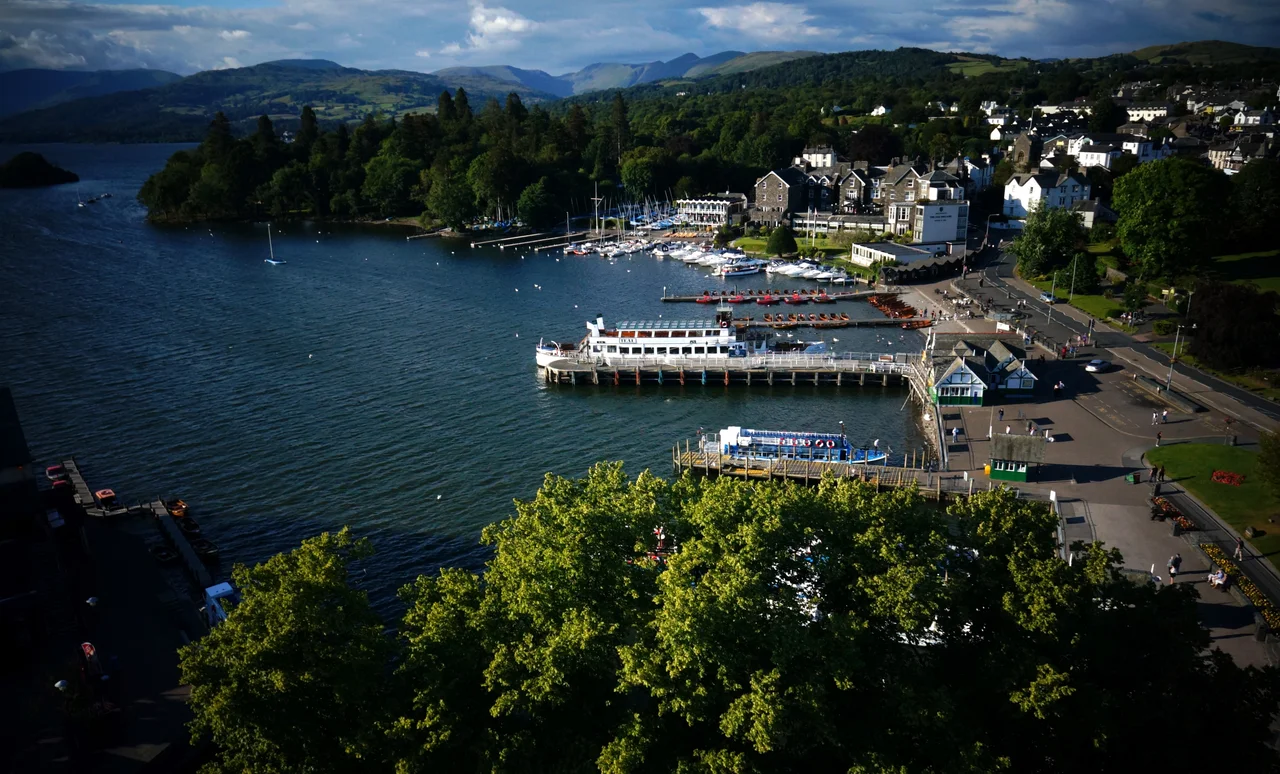

Bowness-on-Windermere
If you grew up reading Swallows and Amazons, you have already been to Bowness without knowing it. Arthur Ransome called it 'Rio' in his novels, the bustling lakeside town where his fictional children stocked up on grog and pemmican before sailing out into the wilder waters beyond. The real Bowness is no fictional invention. It stands on the eastern shore of Windermere, the lake that has been giving the town its name and its living since well before the Victorians arrived, and which keeps doing both today.
Where the Bull Grazed
The name is older than it looks. 'Bowness' began as 'Bulnes' - from the Old English 'bula' (bull) and 'naess' (headland) - meaning 'the headland where the bull grazes,' perhaps a reference to keeping the parish bull on the spit of land that juts into the lake. The 'on-Windermere' part is comparatively modern, appearing on the 1899 Ordnance Survey map to distinguish this Bowness from others. The parish church of St Martin was built in 1483, replacing an older foundation, and the former rectory across the way is said to date from 1415. By around 1600 the town had its own grammar school. A new building for it opened in 1836, funded by John Bolton of Storrs Hall; the foundation stone was laid by William Wordsworth himself.
The Royal Visit That Changed Everything
Until the 19th century Bowness was a fishing village with a sideline in boat-building. Then Queen Adelaide - the widow of William IV - visited in 1840, staying at the Royal Hotel. The royal seal of approval was the final push the town needed. Hotels and boarding houses sprang up. Boat builders adapted from working craft to pleasure yachts, rowing boats, and the steam launches that would define the lake's image for the next century. Bowness, almost overnight, stopped being a place that fished Windermere and started being a place that visited it. By the 20th century the permanent population was largely employed by visitors - making meals, making beds, making boats - and Bowness had quietly become the busiest tourist town in the Lake District.
Steamers, Cable Ferries, and a Bike Boat
Windermere Lake Cruises still runs from Bowness Bay year-round. The boats are now diesel, but the historic name 'steamers' has stuck. Cruises head north to Ambleside at the head of the lake, and south to Fell Foot at its bottom. Stagecoach open-top double-decker buses link Bowness Pier to Windermere railway station - a mile and a half inland - and from there onward to Ambleside and Grasmere. Council minibuses, designed to be wheelchair-accessible, work the village edges. Across the lake, the Windermere Ferry has been carrying cars and foot passengers between Ferry Nab on the east shore and Ferry House at Far Sawrey on the west since well before the road. The crossing takes about ten minutes - a cable ferry hauling itself across one of the prettiest pieces of water in England.
Beatrix Potter, Captain Flint, and a House of Tales
Bowness has built an entire industry on the books that took shape on Windermere's shores. The World of Beatrix Potter attraction opened in July 1991, with the comedian Victoria Wood doing the honours. The Windermere Jetty Museum on Rayrigg Road holds TSSY Esperance, built in 1869 - one of the iron steamboats on which Arthur Ransome modelled Captain Flint's houseboat in Swallows and Amazons. Visitors who know the books experience a peculiar literary double exposure: the real boat is here in front of them, and so is the fictional one it inspired, and the lake outside the window is both the working sheet of water it has always been and the fictional 'Lake' that holds Wild Cat Island somewhere offstage.
A Town That Has Stopped Pretending It Isn't Tourist
Administratively Bowness merged with Windermere in 1905, the urban district councils combining, and the two civil parishes joined on 1 April 1974 under the name of Windermere. The town council today is Windermere and Bowness Town Council. The 1951 census recorded 3,345 people in Bowness; the 2011 figure was 3,814. Numbers swell enormously in summer. The lakeside fills with families queueing for cruises, dogs chasing thrown sticks, paddleboarders in wetsuits, children eating ice cream. The boat-builders' yards are still there, behind the visitor centres and the tea shops. So is the parish church from 1483. So, on a calm day, is the long view north up the lake to the Langdale Pikes - the view that, more than any monarch's visit, made the town what it is.
From the Air
Bowness-on-Windermere sits at 54.3644N, 2.9181W on the eastern shore of Windermere, the long narrow lake at the heart of the southern Lake District. The lake itself - 10.5 miles long, England's largest natural lake - is the dominant visual feature. Bowness Bay is the small east-shore harbour with piers serving Windermere Lake Cruises. Nearest airports are Carlisle Lake District (EGNC) about 35 nm north, Blackpool (EGNH) 38 nm south, and Walney Island (EGNL) 25 nm west. Recommended viewing altitude 3,000-4,000 ft AGL; expect plenty of recreational marine traffic on the lake below.
Nearby Stories
- Morecambe Bay 4.1 km away
- Caldbeck 8 km away
- Pendragon Castle 8.1 km away
- Egremont Castle 8.5 km away
- Upper Teesdale 13 km away
- Solway Firth 13 km away
- Malham Cove 21 km away
- Santon Railway Station 70 km away