
2001 Bradford Riots
On Saturday 7 July 2001, an Anti-Nazi League rally gathered in Centenary Square at the heart of Bradford. The National Front had been refused permission to march and the counter-rally was meant to be peaceful. By that night, scuffles had begun between small groups of rival demonstrators and the police caught between them. By the next two nights, fires were burning in Manningham, a BMW dealership had been destroyed, and the city was on the front pages of every newspaper in the country. The Bradford riots would become the most costly and consequential disturbance of an unhappy summer in northern English towns, and the convictions that followed were unprecedented.
A Northern City Under Strain
Bradford in 2001 was a working-class city with deep history and considerable strain. It had grown in the nineteenth century on wool and worsted, drawing successive waves of immigration: Irish in the 1800s, Polish refugees in the 1940s and 50s, and from the 1950s onwards a large South Asian community, mostly from Pakistan but with significant Indian, Bangladeshi and other Asian populations. By 2001 Bradford had the second-largest South Asian population of any UK city: around 68,000 Pakistanis, 12,500 Indians, 5,000 Bangladeshis. The 2001 census recorded the city as 78.3 per cent white and 19.1 per cent South Asian. Some wards were overwhelmingly Asian (Manningham 74.5 per cent), others overwhelmingly white (Tong 93 per cent, Wibsey 91 per cent). Sociologists argued and still argue about whether this was segregation, white flight, or simply settlement patterns shaped by housing markets and family networks.
A Summer of Unrest
Bradford was not the first. There had been serious rioting in Oldham in May, then in Burnley between 22 and 24 June. The pattern was consistent: long-standing tensions between communities living adjacent but separately, exploited by far-right organisations like the British National Party and the National Front, met by counter-mobilisation from the Anti-Nazi League. When the National Front announced a march for Bradford on 7 July, Home Secretary David Blunkett banned it under the Public Order Act 1986. The Anti-Nazi League rally went ahead in Centenary Square. Witness accounts of how violence began differ; subsequent research found no single identifiable flashpoint. By that night and the next, groups of between thirty and a hundred young men, some white in Ravenscliffe and Holmewood and some Asian elsewhere, were attacking police lines and businesses across the city.
Manningham and the BMW Dealership
The two most lasting incidents both involved buildings. The Manningham Labour Club, then a recreational venue, was firebombed; a 48-year-old local Asian businessman, Mohammed Ilyas, was eventually sentenced to twelve years in prison for arson and reckless endangerment of life, the heaviest sentence handed down in connection with the riots. The club rebuilt at a new site on Bullroyd Lane in 2006. The most expensive single act was the destruction of a BMW dealership, which had also been attacked in a smaller 1995 disturbance in Manningham. Damage across the two nights was estimated at seven million pounds. Two people were stabbed. Police, many of them brought in from neighbouring forces, reported feeling overwhelmed. By Monday morning, calm had returned, but the legal and political consequences were only beginning.
The Unprecedented Prosecution
The number of people eventually convicted of riot for the events of 8 and 9 July was unprecedented in English legal history; the previous high had been five, in a London case. Sentences were heavy. The last rioter was sentenced six and a half years after the events, a tail of court appearances stretching into 2007. Some lawyers and community groups argued the sentences were disproportionate, particularly given the social context. The Guardian carried headlines reading 'too harsh.' Others argued that the convictions were necessary to make clear that the violence had crossed civic lines that could not be crossed. The arguments did not really resolve. They were absorbed into Bradford's long, patient work of community relations.
The Reports, the Drama, the City Now
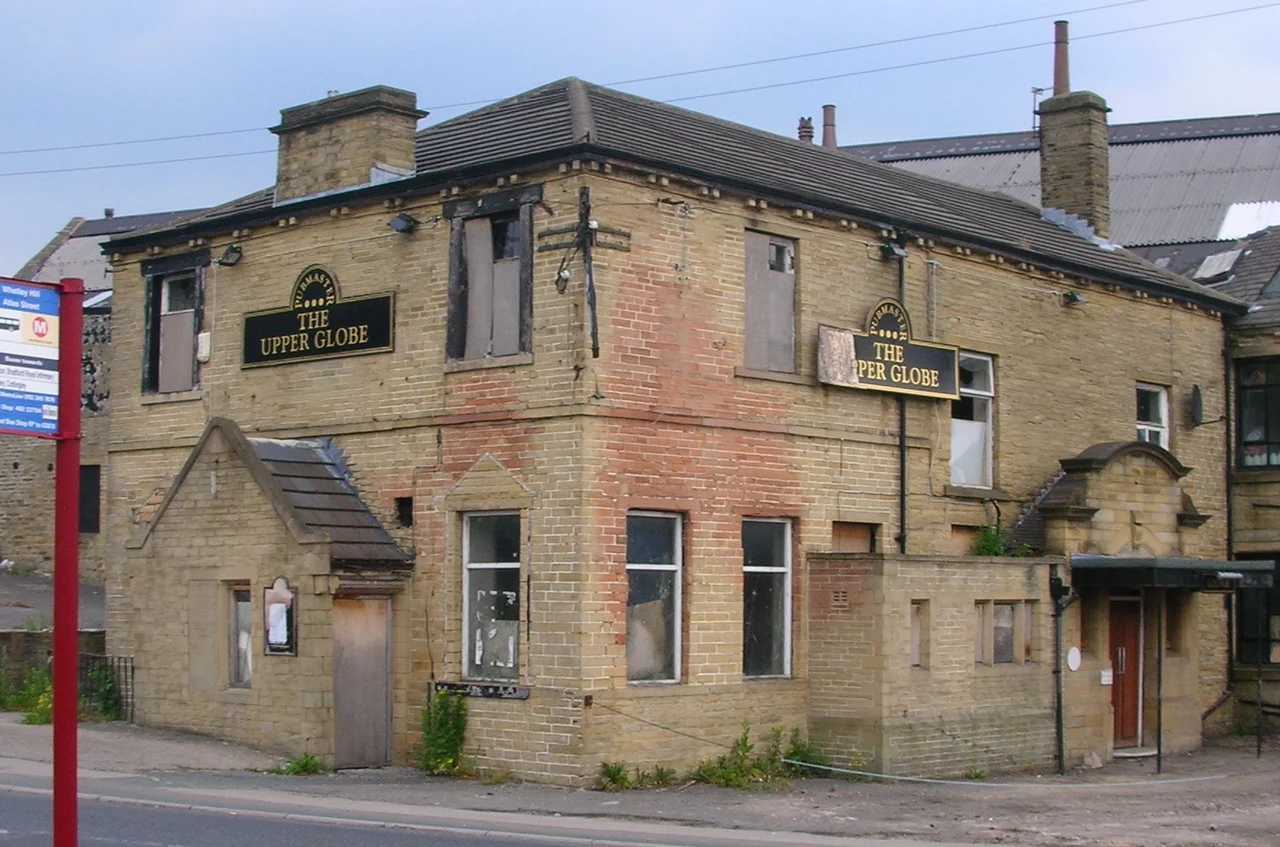
Lord Ouseley's report on the riots, released on 7 March 2005, called for a 'people's programme' to bring harmony to Bradford. The government commissioned the Cantle Report, which made 67 recommendations addressing community cohesion across northern English towns. In 2006 Channel 4 produced a drama, Bradford Riots, directed by Neil Biswas, told from the perspective of an Asian family caught up in the events. Bradford continued. The Upper Globe pub, damaged in 2001, stood derelict for years afterwards as a reminder. The city has since hosted the City of Film designation from UNESCO and the 2025 UK City of Culture. The riots remain a moment its residents continue to think about: not because they define the city, but because of what it took, on both sides, to begin to put together what they revealed.
From the Air
Located at 53.776 N, 1.714 W, central Bradford in West Yorkshire. From the air the city is dominated by the wool-era warehouses and mills of Little Germany and the surrounding wards of Manningham, Holmewood and Ravenscliffe where the disturbances occurred. Best viewed from 3,000-5,000 ft AGL. Nearest airports are Leeds Bradford (EGNM) only 6 nm northeast (essentially overhead in the airport's approach pattern) and Manchester (EGCC) 30 nm southwest. The city sits between the moors of Ilkley to the north and the Yorkshire coalfield to the south. Weather conditions are temperate oceanic; the Pennine edge holds frequent low cloud.
Nearby Stories
- Stockport Air Disaster 4.5 km away
- Hillsborough Disaster 6.1 km away
- Murder of Sophie Lancaster 6.3 km away
- Battle of Stamford Bridge 9.8 km away
- Wressle Castle 12 km away
- Gordale Scar 12 km away
- Gainsborough Old Hall 19 km away