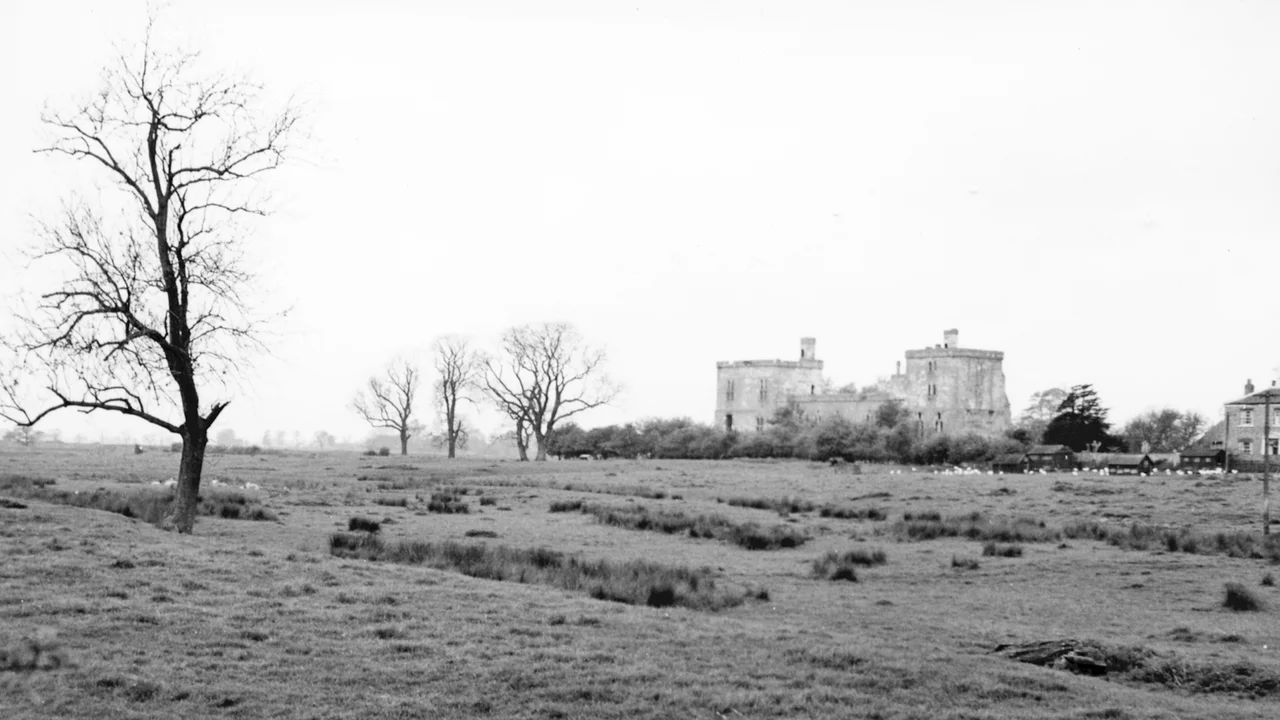

Wressle Castle
Thomas Percy built Wressle Castle in the 1390s, knowing what kind of man he was: a soldier and diplomat who had spent nearly ten years abroad and risen high in the service of Richard II, and who would shortly become a friend of Henry IV. The castle he commissioned reflected that ambition. The architectural historian Anthony Emery called it a residence "reflecting his pedigree and distinguished state service." Percy had less than a decade to enjoy it. In 1403 he joined his nephew Henry Hotspur's rebellion against the same Henry IV he had once supported, and at the Battle of Shrewsbury Thomas was captured. Two days later he was beheaded. His castle was confiscated by the Crown. It would change hands many times over the next two and a half centuries before Parliament finally pulled most of it down.
A Quadrangular Castle
Wressle was a quadrangular castle - four ranges arranged around a central courtyard, with a tower at each corner and a five-storey gatehouse in the middle of the east front. Going clockwise from the northeast, the corner towers were the Constable Tower (where the day-to-day castle administrator lived), the Chapel Tower, the Lord's Tower and the Kitchen Tower. The Chapel Tower contained a two-storey castle chapel with the Lady's Chamber and a library above - the only room in the castle explicitly reserved for women, a detail that says something about late-medieval aristocratic life. The historian John Goodall described the castle as "austerely detailed to give an outward impression of strength," the better to "set off the opulence of the interiors." Architectural similarities with Bolton Castle, Sheriff Hutton, and especially Lumley Castle have led Malcolm Hislop to argue that John Lewyn - who designed the great tower at Warkworth - was probably also Wressle's architect.
The Percys Return
After Thomas Percy's execution the castle was held by the Crown for most of the fifteenth century, with occasional grants to favoured nobles. Then in 1471 it was returned to the Percy family. Henry Percy, 5th Earl of Northumberland, restored it to magnificence and laid out ornamental gardens that contemporary observers thought rivalled royal properties. He died at Wressle in 1527. His son, the 6th Earl, was at Wressle in October 1536 when Robert Aske, leader of the Pilgrimage of Grace, came to enlist his support against Henry VIII. The Earl was already ill and resisted at first; eventually he handed Aske the keys. The Pilgrimage failed. The crown resumed control of Wressle in 1537, and Henry VIII himself stayed three nights in 1541. The Scottish nobleman Matthew Stewart, 4th Earl of Lennox, was lodged at Wressle in January 1545 - a high-status hostage in a high-status house.
Slighted
Wressle was never besieged. Its quadrangular design was built for status more than for war. But it was held by Parliament during the English Civil War and badly damaged in the process - contemporary estimates put the repair cost at 1,000 pounds, then a significant sum. Between 1646 and 1650 it was slighted - partially demolished - on Parliament's orders. The 1648 demolition focused on the battlements; a letter at the time complained that Parliament's agents "would show no care in preserving any of the materials, but pitched off the stones from the battlements to the ground." In 1650 Algernon Percy, 10th Earl of Northumberland, was ordered to demolish everything except the south range, which he was permitted to keep as a manor house. Almost two centuries later a fire struck the surviving wing. By 1880 the castle was mostly ivy.
The Bats and the Bowling Alley
What stands today is the south range - two ruined corner towers, a fragment thought to be a bakehouse, and earthworks marking the moat and gardens. Sheep graze the field where the courtyard once was. Wressle is now Grade I listed and a scheduled monument; the Falkingham family has owned it since 1957. In the 21st century, Historic England, Natural England and the Country Houses Foundation funded major repairs. Ecological surveys before the work began found four bat species roosting in 20 locations across the ruins, and some cracks in the masonry were deliberately left unrepaired so the bats could keep using them. The Old Garden south of the castle once held an orchard and alleys for bowling and walking - pastimes the nobility had taken up by the sixteenth century - and a two-storey building called the School House where Henry Percy, 5th Earl, used to read. The 18-acre River Derwent flows north-south about 180 metres west of the ruin, much as it did in 1390. The village of Wressle predates the castle, recorded in Domesday in 1086, and survives it.
From the Air
Wressle Castle ruins sit at 53.78 degrees north, 0.93 degrees west, on flat East Riding farmland between the River Derwent and the village of Wressle, about 6 nm west of Howden. The south range and corner towers are small but recognizable from low altitude, and the moat earthworks form a clear quadrangle in the surrounding fields. Recommended viewing altitude: 1,500 to 3,000 feet AGL. The nearest controlled airfield is Humberside Airport (EGNJ), 24 nm to the east-southeast. Leeds Bradford (EGNM) is 26 nm to the west-northwest. The M62 runs east-west about 4 nm south, and the River Derwent itself loops directly past the site - a useful visual reference in flat country.
Nearby Stories
- Battle of Stamford Bridge 3.8 km away
- Albert Hall Music Hall 4.6 km away
- Darnall Works 5.2 km away
- Wakefield 6 km away
- Knaresborough Castle 6.2 km away
- Gainsborough Old Hall 7.8 km away
- Skipsea Castle 8 km away
- Battle of Winceby 34 km away