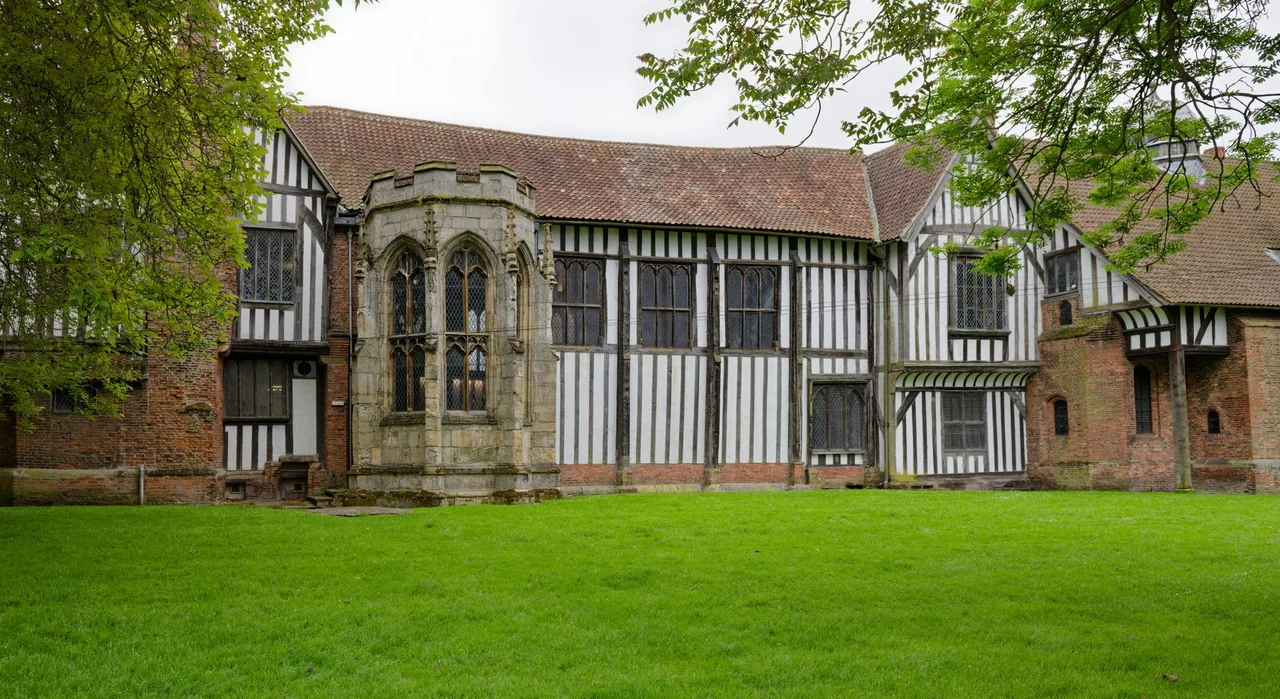

Gainsborough Old Hall
Walk through the front door of Gainsborough Old Hall and you walk into the 15th century. The Great Hall's vast open timber roof rises into the same shadows it cast in 1484, when King Richard III sat at a table here as a guest of Sir Thomas Burgh. The kitchens still have the medieval bread ovens and the great fireplaces. The brick tower at the corner of the west wing - a strong, almost defensive tower, faced in fine 15th-century brick - looks the same from the outside as it does in the earliest engravings. Very little house in England survives this completely from this period. Most great medieval manors are gone, or rebuilt past recognition. Gainsborough Old Hall stayed.
Thomas Burgh's House
Sir Thomas Burgh built the Old Hall in 1460. The Burghs were rich, flamboyant, and powerful, and the hall was a deliberate piece of architectural advertising as much as a home. Burgh endowed Newark Church, founded the chantry and almshouse at Gainsborough, and built the manor on a scale that announced his place at the table. In 1470 a regional rival, Sir Robert Welles, attacked the house in a quarrel about lands, status, and honour, but failed to do it much harm. Burgh entertained Richard III in 1484. Henry VII, after taking the throne at Bosworth the next year, intended to elevate Thomas Burgh to a barony, though for reasons no one now knows, the second writ was never issued and the patent never sealed. The family eventually got their barony anyway, by a different route, and Edward Burgh, 2nd Baron Burgh, was held at the Old Hall after 1510 - confined there, the records say, after being declared mentally incapable. He died in 1528. His daughter-in-law, Katherine Parr, would later become Henry VIII's sixth wife.
Henry VIII and Catherine Howard
Henry came to Gainsborough twice. The first visit, in 1509, was uneventful and probably brief. The second, in 1541, was a different matter. He arrived this time with his fifth wife, Catherine Howard, on the great northern progress that was meant to display royal authority across the territories of the Pilgrimage of Grace. Catherine's behaviour at Gainsborough and at Lincoln on this journey was later cited in the accusations of infidelity that led, the following February, to her execution at the Tower of London. She had been queen for barely eighteen months. The Old Hall is one of the houses where her last reckless months unfolded - she was seventeen, perhaps eighteen, when she stayed here as queen, and within a year she was beheaded. The Burgh family line itself faded in the same century; when the fifth Lord Burgh died without an heir in 1596, the hall was sold to William Hickman, a London merchant who would set its course for the next four hundred years.
A Cradle of Dissent
William Hickman and his mother Rose were Puritans, and in the early 17th century they allowed the Old Hall to be used as a meeting place for English Dissenters - men who had separated from the Church of England and who, by the laws of the time, faced excommunication, fines, and worse. John Smyth held services here. So did Thomas Helwys. Eventually, like many of their generation of separatists, they sailed for the Netherlands to escape persecution; once there they founded what became the Baptist tradition. Some of their congregation drifted onward to America and the Mayflower story. It has often been claimed that some of the Pilgrim Fathers themselves worshipped at the Old Hall before sailing for Holland in 1609; no clear evidence for that specific link has been found, but the connection to the wider story of English religious dissent is genuine and direct. In October 2024 conservators announced the discovery in the hall of a remarkable collection of apotropaic marks - witches' marks, scratched and burned into doorways and timbers to ward off evil - more than had been recorded in any comparable English building. The hall had served as a refuge for one kind of spiritual seriousness while quietly hosting another.
From Friends to English Heritage
John Wesley preached in the Great Hall on Sir Neville Hickman's invitation in 1759, then again in 1761 and 1764. The Hickman family stayed prominent in Gainsborough into the 18th and 19th centuries, with many of them serving as members of Parliament. By 1949 the building was struggling, and a volunteer group called the Friends of the Old Hall (FOHA) stepped in to save it and open it to the public. Sir Edmund Bacon gave the building to the nation in 1970. It is now owned by English Heritage, listed Grade I, and open as a museum. The tower of the hall is supposedly haunted by the Grey Lady - by tradition the daughter of a former lord of the manor, locked in the tower by her father after he discovered her plans to elope with a poor soldier, who died there of grief and is said still to wait. Whether or not you find that plausible, the place is undeniably full of presence. The timbers know things. The bread ovens know things. The brick tower has watched the Trent flow past for five and a half centuries and seems faintly amused at the questions you might ask it.
From the Air
Located at 53.40°N, 0.78°W in central Gainsborough, west Lincolnshire, just east of the River Trent. Nearest airports: Humberside (EGNJ) 24 nm N, Doncaster Sheffield (EGCN) 17 nm NW. From 3,000 ft the Old Hall's distinctive long range with corner brick tower stands out clearly from the surrounding town. The Trent runs north-south to the west. Approach via the A631 from the M180.
Nearby Stories
- Nunnery Colliery 4.4 km away
- Newark Castle 4.5 km away
- Sandal Castle 7.5 km away
- Belper North Mill 8.4 km away
- Flixborough Disaster 12 km away
- Heckington Windmill 13 km away
- Hull Minster 14 km away
- RAF Binbrook 14 km away