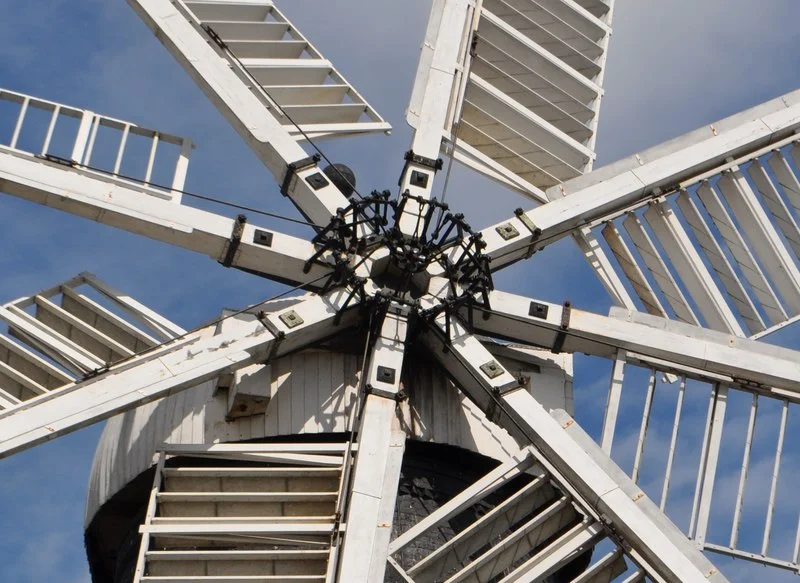

Heckington Windmill
Eight sails turning in a Lincolnshire breeze is a sight that no longer exists anywhere else on Earth. There were once perhaps a dozen of these eight-sailed giants scattered across England, mostly in the wind-swept fen country between the Wash and the Humber. Storms took some. Lightning took others. Owners cut the rest down to four sails because keeping eight in trim was expensive and exhausting. Heckington Windmill, standing between Sleaford and Boston, is the last working survivor of the breed - and the only reason it has eight sails at all is because a stubborn miller named John Pocklington refused to throw away a wrecked mill cap he had bought at a Boston auction for £72.
A Mill Built Twice
The tower itself dates to 1830, built for Michael Hare by a Sleaford millwright named Edward Ingledew. Hare put up the cost of roughly £2,000 - a serious sum at the time, when a labourer might earn perhaps £30 a year - and got back a five-sailed tower of red brick six storeys tall, its outer walls tarred jet-black against the fen damp. He scarcely lived to enjoy it. Hare was dead by August 1834, leaving a widow with two young children and a mill that passed down through second marriages and inheritances over the next half-century. Then came 1890, and the night that ended the mill's first life. Lightning struck the fantail - the small windmill-on-a-windmill that keeps the cap pointed into the breeze. With the fantail destroyed, a tail wind caught the sails the wrong way, the cap began to spin wildly out of control, and the whole rotating crown tore itself loose, smashing the gears and shredding all five sails as it went. The last miller, Joseph Nash, walked away. The tower stood, headless, for nothing.
The £72 Bargain
A year later, in 1891, John Pocklington of nearby Wyberton happened to be at an auction in Boston. The 78-year-old Tuxford's Mill at Skirbeck had finally been condemned, and Pocklington bid £72 for the whole eight-sailed cap, its gears, and its onion-shaped dome. The condition of sale was unforgiving: he had to clear the lot off the Skirbeck site immediately. With no tower of his own to mount the prize on, he urgently bought the wrecked Heckington stump. Over the winter of 1891-1892, Pocklington fitted the white Tuxford cap onto the wider Heckington tower - so the cap visibly overhangs the brickwork, a tell that betrays its second-hand origins to anyone who looks closely - and set the eight sails turning. Pocklington was a one-man rural industry, milling grain, baking bread, building, sawing elm boards for coffins on a wind-driven circular saw he installed in a shed, and farming on the side. The mill is still called Pocklington's Mill in his memory, more than eight decades after his death.
Why Eight Sails Matter
The advantage of eight sails is simple physics. More sail area catches more wind, so an eight-sailer grinds in breezes that leave four-sailed mills standing still - a useful edge in summer, when the fens fall calm. The disadvantage is everything else. Eight sails require eight times the maintenance, eight balanced linkages, eight sets of shutters to operate in unison. When something goes wrong, it goes wrong eightfold. Most of England's eight-sailers were quietly converted back to four sails after their first serious repair: Old Buckenham in Norfolk after damage in 1879, Victoria Road in Diss in 1880. Heckington could easily have followed them. After Pocklington died in 1941 the mill stopped working in 1946, and for the next forty years it stood with its shutters stripped, the framework slowly rotting. Kesteven County Council saved the structure in 1953, but only managed to scrounge four sails - from the disused mills at Old Bolingbroke and Wainfleet St Mary, both around twenty-five miles away. For decades it was a half-sailed survivor, more relic than mill.
The Friends of the Mill
Full restoration came in 1986, driven by a volunteer group calling itself the Friends of Heckington Mill. They built 192 new shutters by hand, raised the funds for four new sails - a cross weighing five tons - and got eight sails turning again for the first time in nearly a century. The mill now grinds with four pairs of stones: two pairs of French quartzite and two of Derbyshire Peak sandstone. There is also a hurst frame on the ground floor driven by an oil engine for windless days. In 2014, with help from a Heritage Lottery Fund grant, the trust bought the surrounding land and the Victorian miller's house and turned the buildings into a visitor centre, bakehouse, tea room, and a small brewery in the old saw shed called, fittingly, the 8 Sail Brewery. The mill is open Fridays, Saturdays, and Sundays through the year, with extended summer hours, and visitors can climb all six floors to watch grain become flour.
A Last of Its Kind
Standing on the stage gallery in a fresh easterly, the eight sails sweeping past at speed produce a sound that almost nothing else in modern England makes - a deep rhythmic thumping shoosh, eight times in every revolution, like a giant breathing. Boyd's Windmill on Rhode Island still has eight sails, but it does not turn. The Finnish hollow-post mills with eight short sails are a different machine entirely. Across the Mediterranean the multi-pole sail-windmills look superficially similar but use triangular canvas sails, not the latticed shutters of the Dutch tradition that Heckington inherited. Nowhere else on the planet are eight Dutch-style sails on a tower mill actually grinding flour. The mill stands beside Heckington railway station - in the 19th century it was simply called Station Mill - and the visual collision of Victorian engineering, steam-era infrastructure, and pre-industrial wind-power feels exactly right for the fens, where every generation built on top of the last without ever quite tearing it down.
From the Air
Heckington Windmill stands at 52.977°N, 0.295°W in the flat fenlands of south Lincolnshire, between Sleaford and Boston. The mill is best viewed from 1,500 to 3,000 feet AGL, where the eight-sailed cross is unmistakable against the dark brick tower and the patchwork fields. Nearby airfields include RAF Cranwell (EGYD) about ten nautical miles west and RAF Coningsby (EGXC) eighteen nautical miles east-northeast. The terrain is essentially sea-level fen, so VFR navigation along the A17 corridor or the East Coast Main Line - which runs past the mill at Heckington station - works well. Visibility along the Wash coast is often hazy with sea fret in cool weather.
Nearby Stories
- Crowland Abbey 6.5 km away
- Oakham Castle and Its Forfeited Horseshoes 7.2 km away
- Murder of Mona Tinsley 10 km away
- Old Hunstanton Lighthouse 11 km away
- Battle of Gainsborough 14 km away
- RAF Downham Market 14 km away
- RAF Binbrook 21 km away
- Silver Pit 42 km away