
Old Hunstanton Lighthouse
Before there was a lighthouse at Hunstanton Point, there was a chapel. Sailors entering The Wash at night used the lights burning in St Edmund's Chapel — a modest medieval structure on the headland — to find their way through the shallow, sandbank-riddled waters of the bay. As late as 1838, a hydrographer's guide still called the position 'the Chapel Light, on Hunstanton Point.' The transition from chapel candle to engineered lighthouse took two centuries and several false starts.
Charles II and the First Lights
In 1663 a consortium of merchants and ship-owners from Boston and King's Lynn petitioned for permission to erect lights near St Edmund's Point. The Wash was — and remains — treacherous: wide, shallow, laced with shifting sandbanks, navigable only by those who knew its channels. Commercial traffic between the east coast ports depended on getting in and out safely.
That November, Charles II issued a warrant to John Knight permitting him to build lights on 'the Hunston-cliffe or chappel lands,' to be maintained by levying dues on passing ships. The same year, Knight's niece Rebecca and her husband James Everard were granted the right to receive those light dues for the next fifty years — the lighthouse became a family income stream as well as a navigational aid. By the late 18th century, two lighthouses stood on the point — visible on John Cary's county map of 1787 — though only one appears on his 1794 map. The other had evidently disappeared in the interim.
The Innovation of 1776
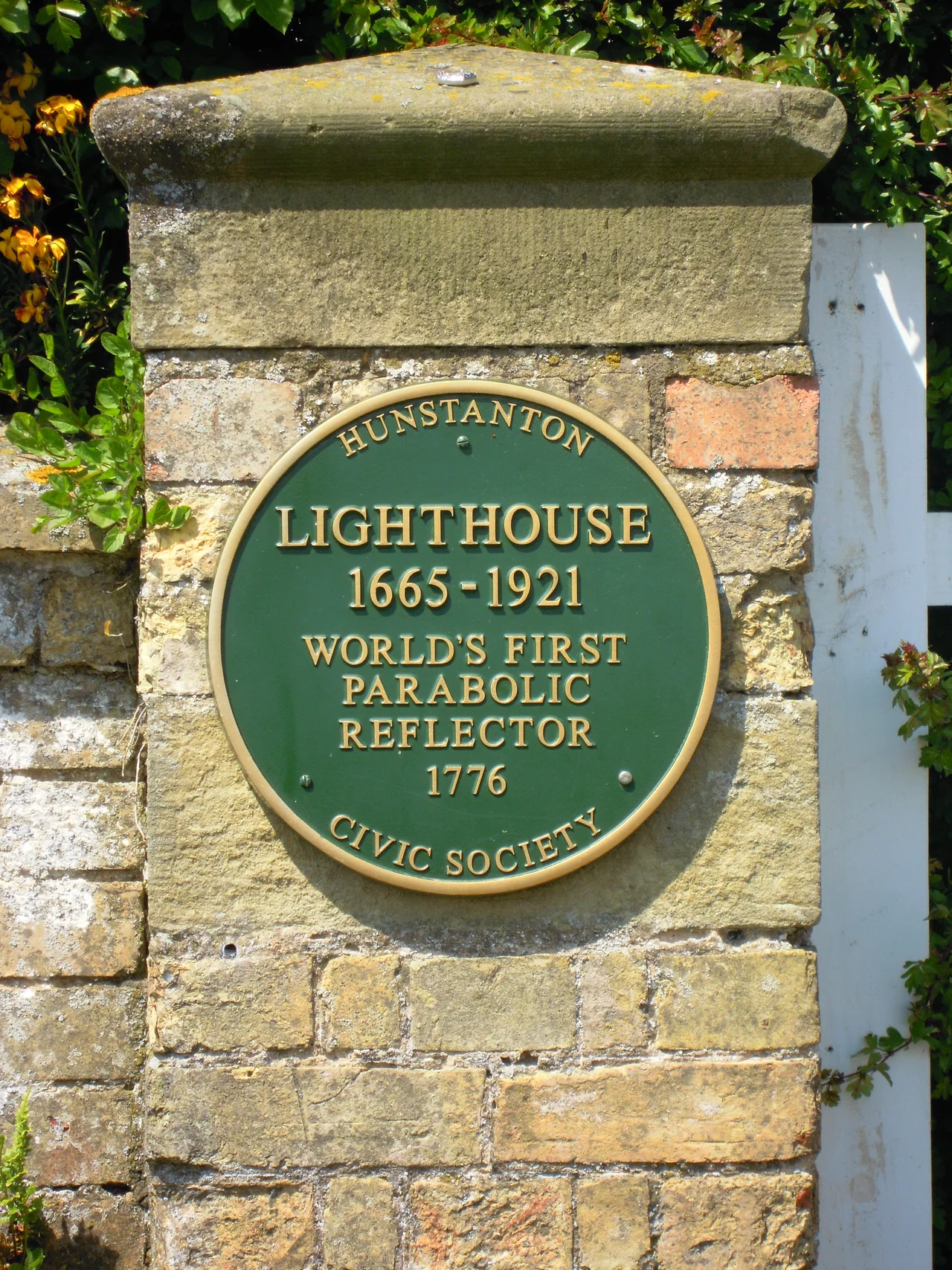
Around 1776, the rear lighthouse was destroyed by fire. Edward Everard of Lynn — grandson of Rebecca and James, heir to the patent rights — commissioned a replacement: a circular wooden tower 33 feet high. What made the new light remarkable was its illuminant. Rather than coal, which was the standard for British lighthouses at the time, the 1776 light used an early reflector system. Writing fifty years afterward, an observer described it: 'Each of the reflectors at Hunstanton contains 700 small mirrors of looking-glass, every one of which reflects part of the light of the small lamp placed in its focus.'
This made Hunstanton the first major coastal light in Britain to move beyond coal — a significant technical step in the history of lighthouse engineering. The later brick tower, 63 feet high, placed the light 109 feet above sea level. In 1781 it was described as 'constant and certain' and visible at sea to a distance of seven leagues. From 1844 a red sector was added to indicate the position of the Roaring Middle shoal. In 1897 the tower was repainted red with a broad white stripe — the coloring that characterizes it today.
Decommissioning and Afterlife
The lighthouse ceased operations in 1921. The lantern storey was removed from the top of the tower the following year. To compensate for its closure, improvements were made to the light of the Inner Dowsing lightvessel, which took on some of the navigational duties the old tower had performed.
In 1922 the property was sold at auction for £1,300. The tower itself was left unused, but the adjacent cottages were converted into tearooms — a familiar English repurposing of obsolete infrastructure. Hunstanton Urban District Council eventually acquired the property and sold it in 1965; one of the cottages was subsequently demolished, and a modern annexe added to the other.
The tower stands now as a listed building, its lantern gone but its shaft intact on the cliffs above Old Hunstanton — a Grade II listed structure visible from The Wash and from the air, repainted in the red and white it wore in its final operational decades. For 258 years, from the first Charles II warrant in 1663 to decommissioning in 1921, some form of light burned on this headland to guide ships into the waters below.
From the Air
Old Hunstanton Lighthouse stands at 52.950°N, 0.494°E on the cliffs above Old Hunstanton in northwest Norfolk, near the headland at the entrance to The Wash. The nearest airport is King's Lynn (EGYL), approximately 20 km to the south. From the air, the white-and-red tower is visible on the clifftop, with the layered chalk and carrstone cliffs beneath it — the geological striping that makes this headland distinctive from altitude. The lighthouse stands near the ruins of St Edmund's Chapel, which predated it as a navigational aid. EGSH (Norwich) is approximately 65 km to the east. Best observed at low altitude when the tower's color banding and clifftop position are clear.
Nearby Stories
- Maud Foster Windmill 2 km away
- Cley Marshes 4.3 km away
- Narborough Bone Mill 6.2 km away
- RAF Attlebridge 6.5 km away
- Crowland Abbey 13 km away
- HMS Cobra 19 km away
- Alford Windmill 23 km away
- RAF Binbrook 25 km away