
Maud Foster Windmill
Two brothers named Reckitt commissioned this windmill in 1819, paid the Hull millwrights Norman and Smithson exactly £1,826 10 shillings and sixpence for the work, and then ran it as millers and bakers for fourteen years before poor harvests broke them. One of those brothers, Isaac, lost the mill, walked away from Boston, drifted to Nottingham, then to Hull, and there started over selling a blue laundry starch that eventually became Reckitt Benckiser - the multinational behind Dettol, Lysol, Strepsils, and Durex. The mill he could not keep is still here, taller and more productive than ever, grinding flour at the head of a Georgian drainage canal in the eastern fens.
Five Sails on a Tower
Maud Foster is not the typical English windmill, which has four sails - in fact she has the slightly perverse number of five. Odd numbers behave strangely on a windmill. A four-sailed cross naturally pairs into opposite couples; a five-sailed cross has no opposite, so if a single sail breaks the whole rotor must be stopped and the broken sail replaced before the mill can run again - whereas a four-sailer can sometimes limp on with two opposite sails removed. Millers tolerated the inconvenience because five sails caught about a quarter more wind than four, and on a light day that meant the difference between grinding and waiting. Maud Foster stands seven storeys to the cap, eighty feet of grey gault brick rising clean above the flat Lincolnshire fields, topped with a white ogee dome of painted timber and canvas. The five sails sweep within inches of a wooden balcony that wraps the third floor like a ship's deck. Climb to the top, on the right kind of day, and the view runs straight across the fens to the lantern tower of Boston Stump four miles south.
The Maud Foster Drain
The mill takes its name not from a person but from a watercourse - the Maud Foster Drain, an eighteenth-century channel cut by the great civil engineer John Rennie to carry fen drainage water out toward the sea. The brothers Reckitt built their tower on the east bank of this drain on Willoughby Road because the drain itself was a working highway. Corn came in by barge from the surrounding villages, was hoisted up the granary lucam on a chain, and the milled flour and porridge oats went back out the same way. The granary still stands beside the mill, three storeys of red brick with a pantile roof and dog-toothed brick eaves, four bays wide with the central pair fitted out as taking-in doors. It is one of the most complete Georgian mill complexes anywhere in England - mill, granary, miller's house, drain - all still legible to anyone walking up from Boston town.
From Mill to Multinational
Isaac Reckitt was thirty-two when the harvests failed and the mill went to auction in 1833. He had a wife and children to feed and no fall-back. He tried various small businesses in Nottingham, found nothing that worked, moved his family to Hull, and in 1840 started a small operation grinding starch from rice and selling it under the name Reckitt's Blue - a laundry brightener that turned yellowed whites a deceptively clean pale blue. The Blue caught on, then the polish, then the black-lead, then everything else, and by the time Isaac died in 1862 the firm employed hundreds. By 1888 his sons floated the business as Reckitt & Sons Limited. A century later it merged with the Dutch firm Benckiser to become Reckitt Benckiser, with brands recognised in nearly every household on the planet. In 1953, Isaac's great-grandson Basil arranged for two Reckitt family charitable trusts to pay for the first serious restoration of the old mill that had begun all of it - a quiet act of remembrance for the great-grandfather who once stood in this same tower checking the stones.
Working Order
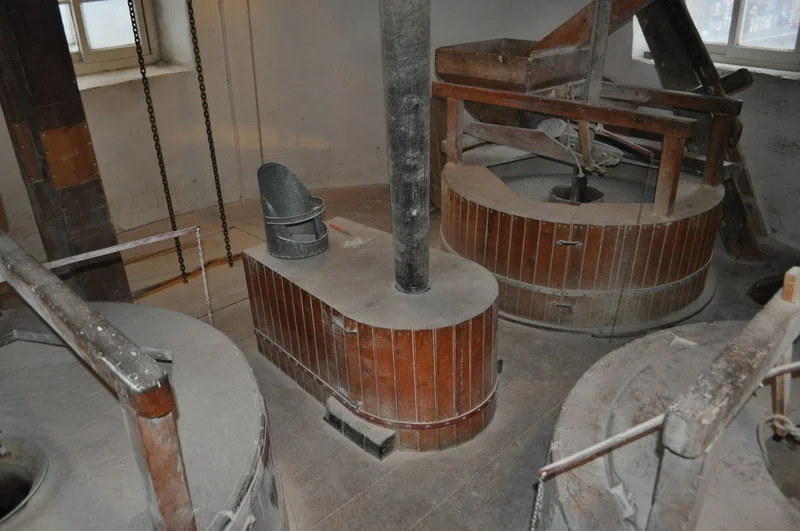
Maud Foster fell out of use after the Ostler family, who had run her as Ostler's Mill since 1914, closed the business in 1948. She stood neglected, sails frozen, for the next four decades until James Waterfield and his family bought her in 1987 and put her back into proper grinding order in 1988. The original 1819 machinery - the iron upright shaft, the wooden clasp-arm brake wheel with its iron tooth ring, the three pairs of grinding stones, the elaborate Y-shaped iron bridge trees that hold the stones at exactly the right gap - all still works. Waterfield calls her the most productive working windmill in England, and on a fresh easterly the five sails can grind serious quantities of flour from local wheat. Visitors climb all seven floors and watch each stage of the process, from the grain hoppers at the top to the bagging on the ground floor. The mill shop sells the flour and porridge that the mill itself produced that morning.
Living Architecture
What makes Maud Foster unusual among English windmills is not just that she still grinds, but that she does it in something close to her original 1819 condition. The unusual cast-iron weather beam was probably an early replacement, and modern roller bearings have replaced some of the original wooden ones - but the layout, the timbers, the stones, the dust floor's distinctive windows are essentially what Norman and Smithson built. Most surviving English mills are either ruins, residences, or museum-piece restorations frozen at a particular moment. Maud Foster is none of these. She is a working factory, two hundred and seven years old, with flour dust on every surface and the quiet rhythmic creak of a wooden frame turning in the wind. The Reckitt brothers might recognise almost every detail. They might be quietly pleased to find their mill outliving the empire that bears their name.
From the Air
Maud Foster Windmill stands at 52.9835°N, 0.0178°W in eastern Boston, Lincolnshire, immediately northeast of the town centre on Willoughby Road. From the air it appears as a tall white-capped tower at the head of a long straight drainage channel running northwest to southeast - the Maud Foster Drain itself, which is unmistakable. St Botolph's Church (Boston Stump) lies less than two nautical miles south-southwest and the two landmarks together orient any approach. Recommended viewing altitude is 1,500 to 2,500 feet AGL. The nearest airfield is RAF Coningsby (EGXC) about thirteen nautical miles north-northwest; Humberside Airport (EGNJ) is twenty-five nautical miles north. The Wash, four nautical miles east, provides a sharp visual horizon. Coastal haze is common on warm summer afternoons.
Nearby Stories
- Crowland Abbey 6.5 km away
- Oakham Castle and Its Forfeited Horseshoes 7.2 km away
- Murder of Mona Tinsley 10 km away
- Old Hunstanton Lighthouse 11 km away
- Battle of Gainsborough 14 km away
- RAF Downham Market 14 km away
- RAF Binbrook 21 km away
- Silver Pit 42 km away