
RAF Attlebridge
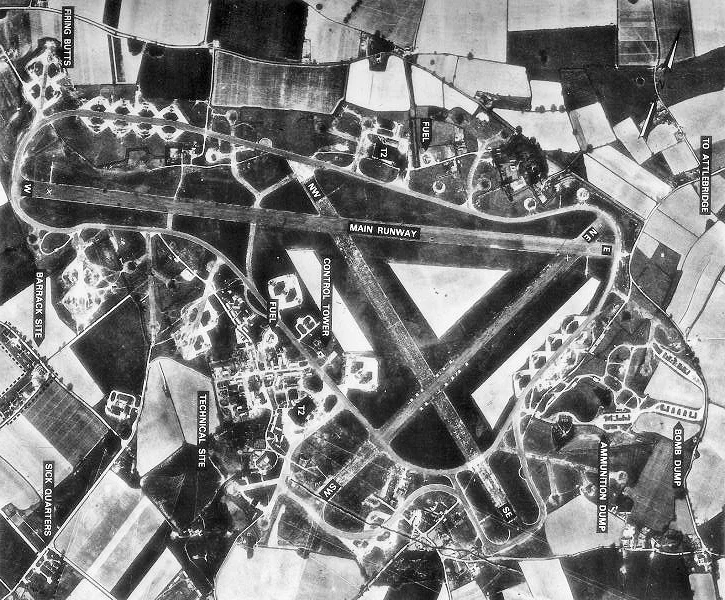
The runway was 1,220 yards when 88 Squadron RAF arrived with their Bristol Blenheims in August 1941. By the time the 466th Bombardment Group's Consolidated B-24 Liberators were leaving the same patch of Norfolk in 1944, the main strip was 2,000 yards long and the perimeter track wound past fifty hardstands. To get from one to the other, the Americans bulldozed several country roads in the parish of Weston Longville, closed three crossings, and put down enough concrete to land a fully-loaded heavy bomber. Attlebridge was Station 120, eight miles northwest of Norwich, and for two and a half years it was a small piece of Louisiana, Kansas, and California parked in the East Anglian countryside.
Blenheims and Bostons
RAF Attlebridge was already an operational field when the war was new. No. 88 (Hong Kong) Squadron - one of the RAF units that had carried Hong Kong's name since the late 1930s - flew Bristol Blenheim IV light bombers from here from August 1941, then Douglas Bostons, the American-designed twin-engine attack bomber the RAF had bought in numbers. The Blenheim was an obsolescent design by 1941, fast but poorly armed and increasingly easy prey for German fighters when sent unescorted across the Channel. 88 Squadron's Blenheims and Bostons hit shipping and shore targets along the occupied Dutch and French coasts, the kind of low-level work that wore aircrews down quickly. 88 Squadron stayed until September 1942, when the airfield was earmarked for American use. No. 320 (Dutch) Squadron of the RAF - a unit manned by Royal Netherlands Naval Air Service personnel who had escaped the German invasion of the Netherlands - brought their North American B-25 Mitchells through Attlebridge in 1943.
Station 120
On 30 September 1942 the airfield was transferred to the U.S. Army Air Forces' Eighth Air Force as Station 120, part of the 2nd Bomb Wing. The first American flying unit arrived from Harding Field, Louisiana on 12 September - the 319th Bombardment Group with Martin B-26 Marauders. They were the first squadrons of this type of medium bomber to reach the UK from America, but they stayed only into November before being moved out as part of the North African campaign. The airfield then had to be heavily reworked. The main east-west runway was stretched to 2,000 yards. The secondary runways went out to 1,400 yards each. Fifty hardstands were carved out around an extended perimeter track. The little country roads of Weston Longville parish - the larger half of the airfield sat inside its bounds - had to be closed or rerouted. By the time the work was finished, what had been a modest RAF station was a full-sized USAAF heavy bomber base.
The 466th Bombardment Group
The 466th Bombardment Group arrived on 7 March 1944 and stayed until 6 July 1945. They flew Consolidated B-24 Liberators - the boxy, slab-sided long-range heavy bomber that did the unglamorous half of the U.S. strategic bombing campaign in Europe. Their tail code was a Circle-L; their four squadrons were the 784th, 785th, 786th, and 787th. They were assigned to the 96th Combat Bombardment Wing. The mission pattern was relentless: pre-dawn briefings, the long roll-up before takeoff in fully fueled and fully bombed-up B-24s, the climb through the Norfolk overcast to assemble in formation, the long flight east-southeast across the North Sea toward whatever target the operations order specified that morning. Marshalling yards in occupied France. Oil refineries deep in Germany. V-weapon launch sites in the Pas de Calais. Big Week. D-Day support. The Battle of the Bulge. Crews flew 25 missions for a complete tour and many never finished. The photograph that survives of the 785th Bomb Squadron's Crew #562 - Albert L. Reynolds and his airmen, standing in front of their B-24 - is one of thousands of such crew portraits taken at fields like this all across East Anglia, men in their twenties next to aircraft they would or would not come home in.
After the Storm
When the 466th flew home in July 1945 the airfield went quiet. Attlebridge was officially closed as a military base in 1950. The runways were broken up. Some of the surface returned to farmland, some became local roads, some still exists in fragments where the wartime concrete is too thick to be worth removing. The old perimeter track winds through agricultural land now. Around 100,000 American airmen were stationed in East Anglia during the war - so many that the Norfolk countryside is still dotted with control towers, half-buried hardstands, and memorial plaques. The 466th Bomb Group is commemorated at the American Air Museum in Britain at Duxford, where the records of crews like Reynolds's are preserved. At Attlebridge itself what remains is mostly the shape of the airfield in the field boundaries and the occasional concrete stub - a quieter monument to the men who took off from here in the dark with full bomb loads and came back, or did not.
From the Air
RAF Attlebridge sits at approximately 52.6920N, 1.1210E, about 8 nm north-west of Norwich and 5 nm west-north-west of Norwich International (EGSH). The site is mostly agricultural now. The original east-west main runway alignment can still be traced in field boundaries; at 1,500-2,500 ft AGL look for the characteristic triangular WWII-airfield layout in the fields north of the B1535 road through Weston Longville. Norwich International (EGSH, field elevation 117 ft) is the obvious diversion. Caution: Norwich CTR is active to the south-east; verify class and altitude before any low pass.
Nearby Stories
- Sheringham 2.7 km away
- Wingfield Castle 4.4 km away
- Castle Acre Castle and Town Walls 6.3 km away
- Brancaster 7.1 km away
- West Stow Anglo-Saxon Village 9.3 km away
- Four Days' Battle 80 km away
- Battle of Lowestoft 80 km away
- SM U-97 110 km away