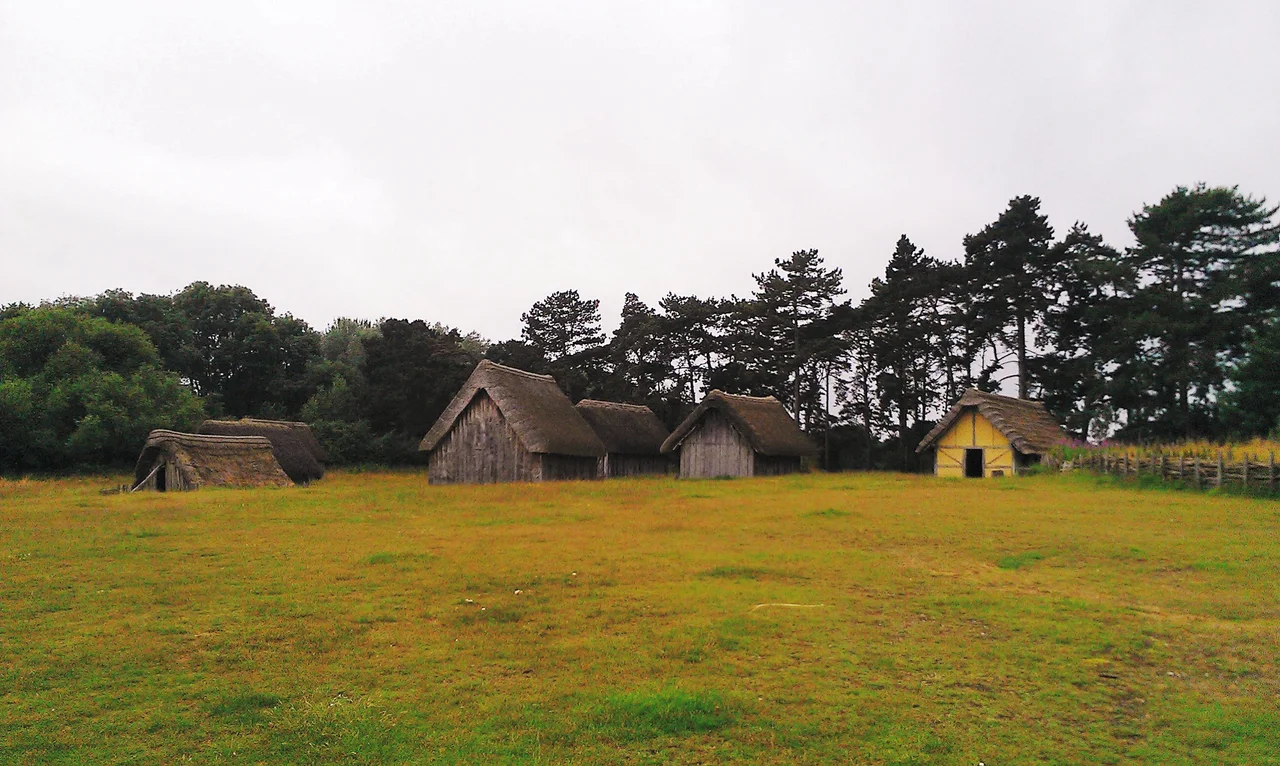

West Stow Anglo-Saxon Village
The land at West Stow was nearly turned into a rubbish dump. After archaeologists completed their excavations in the early 1970s, the St Edmundsbury District Council considered using the site to service the waste needs of nearby Bury St Edmunds. That plan was reviewed, then shelved. Instead, in 1974, an experimental archaeological project began on the site: the reconstruction of the early Anglo-Saxon village that had been discovered beneath it. The reconstructed buildings are not replicas of imagined medieval homes. They are experimental attempts to understand, through the physical act of building, how people in the fifth and sixth centuries actually constructed timber structures on sand. Over fifty years of reconstruction, decay, and rebuilding have produced answers — and new questions.
What the Excavators Found
Evidence of human habitation at West Stow stretches from the Mesolithic through the Neolithic, Bronze Age, Iron Age, and Romano-British period. The wider Lark Valley — the River Lark runs along the site's northern edge — contains the greatest known concentration of prehistoric settlements in East Anglia. But the site is most significant for what was built here between roughly 450 and 650 CE, during the early Anglo-Saxon period: a small village. Archaeologists excavating between 1956 and 1972, led by Vera Evison and then by Stanley West, uncovered 69 sunken-featured buildings and seven post-hole halls, along with animal pens, boundary ditches, and pits. Inside the halls, they found Roman bronze coins, glass fragments, iron objects, and a dolphin brooch — artifacts from people who were already living centuries after Rome's withdrawal, reusing and reinhabiting a landscape the Romans had left behind.
The Experimental Village
Beginning in 1974, buildings were reconstructed on the excavated site using period-appropriate techniques and materials. The oldest reconstructed structure — known simply as the Oldest House — dates to 1974. The Sunken House followed in 1976, the Weaving House in 1984, the Living House in 1987, the Workshop in 1991, the Farmer's House in 2007. Each construction project has tested hypotheses about building techniques. The Farmer's House, for example, carries an experimental wooden-slate roof. The buildings are not static exhibits; they age, require maintenance, and in some cases have been rebuilt. The decay of the original structures provides as much information as the original construction, since it replicates, under observation, the processes that left the archaeological record in the first place.
A Place with Layers
West Stow Anglo-Saxon Village opened to the public with a visitor's centre, museum, and cafe in 1999. The site sits on the north bank of the River Lark, seven miles west of Bury St Edmunds, surrounded by the remnants of prehistoric settlement and early medieval occupation. The wider Lark Valley context gives the village a density of history that makes it unusual even among archaeological sites. In 2009, the fan-made short film *Born of Hope* — based on appendices to Tolkien's *The Lord of the Rings* and set in the world of Middle-earth — was largely filmed here, the reconstructed village serving as a plausible stand-in for a pre-industrial northern landscape. The 1999 ITV sitcom *Dark Ages* was also filmed at the site. The Anglo-Saxon village that almost became a rubbish dump has become, instead, a place where the fifth century and the twenty-first coexist.
From the Air
West Stow Anglo-Saxon Village is located at 52.311°N, 0.635°E, on the north bank of the River Lark near the village of West Stow in Suffolk. From low altitude, the reconstructed timber halls are visible on a gentle hillside against the backdrop of the Lark Valley. The site is 7 miles west of Bury St Edmunds. Nearest airport: Cambridge (EGSC), approximately 26 miles southwest.
Nearby Stories
- Wymondham Abbey 3.8 km away
- St Ives Bridge 6 km away
- RAF Eye 6.6 km away
- Castle Hedingham 6.9 km away
- Royal Hospital School 9.2 km away
- RAF Downham Market 9.9 km away
- Flag Fen 13 km away
- Letchworth 17 km away