
Royal Hospital School
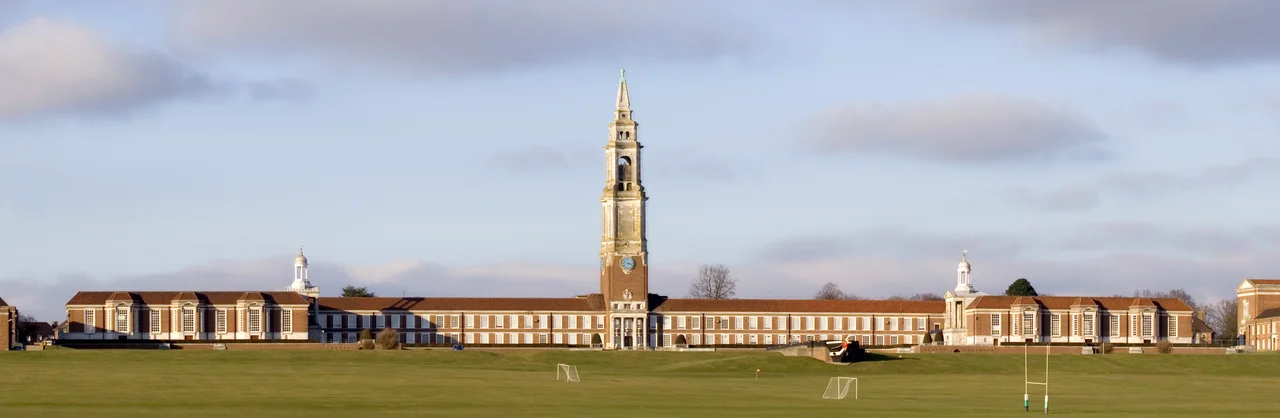
From the air, the Royal Hospital School at Holbrook looks unlike any other English independent school: a great Queen Anne-style range of red brick and white stone laid out across two hundred acres of Suffolk countryside, with a chapel tower rising at the centre and a parade square cut into the lawn. Below the school the ground drops away toward the River Stour, where the estuary opens into Constable's country. Walk across the parade square on a school morning and you will see something not seen elsewhere in British schooling: pupils in Royal Navy uniforms, dressed in actual sailor suits, divided into squads and marched past a band that plays in the style of the Royal Marines. The school's nickname is the Cradle of the Navy, and it is not aspirational. For three centuries it has been training the children of seafarers - and the modern uniform is the visible thread back to a charity founded by William and Mary at Greenwich.
Mary's Darling Object
Greenwich Hospital - more formally the Royal Hospital for Seamen - was founded by Royal Charter in 1694 by William III and Mary II as a hospital and refuge for retired and wounded sailors of the Royal Navy. Mary II reportedly took the establishment as a personal cause: a contemporary biographer recorded that the project was 'the darling object of her life.' She died of smallpox that same year, before the buildings were finished. The hospital that Christopher Wren completed at Greenwich became one of the architectural marvels of English baroque. From the outset its work included caring not only for old sailors but for the children of dead ones - the orphans of men killed in the king's service. In 1712 a school was established at Greenwich Hospital by separate royal charter, taking those boys in and training them for naval careers. It became known by the nickname 'the Cradle of the Navy.' For more than two centuries the school operated within the Greenwich precinct, sending generation after generation of orphaned and seafarers' sons into the fleet.
Jutland and a Cost in Names
By the early twentieth century the school had become one of the principal feeder institutions of the Royal Navy. During the First World War about a thousand former pupils served on Royal Navy ships at the Battle of Jutland on 31 May and 1 June 1916 - the largest fleet engagement of the war. At least 101 former Royal Hospital School pupils were killed in those two days at sea, many of them aboard the battlecruisers Indefatigable, Queen Mary, and Invincible, all of which exploded with catastrophic loss of life when struck by German gunfire. The school's war memorials still record the names. By the 1920s Greenwich Hospital's trustees concluded that the school needed more land, better buildings, and air away from the polluted Thames. A purpose-built campus was commissioned at Holbrook on the Shotley Peninsula, looking out over the Stour. Construction took the better part of a decade. The school relocated to its present site in 1933.
The Holbrook Campus
The buildings at Holbrook were designed in a Queen Anne idiom - tall sash windows, red brick laid in Flemish bond, white pilasters and pediments - to echo the Wren architecture of the Greenwich original. The campus covers some 200 acres of Suffolk farmland and woodland on the Shotley Peninsula between the Stour and Orwell estuaries. The chapel, central to school life, holds a four-manual grand organ by William Hill and Norman & Beard installed in 1933, and apse mosaics by Eric Newton, who later became art critic of The Guardian. Pupils are required to attend short chapel services twice a week, with congregational practice on Saturday mornings. The chapel is a Grade II* listed building. Outside, the parade square dominates the campus front, used for the ceremony known as 'Divisions' in which each school house forms up in two squads and marches past with a band of pupils playing in the Royal Marines style. The school flies its own Royal Hospital School Blue Ensign, approved by the Admiralty - one of only two schools in the United Kingdom whose pupils wear Royal Navy uniform for formal events. The other is Pangbourne College in Berkshire.
Tradition, Bursaries, William and Mary
The school is still owned by the Crown naval charity, Greenwich Hospital, and remains regulated by an Act of Parliament - the Greenwich Hospital Act of 1865. That ownership has practical consequences. The school provides means-tested bursaries to children of Royal Navy, Royal Marines and Merchant Navy families - the original mission of helping the children of seafarers continues in modified form. House petty officers wear chevrons; school chiefs wear chief petty officer ranks with canes; the deputy heads of school carry warrant officer rank. School songs include 'Holbrook,' composed for the school by Benjamin Britten, a lifelong supporter who lived just up the coast at Aldeburgh - members of the school band performed in the premiere of Britten's Noye's Fludde in Orford Church in 1958. The school maintains a long partnership with the College of William and Mary in Virginia, named for the same monarchs who founded Greenwich Hospital. The school's republican thread is honoured too: one of the houses is named for Robert Blake, the great Commonwealth admiral who fought against the same Stuarts whose successors granted the school its charter.
Old Pupils, Strange Endings
The alumni list reads like a particular slice of British seafaring history. Admiral Arthur Phillip, the founder of Sydney and first governor of New South Wales, attended the school in the eighteenth century. John and Charles Deane invented the diving helmet, and in 1839 - while working to clear the wreck of the Royal George - discovered the wreck of Henry VIII's Mary Rose. The Antarctic explorer Ernest Joyce, a hero of Shackleton's Ross Sea Party, was a Royal Hospital School boy. Olympic shooting gold medallists Malcolm Cooper, in Los Angeles in 1984 and Seoul in 1988, was an alumnus. The cricketer Reece Topley plays for England. Less easy to place is Duncan Scott-Ford, who attended the school from 1933 to 1937, joined the merchant navy, sold convoy information to the Germans during the Second World War, and at the age of twenty-one became the youngest person executed under the Treachery Act 1940. He was hanged at Wandsworth in 1942. The school's history holds heroes and a traitor; both attended the same chapel, the same parade square, the same baroque-style buildings still standing today above the Stour.
From the Air
The Royal Hospital School sits at approximately 51.97 N, 1.15 E, in the village of Holbrook on the Shotley Peninsula in south Suffolk, between the rivers Stour and Orwell. Recommended viewing altitude is 1,500-2,500 ft AGL; the campus appears from the air as a large central quadrangle of red-brick Queen Anne-style buildings with a chapel tower at the centre, set in 200 acres of parkland sloping toward the Stour estuary. London Stansted (EGSS) is 42 nm west; Norwich (EGSH) 36 nm north. Class G airspace.
Nearby Stories
- Ickworth House 3.6 km away
- Framlingham 7.9 km away
- Castle Hedingham 8.6 km away
- Battle of Assandun 8.6 km away
- Margate Surfboat 33 km away
- 1382 Dover Straits Earthquake 41 km away
- Four Days' Battle 48 km away
- Battle of Lowestoft 85 km away