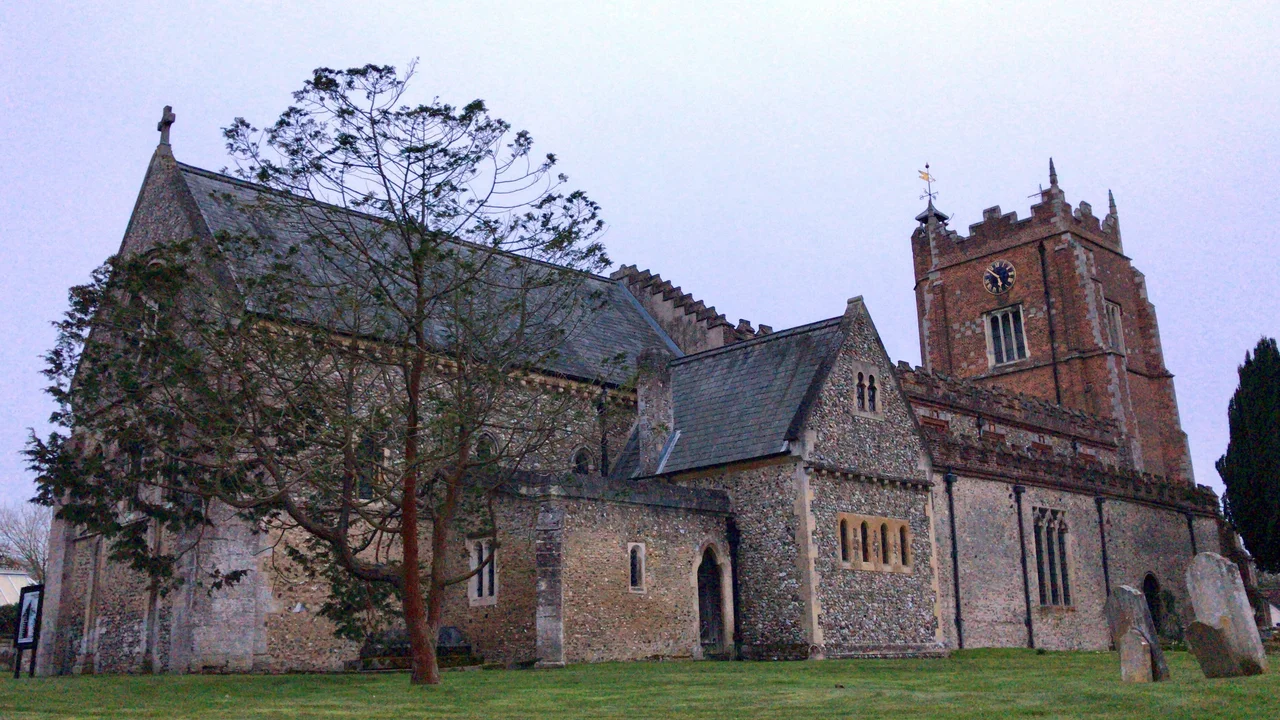

Castle Hedingham
On the morning of 22 August 1485, John de Vere - thirteenth Earl of Oxford, hereditary lord of Castle Hedingham - took command of Henry Tudor's vanguard at Bosworth Field. His was the decisive flank in the battle that ended the Wars of the Roses and put a new dynasty on the English throne. He had been raised in the keep that still rises above this village - one of the finest Norman towers in Europe, a hundred and ten feet high, its walls four metres thick at the base. Twenty generations of de Veres ran their county and their kingdom from this place. The village beneath the castle still feels like part of their household.
The de Veres of Hedingham
When the Domesday clerks compiled their inventory of England in 1086, the entire manor of Hedingham belonged to Aubrey de Vere I, a Norman knight rewarded for backing William the Conqueror. His grandson Aubrey de Vere III became the first Earl of Oxford in 1142 and completed the great stone keep that gives the village its name. He also founded a small Benedictine nunnery, Castle Hedingham Priory, just outside the castle gates - a typical arrangement of medieval lordship, where prayer for the family's souls was as much a part of estate management as fields and tenants. The fourth earl, Hugh de Vere, bought the right to hold a weekly market in the mid-13th century and founded a hospital outside the castle walls around 1250. The market made the village. The hospital cared for travellers and the sick. The earls' presence drew craftsmen and shopkeepers into the lanes that still curl around the church.
Magna Carta to Bosworth
The de Veres were almost never minor figures. Robert de Vere, the third earl, was one of the twenty-five barons elected to enforce Magna Carta against King John in 1215. Robert de Vere, the ninth earl, was favourite and possibly more than favourite of King Richard II, briefly created Duke of Ireland before he was exiled and died in a boar hunt in Flanders. John de Vere, the twelfth earl, was beheaded for Lancastrian loyalty in 1462. His son, the thirteenth earl, escaped to join Henry Tudor in France and commanded the army that defeated Richard III three years later. Edward de Vere, the seventeenth earl, was a courtier-poet at the court of Elizabeth I, patron of theatre companies, and still championed by a stubborn minority who believe he, rather than the Stratford glover's son, wrote the plays of Shakespeare.
St Nicholas and Its Hammerbeams
Construction of the parish church of St Nicholas began around 1180. The Norman Romanesque core survives - look for the great wheel window at the east end and the cemetery cross, both more than eight centuries old. The remarkable feature, though, is the double hammerbeam roof above the nave, attributed to Thomas Loveday, the master carpenter who worked on St John's College, Cambridge, in the early sixteenth century. A hammerbeam roof is an English speciality, allowing a wider span by replacing the floor of a conventional tie-beam with carved brackets that project from the walls. A double hammerbeam doubles that engineering risk and ornamental opportunity. From below, the timber feels almost weightless - oak that has carried itself for half a millennium. The church has a ring of six bells, and the lanes around it are lined with timber-framed buildings from the 15th to 17th centuries.
Hawkwood and Bingham
Sir John Hawkwood was born around 1320 in Sible Hedingham, the village next door. He served as a longbowman under the Black Prince in France, then crossed the Alps and became the most celebrated mercenary captain in Italy, leading the famous White Company through the city-states of the trecento. The Florentines hired him to defend their republic, and when he died in 1394 they commissioned a posthumous fresco by Paolo Uccello that still rides on the wall of the Duomo. King Richard II had the body returned to Essex. Half a millennium later, Edward Bingham ran the Castle Hedingham Pottery from about 1864 until 1901, producing fantastical wares now collected as Hedingham Ware. The Colne Valley Railway preservation society reopened the old Sible and Castle Hedingham station in 1974, so the steam whistles that once carried Bingham's pottery to London still echo through the woods.
What the Village Holds
Castle Hedingham today is small - about twelve hundred people in 2021, mostly in homes that were built when the de Veres still walked these streets. The castle keep stands open to visitors, restored and maintained by descendants of the Lindsay family who bought the estate in the 19th century. The painter Eric Ravilious and his wife, the engraver Tirzah Garwood, lived in the village in the 1930s, and his quiet watercolours of the surrounding countryside hang now in the Tate. Sir Fowell Buxton, who took over William Wilberforce's role leading the British abolitionist movement in Parliament, and who founded the RSPCA, also called this place home. The novelist Henry de Vere Stacpoole - whose surname the de Veres had granted his ancestors - lived at Astles, Pye Corner, and wrote The Blue Lagoon. The earls are long gone, but their village remembers every one of them.
From the Air
Castle Hedingham sits at 51.99°N, 0.60°E in the Colne Valley of north Essex, on the ancient road between Colchester and Cambridge. Recommended viewing altitude is 1,500-2,500 feet. The Norman keep is the dominant landmark - a square stone tower on a low hill at the north edge of the village. The River Colne runs east through fields below it. Nearest airports: London Stansted (EGSS) about 12 nm west-southwest, Andrewsfield (EGSL) 8 nm south. The site lies within Stansted Class D - expect to be talking to approach control.
Nearby Stories
- Rettendon murders 4.7 km away
- RAF Mendlesham 5.2 km away
- Royal Hospital School 7.3 km away
- Ickworth House 8.9 km away
- Tottenham Hotspur Stadium 9.5 km away
- St Ives Bridge 14 km away
- Harrow Court fire 14 km away
- Herne Bay Pier 35 km away