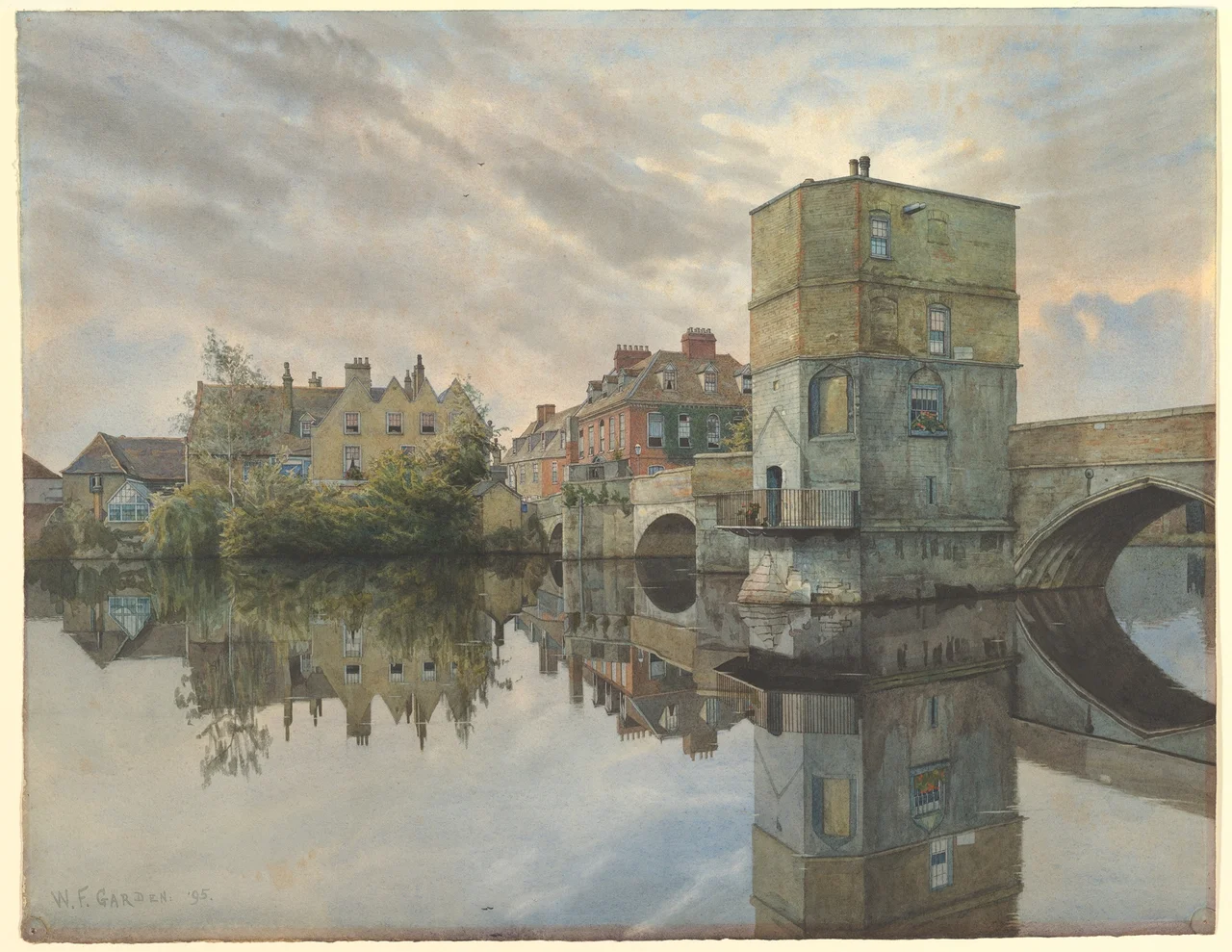

St Ives Bridge
There are only six medieval bridges in England with chapels still standing on them, and the bridge at St Ives is one of them. The others are at Bradford-on-Avon, Rotherham, Wakefield, Derby, and Rochester. Walk across the St Ives Bridge today and you cross six stone arches over the River Great Ouse, with a tiny rectangular chapel jutting out from the third pier - a structure built in 1426 so that travellers could pause halfway across, give thanks for a safe crossing, and possibly drop a coin in for the upkeep. The chapel has been a private house, a public house, a two-storey tenement, and a place of worship. It has had its top two floors added and then chopped off again. It has survived a civil war that demolished half the bridge it sits on. It is small. It is improbable. It is still here.
Limestone from Barnack
Before the stone bridge there was a wooden one, put up in 1107 by the monks of Ramsey Abbey - a Benedictine house twelve miles north that had founded the priory of St Ivo in St Ives a century earlier. Before the wooden bridge there was a ford, probably in use for over a thousand years. The river then was wider and shallower than it is now. The wooden bridge required endless maintenance, and in 1414 a decision was made to replace it with stone. Construction began in 1415 and finished in 1426. The masons used limestone from Barnack, quarried thirty miles away on the River Welland near Peterborough - the same stone that built Peterborough Cathedral and Ely Cathedral, prized for its durability. The new bridge had six pointed Gothic arches with five-rib vaulting and weather-drip mouldings on the arch rings. In the year of completion they added the chapel - dedicated to St Leger, also spelt Ledger or Leodegarius, a 7th-century Frankish bishop martyred for theological politics.
Cromwell's Roundheads Blow It Up
In 1645, deep into the English Civil War, Cavalier forces loyal to King Charles I were gathering in Bedfordshire. The Parliamentary commander Oliver Cromwell needed to defend Cambridge. The Roundheads chose a brutal solution: demolish the bridges across the Great Ouse at St Ives, St Neots and Huntingdon, and replace the missing spans with drawbridges that could be raised in an emergency. At St Ives the two southern arches were blown up, and a wooden drawbridge installed. It remained in use for seventy-one years. In 1716 the Duke of Manchester, who had inherited ownership of the bridge, finally rebuilt the demolished arches in stone - but his masons used a different design. The two replacement arches are smooth, segmental and rounded. The four surviving original arches are pointed and Gothic. From a passing boat you can read the dividing line between a 15th-century bridge and an 18th-century repair in a single glance.
The Chapel as Pub, House, and Survivor
The chapel was deconsecrated in 1539 during the dissolution of the monasteries, the same wave that destroyed Ramsey Abbey and stripped its founding institutions. It became a private dwelling, then a public house. In 1736 two additional brick storeys were piled on top - a tenement floating above the river, two metres above the water. The Victorian painter William Fraser Garden caught the bridge with its chapel-house extensions in an 1895 watercolour now in the Metropolitan Museum of Art. By 1930 the chapel's foundations were weakened by all that extra weight, and motorised traffic on what was still the main London Road was rattling it apart. An appeal raised funds quickly. The top two storeys were removed in 1930, the original chapel restored, and the building given a modern roof. There is an unusual crypt, about two metres above the river's water level - a feature unique among English bridge chapels.
Still Carrying Traffic After Six Hundred Years
The bridge kept carrying the main London Road from St Ives - the B1040 - until 1980, when the Harrison Way bypass curved around the east of the built-up area and finally took the heavy lorries off the medieval span. Before that, buses and trucks rumbled across a roadway just twelve feet six inches between the parapets. The bridge is now Grade I listed and a scheduled monument; Historic England controls every alteration. The foundations were strengthened after 1980. In 1998 the surface was resealed against water ingress. In 2002 architectural lighting was installed - the arches and the chapel now glow gently at night, reflected in the slow-moving Ouse. The chapel is occasionally used for public worship. The bridge upstream at Huntingdon, six miles away, dates from the same century and saw the same demolition. The bridge at St Neots, demolished at the same time, was rebuilt entirely - so this is the longer story, written in stone, of one regional system.
From the Air
St Ives Bridge sits at 52.3228N, 0.0754W on the south side of the town of St Ives, Cambridgeshire. From the air the bridge is identifiable by its six arches, the small chapel jutting from the third pier, and the open quayside immediately north. The river runs east-west here. Best viewed at low altitude (1,000-2,000 ft AGL) in clear light. Nearest airfields: RAF Wyton (EGUY) four miles west, Conington (EGSF) about ten miles north-west, Cambridge Airport (EGSC) about 14 miles south. The A14 motorway runs about two miles south.
Nearby Stories
- Red Bull Racing 1.3 km away
- Flag Fen 2 km away
- Denver Windmill 3.1 km away
- Uppingham School 3.6 km away
- Sywell Aviation Museum 5.8 km away
- Newmarket, Suffolk 6.8 km away
- Letchworth 6.9 km away
- Castle Hedingham 18 km away