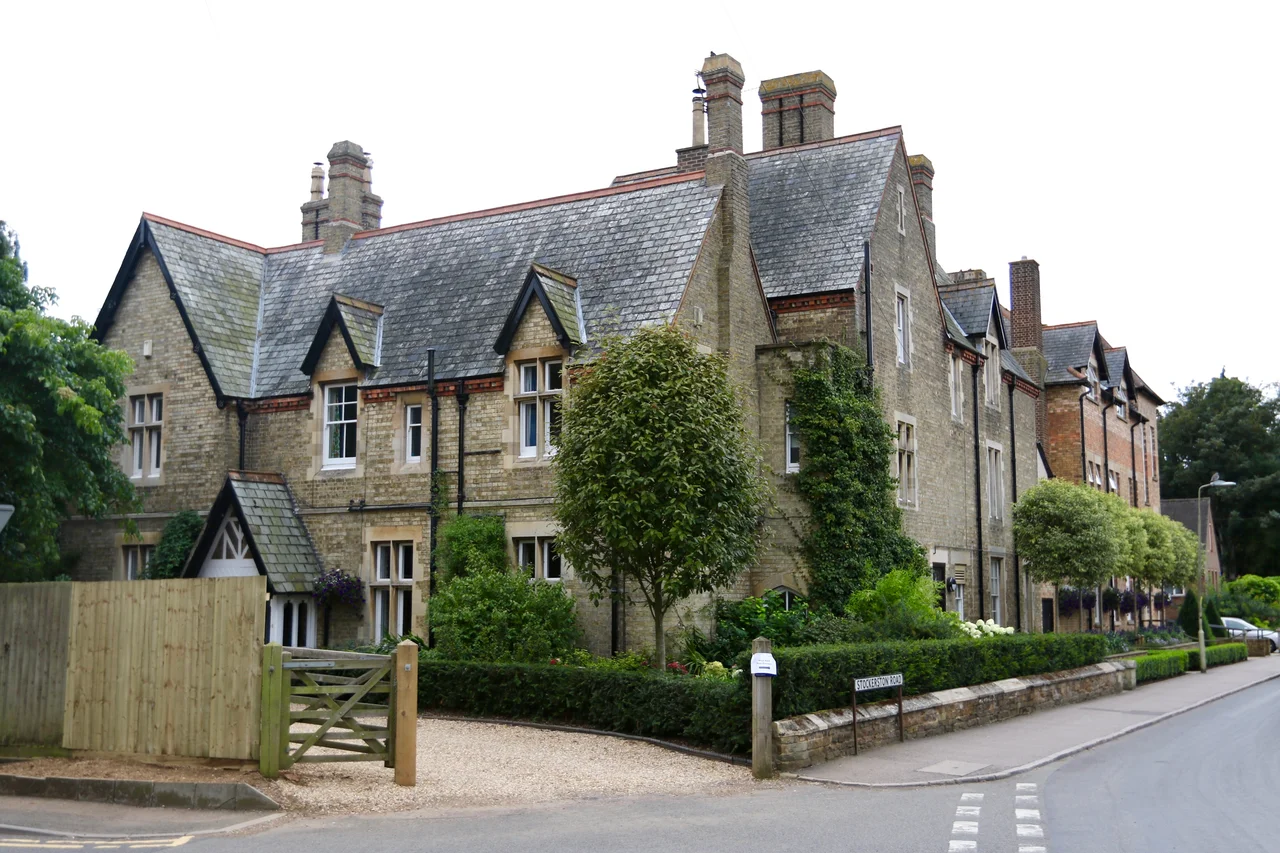

Uppingham School
When Edward Thring became headmaster of Uppingham School in 1853, the institution had been ticking along for two hundred and sixty-nine years with the same approximate enrollment it had started with: between thirty and sixty boys, taught by two masters, in a small stone building beside the parish church. Latin and Greek dominated the lessons, as they had since the school was founded by Archdeacon Robert Johnson in 1584. Thring was thirty-two years old, a Cambridge-educated cleric with strong opinions about almost everything, and over the next thirty-four years he turned this provincial grammar school into something genuinely new in English education - a place where music, science, carpentry, gymnasium exercise and the study of modern languages were treated as serious subjects rather than as distractions from the classics. By the time he died in 1887, the school had over 400 pupils. The transformation made him famous on both sides of the Atlantic. It also, more quietly, set the template for what an English public school could be.
Thring's Quiet Revolution
Thring was not a flamboyant reformer. He did not write manifestos or pick public fights. He simply built, year by year, the buildings the school needed for the kind of education he wanted to offer. He opened the first gymnasium in any English school, a long thin building where boys could exercise indoors in winter. He added a heated indoor swimming pool, a startling luxury for the 1860s. He commissioned a Gothic Revival chapel from G. E. Street, the architect who designed the Royal Courts of Justice. He insisted that music be taken seriously - not as an ornamental skill for young ladies, but as a discipline worth a boy's attention. He brought in carpentry. He hired teachers of French, German, history and art. None of this was revolutionary in itself; what was revolutionary was that Thring did all of it at once, in the same school, and treated the result as obviously what a modern education ought to look like. His ideas spread to other public schools, and through them into the wider English educational system, where many of them remain visible today.
The Borth Exile
In 1875, an outbreak of typhoid forced Thring to do something no English headmaster had attempted before: he moved the entire school - boys, masters, books and equipment - to the Welsh coastal town of Borth, more than a hundred and fifty miles away. For just over a year, Uppingham School operated out of a hotel and a row of seaside houses on the Cardigan Bay shoreline. The boys swam in the sea, walked on the dunes, and continued their lessons in improvised rooms above commercial premises. The exile became something of a legend in school memory - 'Uppingham by the Sea,' as a contemporary book called it - and the move is still commemorated each year in a service in the school chapel. Thring's calculation had been simple: the school's sanitary infrastructure could not be made safe quickly enough, and he was not prepared to see boys die for the sake of staying put. By the time they returned to Rutland in 1877, the town's water supply had been overhauled.
The War Memorials and the Carolling Class
Uppingham's First World War cost it 450 former pupils, an enormous number for a school its size. The school hall was built as their memorial, and the cricket pavilion - a graceful Walter Tapper building from 1923, now Grade II listed - also dates from the early 1920s and carries the same weight of loss. Three Uppinghamians whose names appear in Vera Brittain's Testament of Youth - Edward Brittain, Roland Leighton and Victor Richardson - all studied here before being killed in the trenches. Five Old Uppinghamians have won the Victoria Cross. Among the school's other alumni in the wider 20th century: the actor Boris Karloff, born William Henry Pratt; the motor racer Sir Malcolm Campbell; the composer E. J. Moeran; the war artist C. R. W. Nevinson; the cricket captain Percy Chapman, who won the Ashes for England; the pioneer town planner Patrick Abercrombie; and General Sir Brian Horrocks, who commanded XXX Corps in Montgomery's army. The actor Hugh Jackman taught PE at Uppingham as a young assistant master in 1987, before he had decided to act for a living.
The 2005 Fee-Fixing Embarrassment
In 2005, Uppingham found itself caught up in one of the more awkward news cycles in modern British independent-school history. The Times revealed that fifty of the country's leading fee-charging schools - Uppingham among them - had been quietly exchanging information about planned fee increases for years. Under competition law, that constituted a price-fixing cartel. The schools were each fined a nominal £10,000 and collectively agreed to pay three million pounds into a trust for the benefit of pupils whose families had been affected. Jean Scott, the head of the Independent Schools Council, defended the schools by saying they had simply been following a procedure they had used for decades and were unaware that competition law had been changed without their being consulted. Whether or not that excuse was credible, the episode marked a moment when the parallel world of British boarding schools collided with the regulatory expectations of normal commercial life. Uppingham paid up and moved on. In 2010, the school's pupils staged a brief rebellion of their own over the expulsion of several sixth-formers - five hundred boys and girls refused to attend classes for a day. By 2024, the school had opened a day house named after Sir David Lee Kwok Po, its first Hong Kong pupil, who had arrived in 1954.
Music, Sport and the Quiet Brand
Uppingham's musical tradition - founded on work by Paul David and Robert Sterndale Bennett - is unusually deep for an English boarding school. Two large three-manual pipe organs sit in the memorial hall and the chapel; the chapel organ was rebuilt in 2007 by Nicholson Organs of Malvern, with a smooth Harrison tone and a rare pair of independent Swell shutters that open in two different directions. More than half the school sings in the concert choir. The Paul David Music School opened in 2006 to handle the demand. On the sporting side, the school has the largest playing-field area of any school in England, divided into three separate spaces across the town: Leicester to the west, Middle to the south, Upper to the east. The new sports centre, opened in 2011 by Sebastian Coe, includes a 25-metre pool, a 50-station fitness studio and squash courts. In a country where boarding school identities are usually heavily branded, Uppingham has the slightly self-contained quality of a place that prefers to do well rather than to be famous - which is, in its own quiet way, Thring's legacy too.
From the Air
Uppingham School sits at 52.5878°N, 0.7250°W on a high ridge in the small market town of Uppingham, southern Rutland. From the air, the school is visible as a tight grouping of substantial stone and brick buildings to the north and west of the town centre, with three large green playing-field areas (Leicester, Middle and Upper) framing the town. East Midlands Airport (EGNX) lies about 28nm to the west-northwest; Cambridge Airport (EGSC) is roughly 40nm east. Best viewed at 2,500-5,000 ft AGL in clear conditions.
Nearby Stories
- Midland Railway War Memorial 4 km away
- Battlefield Line Railway 5.2 km away
- Electric Railway Museum 5.2 km away
- All Saints' Church, Brixworth 5.7 km away
- Murder of Bernadette Walker 6.2 km away
- Bingham, Nottinghamshire 6.7 km away
- Heckington Windmill 8.3 km away
- Hinchingbrooke House 12 km away