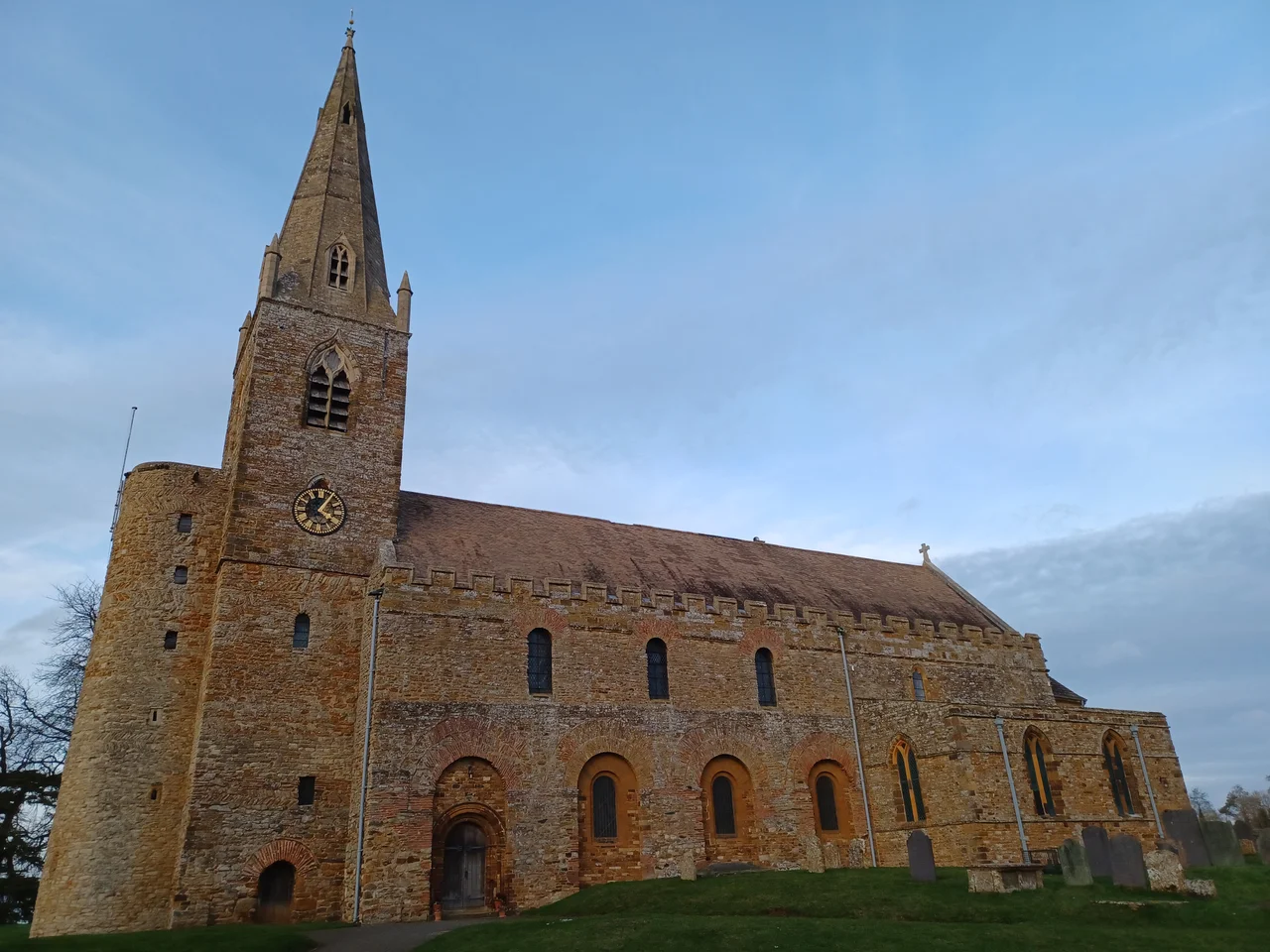

All Saints' Church, Brixworth
Walk into All Saints' Church at Brixworth and look up. The arches above your head are made of slim red Roman bricks - tiles that were fired in the second or third century, used in some now-vanished building in either Towcester or Leicester, abandoned when the legions left, and reclaimed five hundred years later by Anglo-Saxon masons who needed building material and had no idea how to make their own bricks. The church around them was begun in the late eighth or early ninth century, perhaps by King Offa of Mercia, perhaps by his successor Coenwulf. It is the largest English church that remains substantially in its Anglo-Saxon form. People have prayed here for twelve hundred years.
Mercia's Lost Monastery
Before there was a church, there was a monastery. The Peterborough Chronicle records that Brixworth Abbey was founded under Seaxwulf, bishop of Mercia, before the death of King Wulfhere of Mercia in 675 AD. Mercia in that era was the dominant Anglo-Saxon kingdom - the territory that stretched across the English midlands and produced kings powerful enough to be remembered today. The monastery has vanished completely. Of the buildings around it, of the cells and dormitories and refectories that once stood here, nothing visible remains. What survives is the church, begun a century or so after Seaxwulf, on a scale that puzzles modern historians. It is unusually large for an English church of its date - so large that one theory suggests Brixworth may be the long-debated Clofesho, the site of the great Mercian synods of the eighth and ninth centuries. Other locations have been proposed; none has been proved.
Roman Brick in an English Church
Anglo-Saxon builders rarely fired their own bricks. They built with stone, with timber, with thatch and turf, but the technology for making the thin red Roman building bricks had largely been lost in Britain after the legions withdrew. When the masons at Brixworth needed material for their arches, they did what builders across post-Roman Europe did: they robbed Roman ruins. Petrological analysis of the bricks at Brixworth points to two specific sources - Lactodurum, the Roman town that is now Towcester, ten miles to the south, and Ratae Corieltauvorum, the Roman town that is now Leicester, twenty-five miles to the north. Anglo-Saxon carts brought Roman bricks across midland England to a monastic building site. Roman-sized tiles form the arcading and other arches. You stand in a church with a different empire's masonry holding up the walls.
The Ambulatory Below Ground
Most strange features at Brixworth turn out to be original. The current building has an underground passageway, called an ambulatory, that runs around the outside of the original apse below ground level. Steps once led down to it. A barrel vault covered it. Its purpose was almost certainly to house, or to provide access to, holy relics - the bones or fragments of saints whose presence sanctified the church. Pilgrims would have descended into the dim space and walked the circuit close to the consecrated remains. The west tower started life as a two-storey porch, then was heightened in the tenth century, and heightened again in the fourteenth century when the present broach spire was added. The stair turret on the side is one of only four surviving Anglo-Saxon stair turrets in England. Inside the high west wall of the nave, a triple arch supported on baluster shafts - typical of late Anglo-Saxon work - leads to upper levels few visitors ever see. The 13th century added a south aisle and a south chapel; the 14th added the tower's upper stages and the spire. Each century built on top of the last without erasing it.
The Eagle of St John
Just inside the Norman south door, a small piece of carved stone is set into the wall: a relief of an eagle, wings spread, head turned. It is the eagle of John the Evangelist - one arm of what was once a complete carved cross, dating most likely from the ninth century. The carving is Anglo-Saxon, possibly contemporary with the original building of the church. It is the kind of survival that should not exist. Twelve hundred years of weather, fire, Victorian restoration and clumsy hands could easily have destroyed it. Someone, at some point, made the decision to set it carefully into the wall instead of throwing it away. The Victorian vicar Charles Frederic Watkins led the major restoration of 1865-66, removing much of the medieval chancel and exposing the ambulatory below ground level that had been forgotten for centuries. He demolished the south porch and shortened the southeast chapel by a bay, in each case to expose earlier stonework. The work added 247 free seats - free meaning, in the language of the time, that they were not rented to particular families.
Bells, Registers and the War Graves
The west tower holds a ring of six bells. Hugh Watts of Leicester cast the second, third, fourth and fifth in 1622. Henry Bagley of Chacombe cast the tenor in 1683. The Whitechapel Bell Foundry cast the treble in 1993 - a foundry that itself dated from 1570 and would close in 2017, ending one of the longest unbroken industrial businesses in British history. The parish registers begin in 1546, and the vicar from 1735 to 1770, a man called James Jackson, compiled an analytical index of every Brixworth family known back to the sixteenth century. That manuscript still survives at the Northamptonshire Record Office. In the churchyard outside lie the war graves of three British Army soldiers killed in the First World War and one Royal Pioneer Corps officer killed in the Second. Their stones are clean white, modern, recognizable from any Commonwealth cemetery in northern France. They are perhaps a hundred metres from a building begun before England was a nation - twelve centuries of village faith and village grief on a single half-acre of Northamptonshire ground.
From the Air
All Saints' Church stands at 52.334°N, 0.904°W in the village of Brixworth, north Northamptonshire, about seven miles north of Northampton. From altitude, look for the distinctive broach spire rising from a low limestone village set in rolling pastureland, with Brixworth Country Park and Pitsford Water reservoir to the south. Sywell Aerodrome (EGBK) sits eight miles southeast - useful as a navigation reference. London Luton (EGGW) is twenty-five miles south. The A508 runs north-south through Brixworth, useful for orientation in light cloud.
Nearby Stories
- Battle of Bosworth Field 3.6 km away
- Murder of Ross Parker 7.2 km away
- Royal Leamington Spa 8.8 km away
- Buckingham 9 km away
- St Neots 9.4 km away
- Letchworth 10 km away
- Uppingham School 11 km away
- Sudeley Castle 39 km away