
Buckingham
The most famous building in the world that bears Buckingham's name is not in Buckingham. Buckingham Palace, the official London residence of the British monarch, sits in Westminster more than fifty miles away from the small Buckinghamshire market town that lent it the name. The palace was originally Buckingham House, built in 1703 for John Sheffield, the 1st Duke of Buckingham, a peerage that takes its title from this place. Even the county - Buckinghamshire - is named after a town that has not been its political capital for nearly three centuries. By the eighteenth century, Aylesbury had overtaken Buckingham as the county's administrative centre, and Buckingham settled into a quieter life as a market town tucked into a loop of the River Great Ouse, its 12,890 residents getting on with farming, education, and the weekly market that has run here for over six hundred years.
Bucca's Hemmed-In Land
The name itself is Anglo-Saxon. Buckingham means "the hemmed-in land of Bucca's people" - Bucca being the leader of the first Saxons to settle the meander of the Great Ouse in the seventh century. The original village sat on what is now the Hunter Street campus of the University of Buckingham, on the high ground inside a sharp loop of the river that made the spot easy to defend. Between the seventh and eleventh centuries the town changed hands repeatedly between Saxons and Danes. In 914, King Edward the Elder - Alfred the Great's son - encamped his army in Buckingham for four weeks, building two new fortified burhs on either side of the Ouse and forcing the local Danish Viking leaders to surrender. Buckingham was an Anglo-Saxon frontier outpost, the place where Wessex met the Danelaw. Its name in the Domesday Book of 1086 lists 26 burgesses, 11 smallholders, and one mill. Queen Mary granted the town its borough charter in 1554, defining boundaries from Thornborough Bridge to Padbury Mill Bridge - boundaries the town still recognises.
The Great Fire of 1725
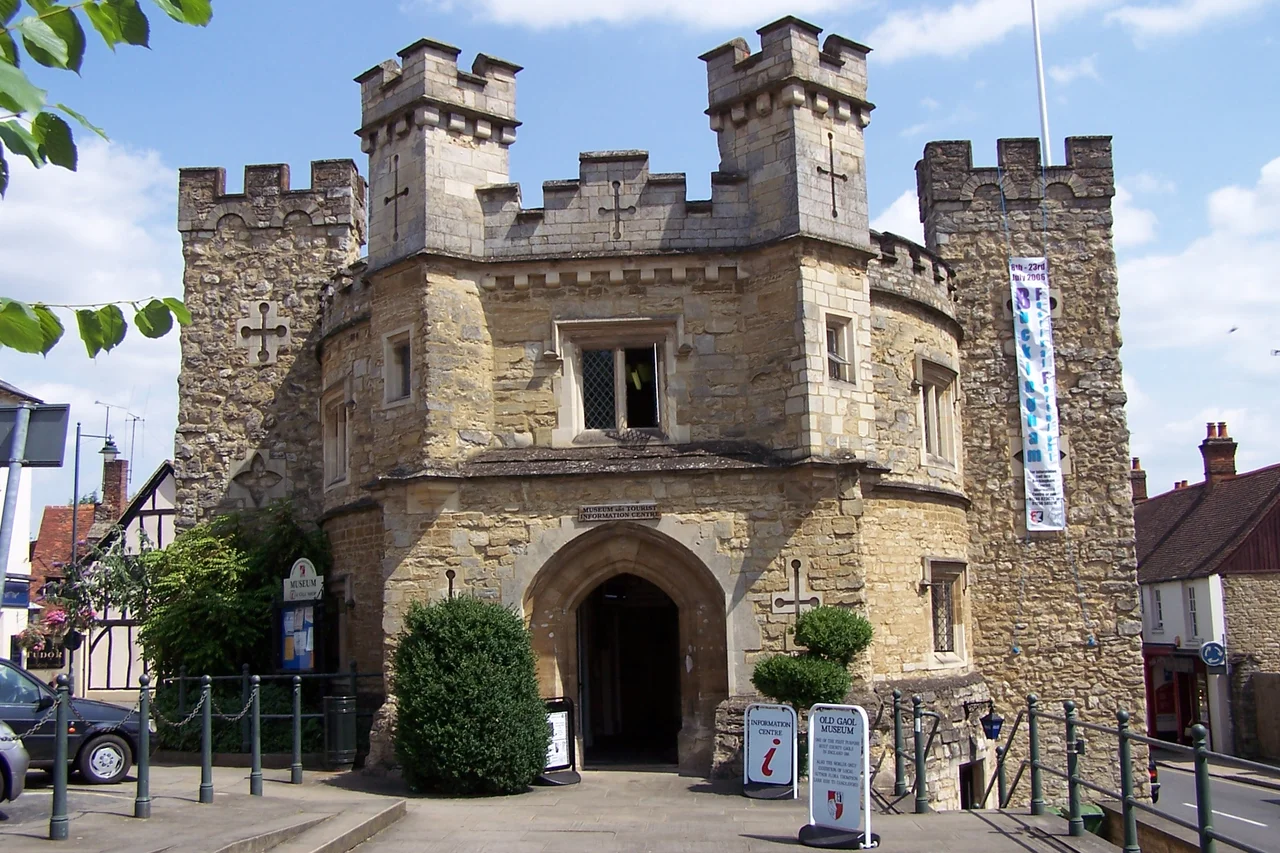
On 15 March 1725, fire swept through the town centre. By the time it was out, 138 of Buckingham's 387 dwellings had been destroyed - more than a third of the town. Castle Street, Castle Hill, and the north side of Market Hill were gone. Collections were taken in Aylesbury and Wendover for the homeless. The rebuilding took decades - by 1730, only a third of the lost homes had been replaced - but it produced the streetscape visitors see today: dignified Georgian brick frontages in soft red and grey, regularly spaced sash windows, the Buckingham Town Hall (Grade II* listed) rising at the top of Market Square. The Grade I listed Castle House on West Street survived the fire and dates back to the fifteenth century - one of the few medieval houses to make it through. The town hall, the gaol (now the museum), and the parish church of St Peter and St Paul - rebuilt 1777 to designs by Francis Hiorne - all date from the post-fire generation. Buckingham is, almost uniquely among English market towns, mostly Georgian by accident.
Stowe, Just Down the Road
Two miles north of Buckingham, along the A422, lies Stowe. The house is now Stowe School, one of England's grand public schools, but the gardens are open to the public under the National Trust. They were the eighteenth-century masterpiece of Capability Brown, who began his career as head gardener here under Lord Cobham in 1741. Stowe is essentially where English landscape gardening was invented - the moment the formal French parterre was abandoned in favour of artful pastoral grandeur. Forty acres of lakes, temples, monuments, and follies arranged across a rolling Buckinghamshire valley, with Cobham's politics encoded in every Greek and Roman reference. The Temple of British Worthies. The Temple of Ancient Virtue. The Gothic Temple. Visitors to Buckingham who don't drive the two miles out to Stowe are missing the point - the town's centuries of importance, its dukes and parliamentary seats, are partly explained by what their county neighbours built within walking distance.
Charter Markets and a Saint Buried Nowhere
Buckingham's street market has run continuously for more than six hundred years and was formalised by the charters of Queen Mary in 1554 and Charles II in 1664. Every Tuesday and Saturday, traders set up in Market Square selling fish, vegetables, bread, household goods, and flowers. A flea market runs on Saturdays on the site of the former cattle pens. The annual Charter Fair, held over two Saturdays in October beginning after the eleventh of the month, dates back centuries and once featured the public roasting of an ox, a sheep, and a pig at the same time. The town's quieter mystery is Saint Rumbold (or Rumwold), a seventh-century Anglo-Saxon saint who, according to legend, lived for just three days but spoke clearly during that time, asked to be baptised, and predicted his own burial in Buckingham. St Rumbold's Well on the southern edge of town - now dry for most of the year - is said to mark a place associated with him. He gives his name to a local road and is the town's quiet patron, much less famous than the Duke whose title made the palace.
From the Air
Buckingham sits at approximately 52.00 degrees north, 1.00 degrees west, in north Buckinghamshire, with the borders of Northamptonshire and Oxfordshire close by. The River Great Ouse loops sharply through the southwest of the town. The main visual landmark from the air is the Georgian town centre and, two miles north, the great green expanse of the Stowe estate with its lakes and classical temples. Cranfield University Airport / Cranfield Airfield (EGTC) lies about thirteen nautical miles east, and Silverstone race circuit is about seven nautical miles southwest. Recommended viewing altitude 1,500 to 2,500 feet for a clear look at the town and Stowe gardens together.
Nearby Stories
- Battle of Northampton (1460) 1.8 km away
- Hitchin Boys' School 5.1 km away
- EastEnders 5.6 km away
- St Neots 6.2 km away
- Chesterton Windmill 6.4 km away
- Hellfire Caves 6.5 km away
- Battle of Edgehill 23 km away
- Littlecote Roman Villa 30 km away