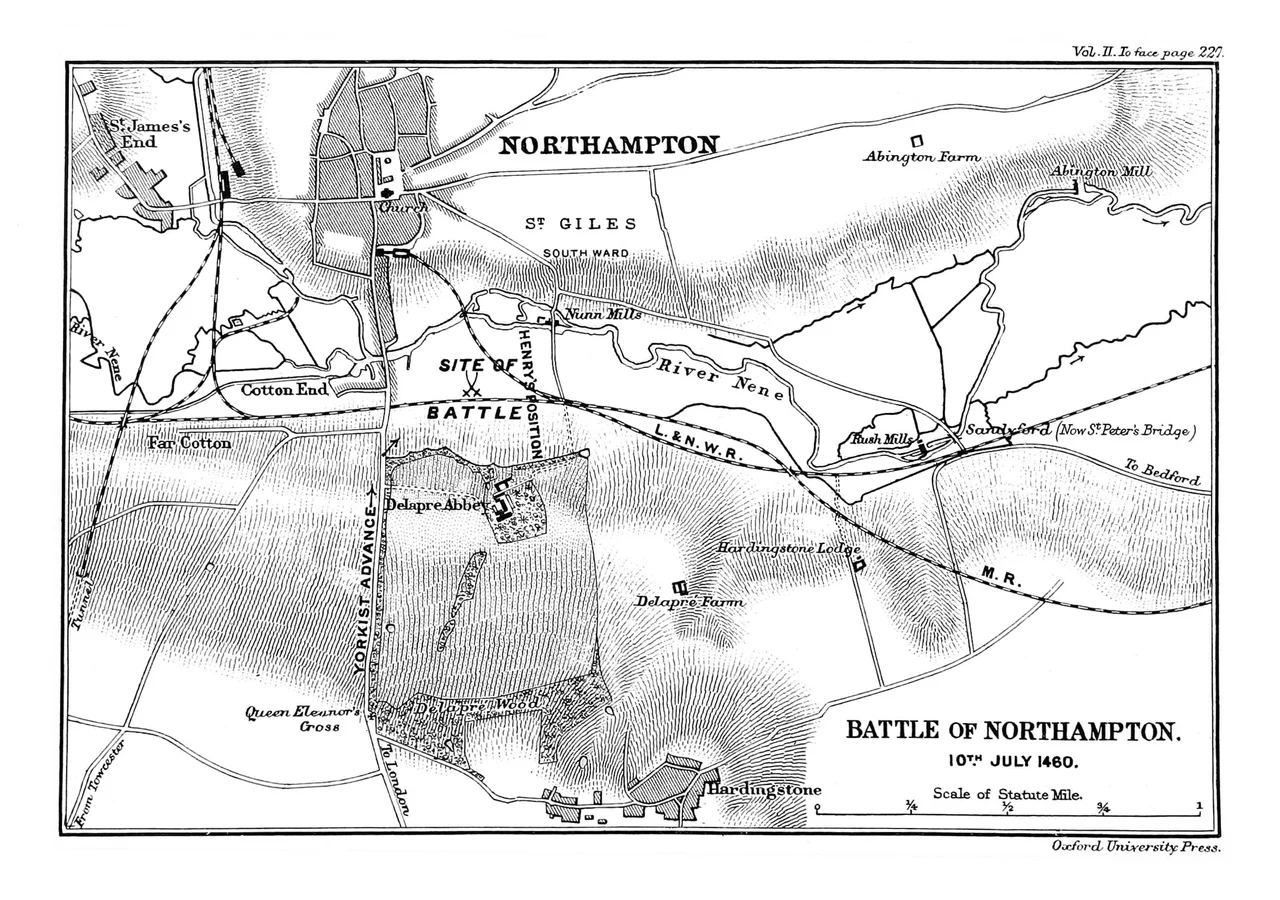
![Photo: James Henry Ramsay (1859–1925)[1] | Public domain](https://commons.wikimedia.org/wiki/File:Map_for_Battle_of_Northampton_by_Ramsay.jpg)
Battle of Northampton (1460)
Rain blew sideways across the meadows by Delapré Abbey on the afternoon of 10 July 1460, and the soldiers slogging through it knew the weather had a vote in what came next. The Earl of Warwick's Yorkist column was advancing in column order, faces streaming, longbows half-useless in the wet. Across the field, behind earthworks ringed with a clutch of newly cast cannon, King Henry VI sat in his tent while the Duke of Buckingham waited to defend him. The cannon had been a serious problem in the planning stage. Now they were waterlogged and silent. Within half an hour the field would be Yorkist, the king would be a prisoner, and the Wars of the Roses would have one of their sharpest pivots.
The road to the meadow
The Yorkists arrived at Northampton because they had nowhere else to go. After their army melted away at Ludford Bridge the previous autumn, the Duke of York had retreated to Dublin, while his teenage son Edward, Earl of March, ran for Calais with the Earl of Warwick and the Earl of Salisbury. The gates of Calais stayed firmly shut against the Lancastrian Duke of Somerset, who had been named its new captain on paper but could not take the port in fact. Through the spring of 1460 Warwick raided Sandwich repeatedly, stealing the very ships the Lancastrians were building to come kill him. By late June he was back in England with an army at his back, moving inland to find the king and force a reckoning. Three times he sent envoys ahead asking simply to speak with Henry; three times the answer came back from Buckingham, blunt as a hammer: 'The Earl of Warwick shall not come to the King's presence, and if he comes he shall die.'
The wet field
Henry's commanders had chosen ground well. They dug in south of the town on a loop of the River Nene, with the abbey at their back and a deep ditch in front, and they mounted artillery on the bulwarks. On paper it was a position to break an army against. Then the heavens opened. By two o'clock, when the Yorkists began their advance, the downpour had soaked the gunpowder into a useless paste. Warwick's men trudged forward through churned mud, took an unpleasant volley of arrows from the Lancastrian archers, and kept coming. The whole carefully built fortification, with its drowned cannon and its ditch slick as a butter dish, started looking less like a stronghold and more like a trap with the defenders inside it.
The black ragged staff
The thing that actually decided the battle was a deal made before a single arrow flew. Lord Grey of Ruthin, commanding the Lancastrian left, had quietly sent word to the Earl of March that he would change sides in exchange for Yorkist help in a long-running property dispute with his cousin, the Duke of Exeter. When Warwick's column reached Grey's position, Grey's men simply laid down their weapons and stood aside. Warwick had already ordered his own soldiers to spare ordinary troops, and especially anyone wearing the black ragged staff badge of Lord Grey's retinue. The Yorkists walked into the camp through the gap. From that moment the defenders inside the fortifications could not manoeuvre to face the new direction of attack, and the battle was effectively over. Three years later Grey would collect his payment in the form of high office: Treasurer of England, 1463.
Thirty minutes, four lords, one king
What followed lasted about half an hour. The Duke of Buckingham, the Earl of Shrewsbury, Lord Egremont, and Lord Beaumont all died trying to hold the line at the king's tent. Around three hundred other Lancastrian soldiers died with them, many drowned in the ditch as panic broke the line. King Henry VI, whose grip on his own kingdom was loose at the best of times and frayed during episodes of mental illness, was found in his tent by an archer named Henry Mountfort. Warwick, March, and Lord Fauconberg arrived a few minutes later. With the deliberate, careful courtesy that English politics demanded even in the middle of a coup, they bowed to the king they had just defeated and escorted him to Delapré Abbey for the night, then to Northampton, then to London. The Tower garrison surrendered shortly after.
Walking the ground today
The battlefield south of Northampton is a registered historic site, and you can walk parts of it across what is now Delapré Park. In 2015 a cannonball was found here that is considered the oldest surviving from a British battlefield, a stubby iron memento of the artillery that did not save the king. The Eleanor cross at the edge of the abbey grounds still stands. The abbey itself, where Henry slept his first night as a captive, was a Cluniac nunnery in 1460; it now houses the county records and a heritage centre. None of the men who died that afternoon are buried under marked stones. The river still loops below the slope, and on a wet July day, when the meadows turn dark and the rain comes in sideways, it is not hard to picture where the line broke.
From the Air
Coordinates 52.223°N, 0.884°W, in the meadows of Delapré Park immediately south of Northampton town centre and east of the River Nene. Recommended viewing altitude 2,500-3,500 ft AGL for orientation. Visual landmarks: the loop of the River Nene around the abbey grounds, the dark mass of Delapré Abbey, and the long ridge running down to the river. Nearest airport is Sywell Aerodrome (EGBK), 6 nm northeast. Cranfield (EGTC) lies 13 nm south-southeast for IFR diversion.
Nearby Stories
- Battle of Bosworth Field 3.6 km away
- Murder of Ross Parker 7.2 km away
- Royal Leamington Spa 8.8 km away
- Buckingham 9 km away
- St Neots 9.4 km away
- Letchworth 10 km away
- Uppingham School 11 km away
- Sudeley Castle 39 km away