
Letchworth
Ebenezer Howard was working as a parliamentary stenographer in London in 1898 when he published a small book with a long title: To-morrow: A Peaceful Path to Real Reform. The book had a diagram in it. Three magnets, labeled Town, Country, and Town-Country, drew people in different directions. Howard argued that the third magnet, a new kind of settlement combining the best of cities and countryside, could outpull the other two. Most reviewers ignored him. A few read the book, met him for tea, and decided to actually build one. The land they bought, 3,818 acres around the small village of Letchworth in north Hertfordshire, became the first attempt to put Howard's diagram on the ground. The first families moved into their new houses in July 1904.
The Letchworth That Was
Long before the garden city, there was a village called Letchworth. It appears in the Domesday Book of 1086 as Leceworde: nine villager households, four cottagers, one slave, one priest, suggesting it was already a parish. The parish church of St Mary's was built in the twelfth century, probably on the foundation of something older. A late Bronze Age hill fort once stood on Wilbury Hill, beside the ancient track of the Icknield Way, and was refortified in the Middle Iron Age before being abandoned around the time the Romans arrived. The name itself comes from Old English: lycce weorth, the enclosed farm. By 1901 the population was 96. It was the kind of place where Howard's planners could buy in secret from fourteen adjoining landowners and assemble an estate large enough to test an idea on, for £155,587.
Unwin and Parker
The architects Raymond Unwin and Barry Parker drew the original layout. Industry was to be kept to the eastern edge, near the railway and the Great North Road. Housing radiated out from a central avenue, organised around tree-lined streets and small parades of local shops. There were to be open spaces, allotments, and a protective belt of agricultural land. The first houses, six Alpha Cottages at 22-32 Baldock Road, were occupied in July 1904. In 1905 and again in 1907, a Cheap Cottages Exhibition was held to encourage architects and builders to demonstrate innovations in low-cost housing. The first exhibition drew 60,000 visitors. The Daily Mail was so taken with the idea that it launched its own copy in 1908, calling it the Ideal Home Exhibition. The thing has run, in one form or another, ever since.
Sollershott Circus
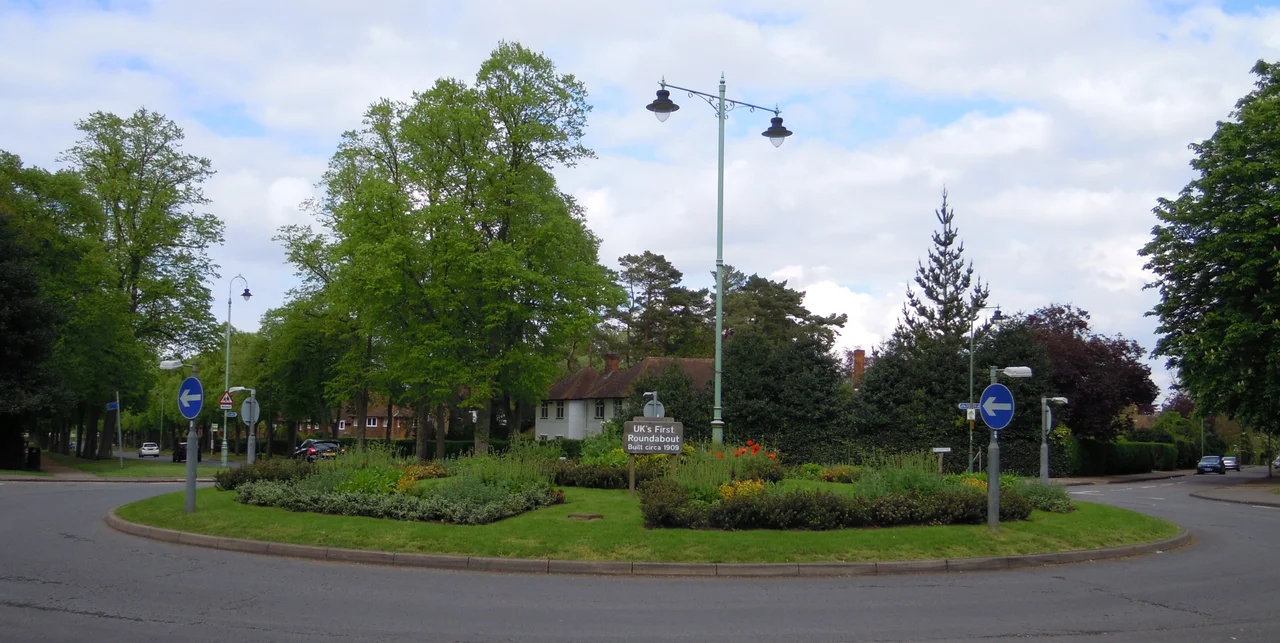
In 1908 the engineers came to a six-way junction in Letchworth's main avenue and proposed something unusual. The plans, drawn in July of that year, called for a circular traffic island at the meeting point of Broadway, Spring Road, and Sollershott. Unwin had recently been to Paris and seen the Place de l'Étoile. The Letchworth roundabout was in use by 1910, although the instruction to keep left was not added until 1921 (before that, traffic could circulate in either direction, as some elderly residents still recall). It is officially called Sollershott Circus. Two signs erected in 2006 announce it as the United Kingdom's first roundabout, the result of a campaign by a Letchworth schoolboy named Andrew White. The signs are not exaggerating. Every roundabout in Britain, of which there are now over 25,000, descends from this one.
The Town with No Pub
Many of the early residents had non-conformist or Quaker leanings, and Letchworth quickly acquired a reputation for earnestness. The poet John Betjeman, in his poems Group Life: Letchworth and Huxley Hall, painted the inhabitants as health-obsessed sandal-wearers eating brown bread. The most-cited expression of the town's seriousness was a public vote in June 1907 that banned the sale of alcohol in licensed premises within the garden city. Letchworth did have a sort of pub: the Skittles Inn, opened in March 1907, served non-alcoholic drinks and was nicknamed "the pub with no beer." The ban lasted fifty years. It was finally lifted in 1957, and the Broadway Hotel opened in 1962 as the first proper public house in the centre of the garden city. Even now Letchworth has fewer pubs per head than most towns its size.
Hotel York and the Rescue
The garden city was supposed to be run for the benefit of its residents. The original company, First Garden City Limited, restricted shareholder dividends to 5 per cent and intended that, once the town was complete, the estate would pass to a public body. By 1956, that intention had been quietly abandoned. The dividend cap was lifted. In 1960 a company called Hotel York Limited, controlled by the Rose family, acquired a controlling interest in First Garden City Limited and began auctioning off freeholds and proposing to develop the agricultural belt. The town reacted with alarm. The local council enlisted the support of its MP, Martin Maddan, who sponsored a private bill in Parliament. Against fierce opposition from Hotel York, the Letchworth Garden City Corporation Act 1962 transferred the entire estate to a new public-sector body. In 1995 the Corporation became the Letchworth Garden City Heritage Foundation, a charitable body that still owns most of the industrial, retail, and agricultural land in the town. In 2020 its assets were valued at £193 million. Its annual surplus, around £6 million, is reinvested in the town.
What Howard's Idea Became
Walk down Broadway in Letchworth today and the trees are mature, the front gardens are well-tended, and the houses have a slightly fussy Arts and Crafts solidity. Some of them are the original 1904 buildings. Norton Common, the wedge of unimproved grassland and woodland on the north side of the town, still holds a Green Flag Award. The Spirella corset factory, designed by Cecil Hignett in 1912 in the Arts and Crafts style and nicknamed Castle Corset, has been converted into offices but its battlements still rise above the railway line. Letchworth's influence stretched a long way. Welwyn Garden City, founded by Howard himself in 1920, used the same model. Hampstead Garden Suburb borrowed from it. The British New Towns of the 1940s and 1950s, including nearby Stevenage, drew on the same ideas in coarser form. Aspects of the layout were echoed in Canberra, Hellerau, Tapiola, and Mežaparks. Howard died in 1928 and is buried in the garden city's cemetery, a few hundred yards from where his diagram became three streets.
From the Air
Letchworth Garden City lies at approximately 51.9787°N, 0.2298°W in north Hertfordshire, about 35 miles north of central London. The town sits on the railway line linking King's Cross to Cambridge, immediately east of the A1(M) motorway. Recommended viewing altitude is 2,000 to 3,000 feet to take in the deliberately planned street layout, with Broadway running east-west through the centre, Sollershott Circus (the UK's first roundabout) at its western end, and the protective belt of agricultural land still visible around most of the town. The Spirella Building, with its Castle Corset battlements, is a prominent landmark. Nearest airports: Luton (EGGW) 12 miles southwest, Cambridge (EGSC) 25 miles north, Stansted (EGSS) 25 miles east, Old Warden (EGTH) 10 miles north. Hitchin lies 3 miles south and Stevenage 6 miles south.
Nearby Stories
- Battle of Barnet: The Fog That Decided a Dynasty 2 km away
- Ingatestone Hall 3.3 km away
- National Horseracing Museum 5.4 km away
- St Neots 6.6 km away
- Bletchley Park 6.6 km away
- Hellfire Caves 7.8 km away
- Sywell Aviation Museum 12 km away
- Pleshey Castle 16 km away