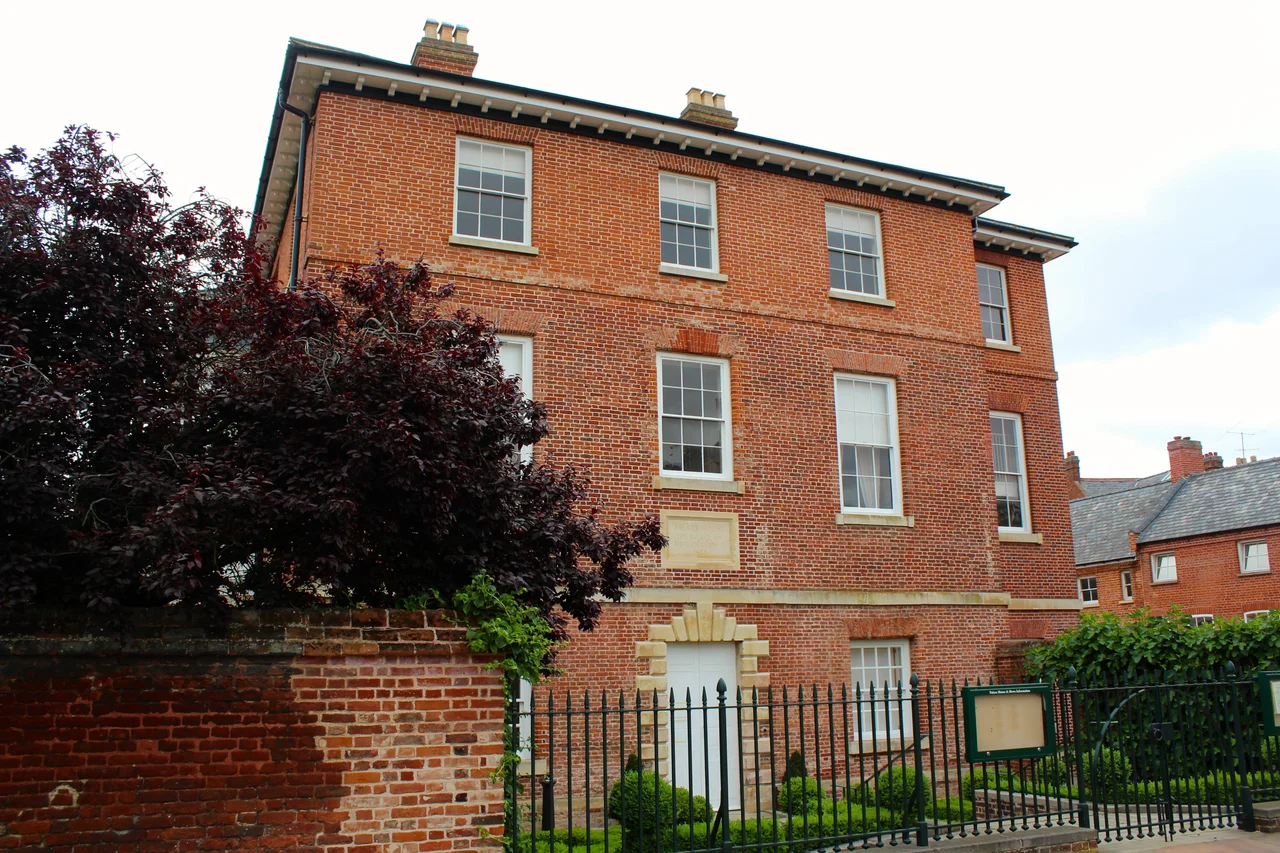

National Horseracing Museum
Palace House in Newmarket is the only surviving piece of the palace that Charles II built here in the seventeenth century, when the Stuart court made this Suffolk market town one of the great centres of English royal life. The palace is mostly gone; the house remains. Today it contains the Fred Packard Museum and Galleries of British Sporting Art, where George Stubbs's equine portraits hang alongside work by Sir Alfred Munnings and Lucy Kemp-Welch — painters for whom the racehorse was not a subject but an obsession. This is the heart of the National Heritage Centre for Horseracing and Sporting Art, opened by Queen Elizabeth II in 2016, and it is one of the more unusual cultural destinations in England: a museum about sport, art, and animals, located in the ruins of a royal palace.
From Jockey Club Rooms to Palace Street
The National Horseracing Museum's origins lie in a practical question: what to do with the Subscription Rooms of the Jockey Club when they closed in 1981. Jockey Club handicapper Major David Swannell saw an opportunity, and the museum opened on 30 April 1983, in the old rooms on Newmarket High Street — with a statue of Hyperion, the 1933 Epsom Derby winner, standing at its entrance. For more than three decades the museum occupied those rooms before the larger ambition took hold. In 2016, the museum joined forces with the British Sporting Art Trust and the charity Retraining of Racehorses to create a combined cultural centre on Palace Street, covering five acres in the heart of the town. The combined centre was opened by the Queen on 3 November 2016. In May 2024, Queen Camilla became its patron.
Inside the Trainer's House
The museum's collections are housed in the Trainer's House and the King's Yard Stables — buildings that retain the functional character of a working yard. The exhibits themselves range from fine painting to sporting memorabilia to the applied science of horse racing. Jockey silks worn by Lester Piggott and Frankie Dettori sit in cases nearby. A racehorse simulator lets visitors try for themselves what it feels like to ride a thoroughbred at speed — or an approximation of it. Temporary exhibitions rotate through the galleries: in 2025, the museum staged an exhibition on horseracing board games, a subject that turns out to have a more elaborate history than most people expect. A gift shop and second-hand bookshop occupy part of the Trainer's House, and a cafe and restaurant open onto a courtyard where a statue of Frankel — widely considered one of the greatest racehorses in history — stands in the open air.
The Rothschild Yard
Behind the public galleries, the Rothschild Yard serves a different purpose. It is home to Retraining of Racehorses, the charity that manages the transition of thoroughbreds from competitive racing into second careers. The yard provides stabling and paddocks for horses currently undergoing retraining, and visitors can meet them at specified times — an encounter that brings the abstract history of the sport into immediate physical contact. Several times a year the Peter O'Sullevan arena hosts demonstrations: horseball, horseback falconry, and displays featuring Suffolk Punch horses, one of England's oldest and most endangered breeds. The museum received recognition in the East Anglian Daily Times Norfolk and Suffolk Tourism Awards in 2020, and was a highly commended runner-up in the Suffolk Museum of the Year Awards in 2022.
From the Air
The National Horseracing Museum is located at 52.243°N, 0.405°E in central Newmarket, Suffolk. From altitude, Newmarket is identifiable by its two racecourses — the Rowley Mile and the July Course — flanking the town to the north and south. The museum sits near the town centre on Palace Street. Nearest airport: Cambridge (EGSC), approximately 14 miles southwest.
Nearby Stories
- Wymondham Abbey 3.8 km away
- St Ives Bridge 6 km away
- RAF Eye 6.6 km away
- Castle Hedingham 6.9 km away
- Royal Hospital School 9.2 km away
- RAF Downham Market 9.9 km away
- Flag Fen 13 km away
- Letchworth 17 km away