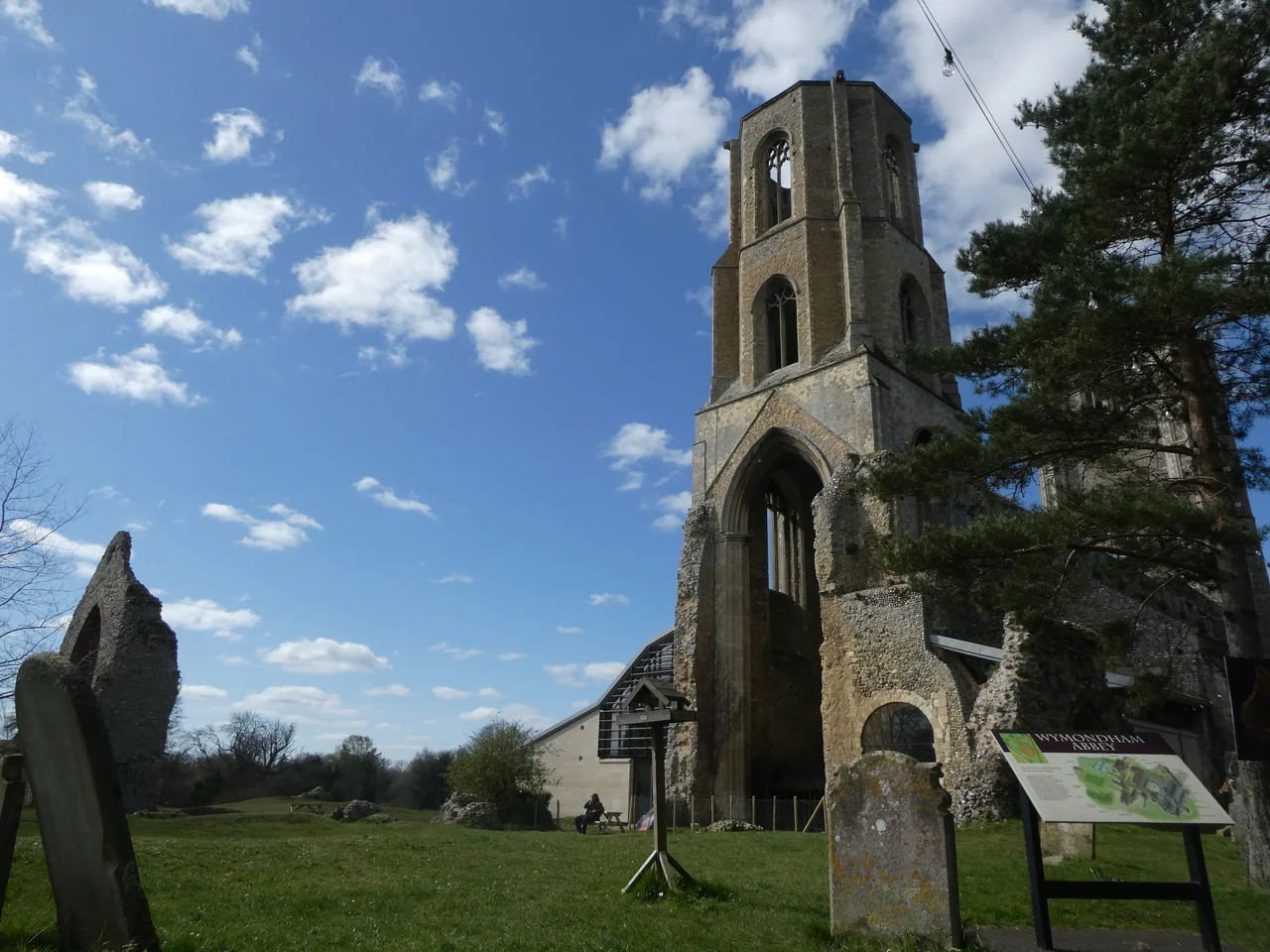

Wymondham Abbey
The town is called Wymondham, but nobody pronounces it that way. Locals say 'Windum' — three syllables compressed into two, the letters smoothed away by generations of use. The abbey at its heart was founded in 1107 by William d'Aubigny, Butler to King Henry I, a Norman nobleman whose family came from Saint-Martin d'Aubigny in Normandy. He established it as a small dependency of the Benedictine monastery at St Albans, where his uncle Richard was abbot, and intended it for perhaps twelve monks. What he got instead was nine centuries of continuous life: dispute, elevation, dissolution, survival, and a 1793 organ that still fills the nave with music.
A Foundation Built for Argument
From almost the beginning, Wymondham's monks disagreed with their superiors at St Albans. The relationship was a dependent one: Wymondham Priory owed obedience to the larger house, and that arrangement generated friction across centuries. The disputes were frequent enough to be characteristic.
In 1249 Pope Innocent IV intervened to divide the building itself — the monks of Wymondham received the chancel, central tower, transepts, south aisle and south-west tower, while the nave's north aisle and north-west tower became the parish church, served by an independent vicar. The building was quite literally split between two jurisdictions, the monastic and the civic, sharing walls and roof while answering to different authorities. This was an unusual arrangement even by medieval standards, and the physical legacy of that division — two towers, two histories — still marks the building's silhouette today.
The long argument ended only in 1449. Following a successful petition to the king, Pope Nicholas V granted Wymondham the right to become an abbey in its own right, independent of St Albans. It had taken 342 years.
The Organ Builders
The earliest record of an organ at Wymondham dates to the late 1400s. The church still holds a written guarantee for a new instrument built in 1523 by William Beton — or Bylton — of King's Lynn: 'a payre of orgons in ye quire,' in the spelling of the day. Beton went on to become the royal court organ maker, building instruments at Hampton Court, the Chapels Royal, and Old St Paul's Cathedral.
Today's main organ is a different instrument entirely: built in London by James Davis and installed in 1793, housed in a fine Chippendale 'Gothick' style case on the gallery at the west end of the nave. It is a three-manual instrument that has been enlarged and rebuilt several times over the past two centuries, but retains most of its original 18th-century pipework. A smaller chamber organ, also by Davis and built in 1810, stands in the north aisle. The abbey has maintained a tradition of choral excellence across this whole arc of instrument-making, from the Tudor organ-builder who rose to royal service to the Georgian craftsman whose pipes still speak.
Dissolution and Survival
The last abbot of Wymondham was Loye Ferrers. When the monastery was dissolved in 1538 under Henry VIII's reorganization of the Church, Ferrers was appointed vicar of the parish — a transfer of role rather than a disappearance. The monastic community ended; the building did not. Because half the structure already functioned as a parish church, the townspeople of Wymondham had a stake in it that protected it from the demolition that consumed so many English monasteries in this period.
What remained was a complex, scarred building — towers missing their tops, the monastic east end ruined — but alive. The ruined east tower still stands within the grounds, its open sky visible through windows that long ago lost their glass. Inside, Norman pillars line the nave, some of them 'squared off' in the 1580s when medieval stonework was routinely modified to suit changing tastes. The Parish Archives, some dating to the 13th century, are kept in a chamber above the porch. The church holds a 1613 edition of the King James Bible.
Becket's Chapel and the Modern Abbey
A chapel dedicated to Thomas Becket once stood in the town, served by two monks from the priory as chaplains. Over the centuries it served successively as a guild chapel, a grammar school, and a town library — the kind of adaptive reuse that marks buildings people refuse to give up. In 2022 it was purchased by Historic Norfolk and reopened, following major restoration, as an arts centre.
Back at the abbey itself, 2016 brought new extensions at the east end, funded by the Heritage Lottery Fund and local donors: display areas, a café, vestries, and a comfortable social space that makes the 900-year-old church easier to live in. The Preservation Trust and a volunteer archivist continue the work of keeping it whole. Wymondham Abbey is simultaneously a ruin, a working parish church, and a museum of its own layered history — and Sunday morning services are held in the same nave where Benedictine monks once chanted their offices.
From the Air
Wymondham Abbey lies at 52.570°N, 1.107°E, approximately 12 km south-west of Norwich. The nearest airport is Norwich International Airport (EGSH), roughly 17 km to the northeast. From the air, the abbey's distinctive twin-tower profile is visible above the rooflines of the small market town of Wymondham: the intact north-west tower of the parish church contrasts with the ruined east tower whose open top is visible even from altitude. The surrounding Norfolk countryside is flat agricultural land with the River Tiffey threading nearby. Best observed at low altitude — the contrast between the standing west front and the roofless east tower is most dramatic from above.
Nearby Stories
- Sheringham 2.7 km away
- Wingfield Castle 4.4 km away
- Castle Acre Castle and Town Walls 6.3 km away
- Brancaster 7.1 km away
- West Stow Anglo-Saxon Village 9.3 km away
- Four Days' Battle 80 km away
- Battle of Lowestoft 80 km away
- SM U-97 110 km away