
RAF Eye
The B-17 Flying Fortress with serial number 43-38400 was called Alice Blue Gown. Painted as the 851st Bomb Squadron sent it into action from RAF Eye, she completed sixty-seven combat missions over Germany - one of the highest tallies of any Fortress that flew from this Suffolk airfield. The 490th Bombardment Group arrived at Eye in May 1944 from Mountain Home Army Air Field in Idaho. Their B-24 Liberators flew the first missions in June, bombing French coastal defences as part of the D-Day support effort. Within five months the group had switched to B-17s and was attacking strategic targets across the Reich. After the war, Eye became something more unexpected. In 1992 it became the site of the world's first poultry-litter-fuelled power plant. The runways that once launched B-17s now surround a generating station fed on chicken manure.
Built In a Hurry, Built To Standard
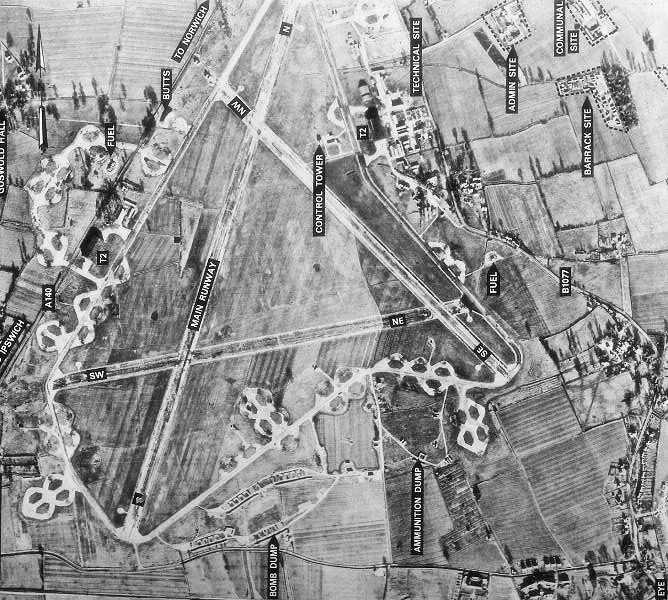
Eye was a standard Class A airfield - the American specification for heavy bomber operations in England, with three intersecting runways laid out in a triangle and fifty hardstandings around the perimeter. Construction began in September 1942 with the U.S. Army's 829th Engineer Battalion. The 827th arrived in December to help. The 859th came in May 1943 when the 829th rotated out. The bulk of the work happened through the summer of 1943, with the 827th setting records for concrete pouring while the 859th specialised in building construction. British contractors filled in around the edges. The airfield was declared operational on 7 December 1943 - exactly two years after Pearl Harbor - and turned over to the U.S. Army Air Forces. By 1 April 1944 it was complete and occupied by the 8th Air Force, designated AAF Station 134. It was one of the last wartime airfields built in East Anglia, and some of the construction equipment never left.
The 490th and Its Missions
The 490th Bombardment Group flew its first combat mission in June 1944, with B-24 Liberators marked with a Square-T tail code. Four squadrons formed the group: the 848th, 849th, 850th and 851st Bombardment Squadrons. The early missions targeted airfields and coastal defences in France, supporting the Normandy landings. Through July the group bombed bridges, rail lines and troop concentrations around Caen as the ground forces fought their way out of the bocage country. In September they supported the operations near Brest. In October the group converted from B-24s to B-17 Flying Fortresses, adopting a red stripe at the top of the aircraft fins as their new identification. The strategic campaign against Germany filled the next five months: oil plants, tank factories, marshalling yards, aircraft works and airfields at Berlin, Hamburg, Merseburg, Munster, Kassel, Hannover and Cologne. They flew interdiction missions during the Battle of the Bulge in December 1944 and January 1945. From March they shifted to tactical support for the advancing Allied armies.
After V-E Day
When the war in Europe ended in May 1945, the 490th's aircraft did not immediately fly home. Their first post-combat task was a humanitarian one: dropping food into the flood-stricken areas of the Netherlands during Operation Chowhound, where civilians had been close to starvation through the brutal Dutch hunger winter. The group also flew French, Spanish and Belgian former prisoners of war out of Austria to Allied collection points - shuttling people who had survived Nazi captivity back toward their countries of origin. These missions, less famous than the bombing raids, involved many of the same crews dropping bread instead of bombs into the same continent they had spent a year bombing. The 490th flew its last mission of any kind from Eye in early September 1945 and returned to Drew Field, Florida, on 3 September. The group was inactivated on 7 November 1945.
Chicken Litter and Concrete
After the war, Eye transferred to RAF Bomber Command on 1 November 1945 as an active station, but the airfield gradually wound down through the 1950s. The Air Ministry finally sold the land in 1962-63. The hangars and technical site were converted into an industrial estate, with a large factory established for processing straw. Later industrial development followed. A natural gas pumping station now occupies part of the centre of the former airfield. In 1992, on a site that had once been an Eighth Air Force bomber dispersal, the world's first poultry-litter-fuelled generating plant began operation. The plant produces 12.7 megawatts of electricity and consumes about 140,000 tonnes of chicken litter per year - waste from the East Anglian poultry industry, which would otherwise have to be disposed of, burned in a fluidised bed combustor to drive a steam turbine. It is owned by Energy Power Resources. Much of the wartime concrete remains: the old taxiways, sections of runway, a T-2 hangar, and various technical site buildings in different states of repair. A memorial to the 490th Bombardment Group, unveiled on 29 May 2016, stands as the formal commemoration of the Americans who lived and died here.
From the Air
RAF Eye lies at 52.33 degrees north, 1.13 degrees east, on the north-west edge of the market town of Eye, eleven miles north-east of Stowmarket and a short distance south of Diss. The wartime triangular runway pattern is still visible from the air, partly preserved as industrial estate roads. Recommended viewing altitude is 1,500-2,500 feet. The River Waveney and the Norfolk border lie just to the north; the A140 runs through the area. Nearest active airfields are RAF Marham (EGYM) to the west, Norwich (EGSH) to the east, and RAF Wattisham (EGUW) to the south. The poultry-litter power station's stack and pumping station structures are visible features on the former airfield. North Sea weather brings rapid changes in coastal visibility.
Nearby Stories
- RAF Hethel 4.1 km away
- West Stow Anglo-Saxon Village 4.9 km away
- Castle Hedingham 8.1 km away
- Shotley Gate 8.5 km away
- RAF Marham 14 km away
- Four Days' Battle 52 km away
- Southern Bight 79 km away
- SS Elbe 113 km away