
RAF Marham
On the morning of 30 January 1943, three Mosquitoes from Marham flew low and fast across the North Sea, timed their arrival on Berlin to the minute, and dropped their bombs precisely as Hermann Goring stepped to a microphone to make a speech marking ten years of Nazi rule. German listeners heard the rumble of engines, then anti-aircraft fire, then sudden classical music as the broadcast engineers cut their man off. All three Mosquitoes came home. The raid was as much theatre as bombing, and that is the Marham character: small forces, careful timing, exceptionally good aircraft. Today the airfield is home to the F-35B Lightning II, the most expensive theatre England has ever staged.
From Zeppelins to Stirlings
Marham's first dogfight ended badly. On the night of 27-28 November 1916, Lieutenant Gaymer of No. 51 Squadron took off from the Norfolk aerodrome to intercept Zeppelin L21, crashed his Royal Aircraft Factory F.E.2b without making contact, and was killed. L21 was shot down later by Royal Naval Air Service crews near Lowestoft. The aerodrome closed shortly after the First World War and reopened in 1937, the first squadron to arrive being No. 38 with its Fairey Hendon bombers. Wellingtons followed, then Short Stirlings of 218 Squadron from late 1940, then de Havilland Mosquitoes of 105 Squadron, the same unit that buzzed Goring in Berlin. Marham became part of the Pathfinder force and helped develop Oboe, the precision blind-bombing aid that finally let RAF crews hit specific buildings rather than whole cities.
Cold War Steel
In the spring of 1946, Marham hosted Project Ruby: seven B-17 Flying Fortresses and three modified B-29 Superfortresses of the USAAF spent six months attacking the Nordsee III U-boat pen at Heligoland and the Valentin assembly plant at Farge to see whether Grand Slam and Disney penetrator bombs could break massive German reinforced concrete. They could, with effort. The Cold War turned Marham into a V-bomber station, and in October 1957 the station was awarded its badge: a blue bull, head lowered, facing the viewer, with the single-word Latin motto Deter. The bull marked Marham's nuclear deterrence role. From 1980 to 1983, twenty-four hardened aircraft shelters were built into the apron, each fitted with the American Weapon Storage Security System capable of holding four WE.177 nuclear bombs.
The Tornado Years
On 24 April 1982 the first Panavia Tornado GR1 to be delivered to Marham, ZA601, flew in from BAe Warton. On 1 January 1983 No. 617 (Dambusters) Squadron reformed at Marham to fly it. The Tornados stayed for thirty-seven years. They flew from Marham to Iraq in the first Gulf War, to Bosnia, to Kosovo. On the night of 19 March 2011, IX Squadron Tornados flew a 3,000-mile round trip from Marham to launch Storm Shadow cruise missiles against targets in Libya as part of Operation Ellamy. From 2014 they bombed ISIL targets in Iraq and Syria as part of Operation Shader. The Tornado retirement came in stages and ended on 14 March 2019 with a final flight of ZA463 during the disbandment parade of IX Squadron and 31 Squadron. The Tornado GR4 left RAF service entirely on 1 April 2019.
Project Anvil and the F-35
Marham did not get to retire. The British government had committed to the F-35B Lightning II, the carrier variant designed to take off short and land vertically from the Royal Navy's new Queen Elizabeth-class aircraft carriers, and Marham was chosen as its home base. Project Anvil ran from 2016 to 2018: a 250-million-pound rebuilding programme that demolished a 1930s hangar, built a Lightning Maintenance and Finish Facility in its place, raised an Integrated Training Centre with full mission simulators, threw down 18,000 tonnes of new asphalt on both runways in a three-week resurfacing in September 2017, and refurbished the hardened shelters. On 6 June 2018, four F-35Bs of 617 Squadron made the eight-hour Atlantic crossing from Marine Corps Air Station Beaufort, supported by Voyagers and an Atlas, and Marham had its new aircraft. 207 Squadron, the F-35 operational conversion unit, reformed at Marham on 1 August 2019. In June 2025, the Ministry of Defence announced the purchase of twelve F-35As, dual-capable conventional and nuclear, also to be based at Marham, formalising what the blue bull on the badge had always implied.
The Royal Connection
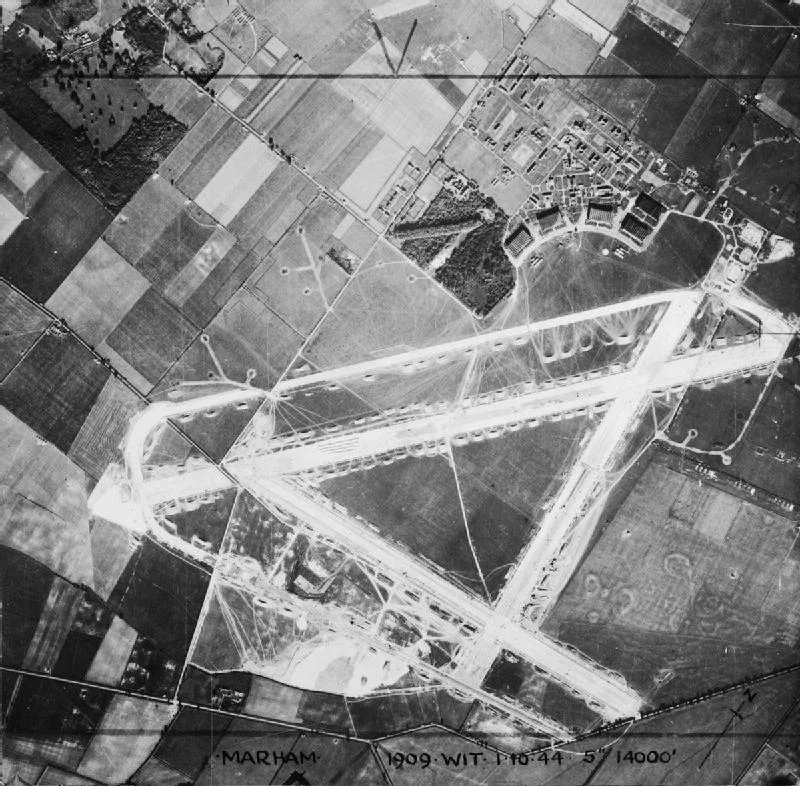
Sandringham House, the Norwegian estate of the late Queen Elizabeth II, sits roughly twenty miles north of Marham. The Queen was the station's Honorary Air Commodore and visited many times; her last official engagement of 2020 was at Marham on 3 February to inspect the F-35Bs. From cruising altitude the Norfolk countryside spreads out flat and green: the airfield is unmistakable, with its long parallel runways, hardened shelters in regular rows around the perimeter, the new Lightning facilities clustered on the north and south sides, and the village of Marham itself just beyond the threshold.
From the Air
RAF Marham sits at 52.65°N, 0.55°E, southwest of King's Lynn in the heart of Norfolk. ICAO: EGYM. The airfield is home to F-35B Lightning II operations of No. 617 (Dambusters) Squadron and No. 207 Squadron (OCU), with No. 138 Expeditionary Air Wing as the parent formation. RAF Lakenheath (EGUL, F-15E/F-35A) is about 18 nm southeast. The Marham MATZ is busy; expect Lightning departures and recoveries through the day. The royal estate at Sandringham lies roughly 20 nm to the north.
Nearby Stories
- RAF Mildenhall 3.7 km away
- Hunstanton 3.9 km away
- Cley Marshes 5.4 km away
- RAF Attlebridge 6.8 km away
- Boston Guildhall 7.5 km away
- RAF Eye 7.5 km away
- St Ives, Cambridgeshire 7.8 km away
- Crowland Abbey 12 km away