
RAF Hethel
On 1 August 1943 a second lieutenant named Lloyd Herbert Hughes flew a Consolidated B-24 Liberator at low altitude over burning oil refineries in Romania, with fuel streaming from holes that flak had torn in his wings. He pressed the bomb run, dropped his ordnance on target, and tried to put the airplane down in a forced landing it could not survive. He was awarded the Medal of Honor posthumously. The airfield he had taken off from a few weeks earlier - and would never see again - sat in Norfolk fields seven miles south-west of Norwich, and today it is owned by Lotus Cars, which uses two and a half miles of his old runways as a sports-car test track.
Station 114
Hethel was built in 1942 for the Americans and never really served the RAF as a wartime bomber base of its own. The USAAF designated it Station 114. The first arrivals in September 1942 were the 320th Bombardment Group flying Martin B-26 Marauders, who treated Hethel as a staging point on their way to Algeria as part of the new Twelfth Air Force in North Africa. The buildings were still uncompleted when they got there. The 310th Bombardment Group passed through the same way in spring 1943, also bound for North Africa - Mediouna Airfield in French Morocco - making Hethel briefly a transit hub for the Mediterranean theater. The 2nd Combat Bombardment Wing of the 2nd Bombardment Division took the airfield as its headquarters from 14 September 1943 to 12 June 1945, running operations for the Liberator groups across this section of East Anglia.
The 389th Bombardment Group
The unit that defined Hethel arrived on 11 June 1943 from Lowry AAF, Colorado. The 389th Bombardment Group (Heavy) - tail code Circle-C, four squadrons coded YO, EE, RR, and HP - flew B-24 Liberators in the Eighth Air Force's strategic bombing campaign. They had barely settled in when a detachment was sent to Libya, where they began operations on 9 July. Three weeks later that detachment took part in Operation Tidal Wave, the low-level B-24 attack on the oil refineries at Ploesti that killed 310 American airmen on a single day. Of the 178 B-24s that took off on 1 August 1943, 53 did not come back. Lloyd Hughes was the 389th's. The group came home with a Distinguished Unit Citation for Ploesti and a permanent place in the bleakest chapter of the air war. They went out again to Tunisia in the autumn, supported the Allied landings at Salerno, then returned to Hethel in October 1943 to do what the Eighth Air Force was built to do: bomb Germany every day the weather would let them.
The Years of Maximum Effort
From their return through April 1945 the 389th flew strategic missions against shipbuilding yards at Vegesack, industrial districts in Berlin, the oil plants at Merseburg, factory complexes at Munster, the marshalling yards at Sangerhausen, and the V-weapon sites stretched along the Pas de Calais. They flew during Big Week in February 1944, the intensive air campaign against the German aircraft industry. They flew tactical support before and during D-Day, hitting gun batteries and airfields along the Normandy coast. They flew interdiction during the breakthrough at Saint-Lo, support during the Battle of the Bulge, and resupply drops during Operation Varsity, the airborne assault across the Rhine. On 21 November 1944 seventeen members of the group were killed in a mid-air collision over Carleton Rode, a few miles from base; a memorial plaque and a stained-glass window in the parish church there were dedicated to them in June 1946. The group flew its last combat mission late in April 1945 and went home to Charleston, South Carolina on 30 May. They were inactivated in September.
Polish Squadrons, Polish Refugees, Lotus Cars
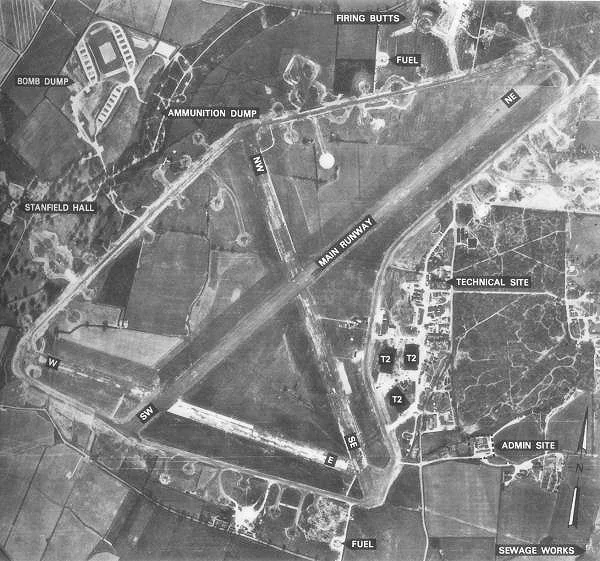
After the Americans left, Hethel was returned to RAF Fighter Command. Polish RAF personnel flying North American Mustangs were among the first arrivals - Polish flyers had been with the RAF since 1940 and many had nowhere to go home to after Yalta. From 1948 about 900 Polish displaced persons were housed in the Nissen huts around the airfield, in a National Assistance Board camp that ran until 1960 or 1961. Polish graves remain in nearby All Saints Churchyard. The station itself closed in 1948. The Air Ministry sold the land in 1964. Two years later Lotus Cars moved in, building a purpose-built factory on the technical site and developing portions of the runways and taxiways as a test track. Today Lotus's factory and engineering centres cover 55 acres of the former airfield and use 2.5 miles of the former runways. Much of the rest has been broken up for road material or returned to agriculture, though the layout is still legible from above. Of the wartime buildings, the most striking survivor is a former gymnasium that became a chapel. Behind where the altar once stood is a painted crucifix made in early 1944 by an American serviceman known as 'Bud' Doyle, assistant to the Catholic chaplain Father Beck. Volunteers have restored the chapel. It is on private property. The former 2nd Air Division headquarters at Ketteringham Hall just north of the airfield is now Group Lotus's own headquarters - the war's command center turned into the boardroom of one of Britain's iconic sports-car companies.
From the Air
RAF Hethel sits at approximately 52.5644N, 1.1708E, about 7 nm south-west of Norwich and 6 nm south-south-west of Norwich International (EGSH). The site is now Lotus Cars' headquarters and test track. From 1,500-2,500 ft AGL the old triangular runway pattern is clearly visible in the agricultural fields and Lotus complex - look for the long straight sections that are now the test track loops. Ketteringham Hall (former 2nd Air Division HQ) stands just to the north. Norwich International (EGSH, elev 117 ft) is the obvious diversion. Note: Lotus tests cars at the site; expect occasional ground activity but no aviation traffic.
Nearby Stories
- Sheringham 2.7 km away
- Wingfield Castle 4.4 km away
- Castle Acre Castle and Town Walls 6.3 km away
- Brancaster 7.1 km away
- West Stow Anglo-Saxon Village 9.3 km away
- Four Days' Battle 80 km away
- Battle of Lowestoft 80 km away
- SM U-97 110 km away