.jpg)
Ingatestone Hall
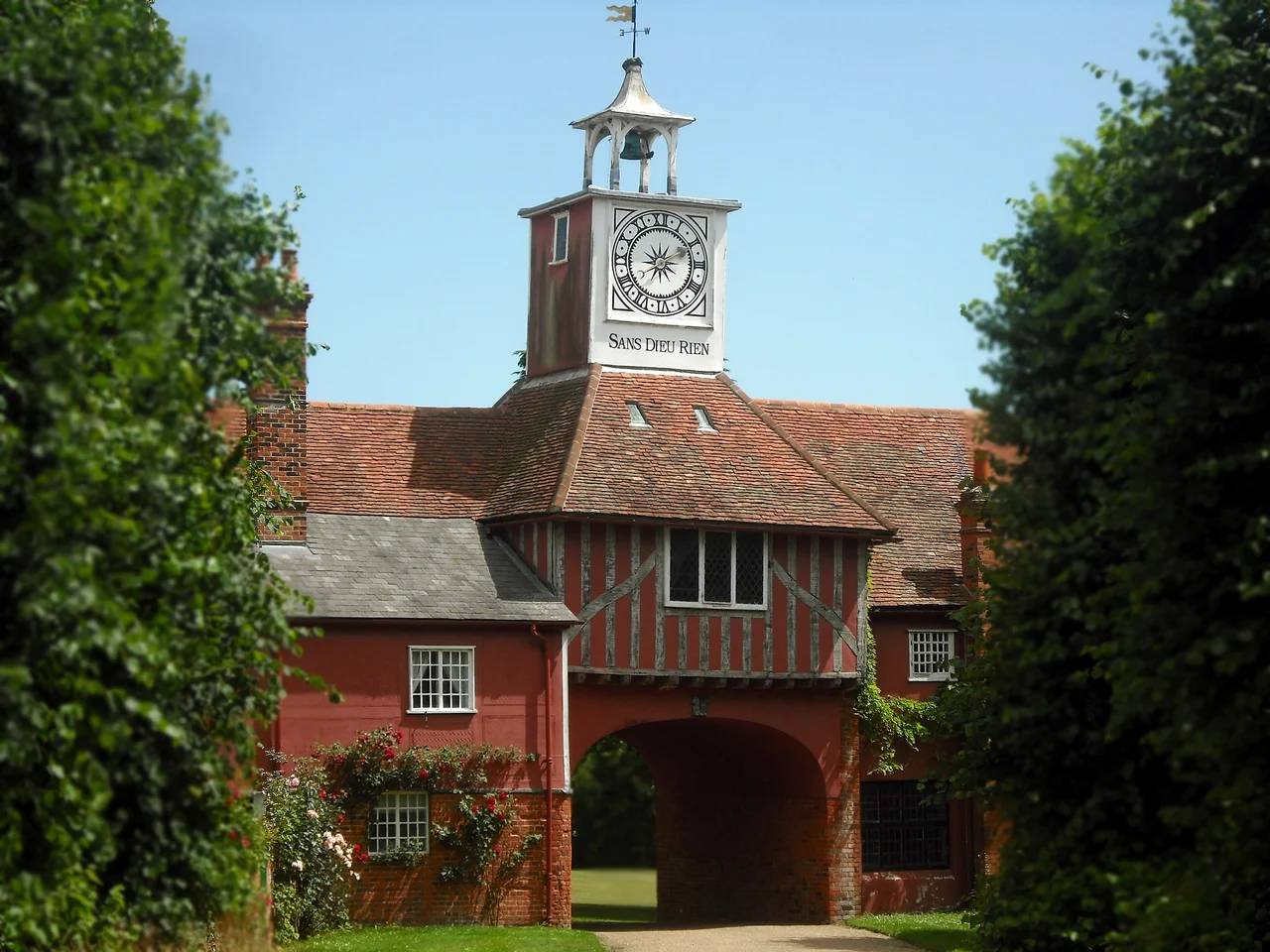
In December of 1589, the composer William Byrd spent Christmas at Ingatestone Hall, writing Mass settings that could not legally be sung anywhere else in England. The Petre family chapel was one of a small number of places where Catholic worship still happened in Elizabethan England, and it happened in secret. Above the courtyard a one-handed clock ticks beneath the motto Sans dieu rien - without God, nothing. The Petres have lived in this house since the 1540s. They still do.
Built from a Monastery
Sir William Petre bought the manor of Ingatestone soon after Henry VIII's Dissolution of the Monasteries, paying about £850 for land that had belonged to the abbey of Barking. Between 1539 and 1556 he raised a house of red English-bond brick around a central courtyard, with stepped gables and tall, ornate chimneys that announced their owner's place in the new Tudor order. Petre had risen as one of Henry's commissioners during the Dissolution itself - the man who inventoried the religious houses being broken up - and the irony of building a family seat on a foundation of suppressed Catholic property would haunt the Petres for generations. The Hall once had four wings around its courtyard. The western range, which contained the great hall, was demolished in the eighteenth century, leaving the U-shape that visitors approach today through the gate-arch.
The Queen Stays the Night
In June 1561, Elizabeth I came to Ingatestone on royal progress. She held court here for several nights, and the family records show the staggering cost of entertaining a Tudor monarch - the food procured, the rooms hung with fresh cloth, the gifts assembled, the hopes managed. Three years later, the Hall served a different kind of royal purpose. In November 1564 Sir William was made jailer to Lady Katherine Grey, sister of the nine-day queen Jane Grey and herself a contender for the succession. Katherine had secretly married Edward Seymour without Elizabeth's consent. She lived under Petre's watch at Ingatestone for two years before being moved on to another guardian. The house Elizabeth had honoured with her presence became, for a time, her cousin's gilded prison.
Priests in the Walls
The Petres were recusants - Catholics who refused to attend Anglican services after the Reformation made them mandatory. The penalties were ruinous: monthly fines, social exclusion, the constant threat of treason charges if a priest were found in the house. The family worshipped in secret in their private chapel. The Hall still contains two priest holes, concealed compartments where visiting clergy could hide during searches. One of those priests was John Payne, the family's chaplain, who was hanged, drawn and quartered at Chelmsford in April 1582 after being betrayed by an informer. He was canonised in 1970 as one of the Forty Martyrs of England and Wales. William Byrd, the greatest English composer of his age and also a Catholic, became close friends with the first Baron Petre. From the 1590s onwards Byrd wrote a complete repertoire of secret Catholic music for the family - the Mass for Four Voices, the two volumes of Gradualia. These works, first heard in the chapel at Ingatestone, are now considered among the finest pieces of Tudor music ever written. They were composed for a few dozen people, in defiance of the state.
Surviving the Centuries
The Petres held on. They lost their fortunes more than once, served in the Lords when Catholics were finally readmitted to Parliament in 1829, and watched the larger family seat at Thorndon Hall burn down in 1876. During the First World War the sixteenth baron, Lionel Petre, was killed in action in 1915, and his widow moved the family back to Ingatestone from Thorndon. The Hall sheltered Wanstead High School during the Second World War. In the 1950s the north wing housed the Essex Record Office, and the architect James Paine's clock tower kept its one slow hand turning over the entrance. The current Lord Petre's son lives in a private wing today. Part of the building is leased as offices. Open afternoons run from Easter through September.
Bleak House on Screen
The exterior was used in the 2005 BBC adaptation of Charles Dickens's Bleak House, standing in for the Jarndyce family seat. It has also appeared in episodes of Lovejoy, the antiques-dealer drama that loved a Tudor courtyard. The Hall holds what remains of the family's picture collection - portraits of generations of Petres, some by serious painters, all by inheritance. The motto above the gate has not changed since the eighteenth century. Sans dieu rien. Without God, nothing. For four and a half centuries the family has chosen to read those words as an instruction.
From the Air
Ingatestone Hall sits at 51.6616 degrees North, 0.3903 East, in flat Essex farmland five miles southwest of Chelmsford and roughly 25 miles northeast of central London. Best viewed at 1,500 to 2,500 feet. The Hall is a small but distinctive U-shaped brick complex with prominent chimneys, set in green parkland with formal gardens. Stansted Airport (EGSS) lies about 14 nautical miles north; London Southend (EGMC) sits 18 nm southeast. The A12 runs just east of the house; the railway line between London Liverpool Street and Norwich passes close by.
Nearby Stories
- Smythe's Megalith 1.5 km away
- Killing of Mark Duggan 4.1 km away
- Kent Museum of Freemasonry 5.4 km away
- Royal Hospital School 15 km away
- Harrow Court fire 15 km away
- Tilty Abbey 15 km away
- The Carrington Event: The Solar Storm That Could Happen Again 15 km away
- Clacton Pier 23 km away