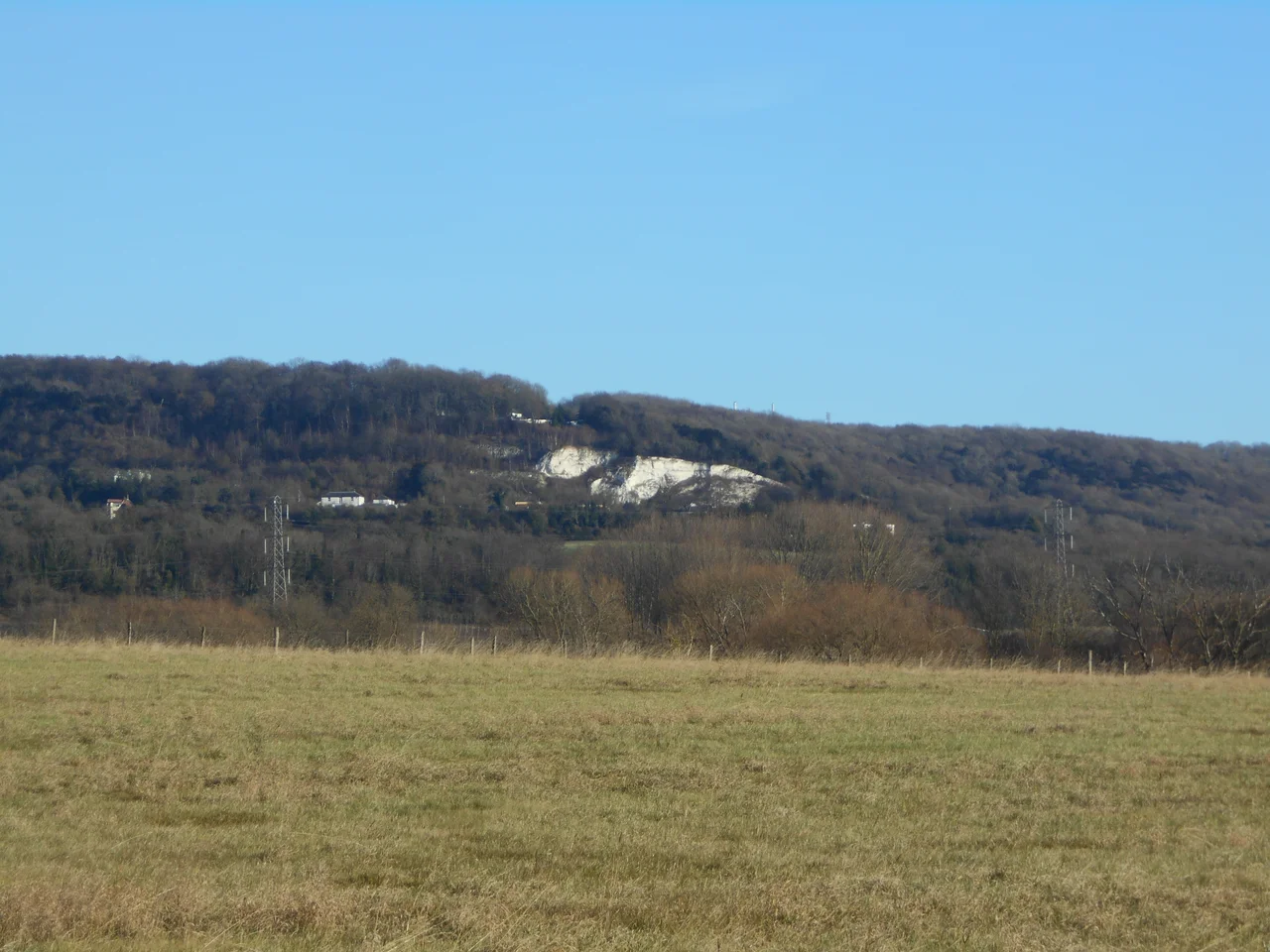

Smythe's Megalith
On a summer day in 1822, the ploughs at Warren Farm on the lower slopes of Blue Bell Hill kept striking something hard under the soil. The labourers cleared the topsoil and found three large sarsen stones - dense, hard, grey, distinctive. The farm's owner sent to Maidstone for two antiquarians who might know what these were. The men who came down, Clement Smythe and Thomas Charles, recognised at once that the stones resembled the chamber of Kit's Coty House, the famous Neolithic dolmen visible from miles away on the ridge above. They drew the chamber. They began to interpret it. By the time they came back the following day, the labourers had already pulled the stones apart with horses and scattered most of the human bones they had found.
What Was Lost
Smythe's Megalith - sometimes called the Warren Farm Chamber - was a chambered long barrow built in the 4th millennium BCE during Britain's Early Neolithic period. The visible chamber consisted of four sarsen stones. The northern stone measured seven feet by four by one. The southern stone was seven by five by two. A third stone, on the western side, was three by four by one. A fourth, smaller stone - three by two by one - had been positioned to prevent the northern stone falling on its southern counterpart, perhaps once dividing the chamber in two. The archaeologist Paul Ashbee, working from the surviving sketches, estimated that the original chamber may have been twenty feet long and contained as many as ten sarsens. The original earthen barrow above it could have reached fifty-five metres in length, lined with as many as 110 to 120 kerbstones - completely invisible by 1822 because millennia of hillwash from Blue Bell Hill had buried it under the field.
The People Inside
Beneath the four chamber stones, the workmen found a flat slab measuring four feet by three. On it lay human remains, aligned east to west. The workmen present on the second day - Smythe was not there - threw most of the bones to the side of the trench. Charles managed to recover some pieces and examined them. The bones included fragments of skull, ribs, thigh, leg, and arm. Two right mandibles and two ulna pieces with their olecranons survived, indicating that at least two individuals had been buried in the chamber. Their molar teeth were worn flat - the kind of grinding wear common in people whose diets contained grit from stone-milled grain. They were of middle age when they died, six thousand years ago. We do not know their names. We do not know whether they were related, or how they died, or who else may have been buried with them whose bones the labourers scattered into the spoil heap before anybody thought to keep them. Beside the human remains the workmen also found the skull of a mole, and a single small sherd of unglazed pottery - perhaps later than the original burial, perhaps from a much later visit to a tomb left open for centuries.
The Antiquarians
Clement Taylor Smythe was a Maidstone antiquarian and historian. Thomas Charles was a doctor in the town who had founded a museum at Chillington House - the building that, decades later, would become Maidstone Museum proper. They had been called in by George Fowle of Cobtree Manor, the farm's owner. A brief announcement of the discovery appeared in the Maidstone Journal on 4 July 1822, and was repeated in the Gentleman's Magazine later that year. About a year after the find, Smythe wrote a fuller account with sketches and a plan of the chamber. He did not publish it. The manuscript went into the archive of Maidstone Museum, where it lay for over a century. Smythe called the monument a "British Tomb" or a "Druidical Monument." Charles wrote a second short account that joined Smythe's in the museum archives. In 1948 the archaeologist John H. Evans published both reports in the journal Archaeologia Cantiana, finally bringing them to the attention of professional archaeology.
Why It Was Buried
Across the Medway valley, the Early Neolithic builders had erected a small cluster of similar chambered tombs - now known collectively as the Medway Megaliths. Smythe's Megalith was part of the eastern group, sharing the hillside with Kit's Coty House, Little Kit's Coty House, the Coffin Stone, and the nearby White Horse Stone. The tombs were built on hilltops and slopes overlooking the river, perhaps as territorial markers between Neolithic herding bands, perhaps as ancestral shrines, perhaps both. Most of them were systematically damaged in the 12th and 13th centuries CE - Ashbee believed by Christian iconoclasts trying to destroy pagan monuments; another archaeologist, John Alexander, suggested by medieval treasure-hunters. By the 1820s, Smythe's Megalith was so deeply buried by accumulated hillwash that nobody had noticed it for centuries. The ploughs were what brought it back into the daylight. The same ploughmen, working on the second day without their educated audience, made certain it disappeared again.
What Remains
Nothing of Smythe's Megalith is visible at the site today. The field where it was found lies east of the A229 dual carriageway, not publicly accessible. In the 1920s the archaeologist O.G.S. Crawford used the Maidstone Museum archives to identify the probable location and included the site in his 1924 Ordnance Survey guide to archaeological sites in southeastern England. In 1955, several substantial stones were found in the area - possibly some of the lost sarsens dragged off the field two centuries earlier. Ashbee noted in 2000 that some kerbstones had "recently come to light, buried in the ditches" of the monument. The drawings Smythe made in 1822 - meagre, hurried, but produced almost half a century before British prehistory existed as a discipline - are now most of what we have. Two people, somewhere in middle age six thousand years ago, were buried together on a hillside above the River Medway. A tomb was built over them. Five thousand years later, it was vandalised. Two centuries after that, it was destroyed entirely. The story of Smythe's Megalith is, more than anything, the story of how much we lose by accident.
From the Air
Located at 51.317 north, 0.517 east, on the lower south-facing slopes of Blue Bell Hill near Aylesford in Kent, just east of the A229 dual carriageway. London Gatwick (EGKK) is about 22 nautical miles west; Manston (EGMH) is 28 nm east. Nothing of the monument remains visible from the air; the site is a ploughed field on the hillside above the M20 motorway.
Nearby Stories
- Blackwall Tunnel 0.2 km away
- London Gateway 2.6 km away
- Canterbury Castle 4.2 km away
- Battle Abbey 7.4 km away
- Plymouth Brethren 9.9 km away
- The Carrington Event: The Solar Storm That Could Happen Again 12 km away
- Clacton Pier 32 km away
- 2008 Channel Tunnel fire 42 km away