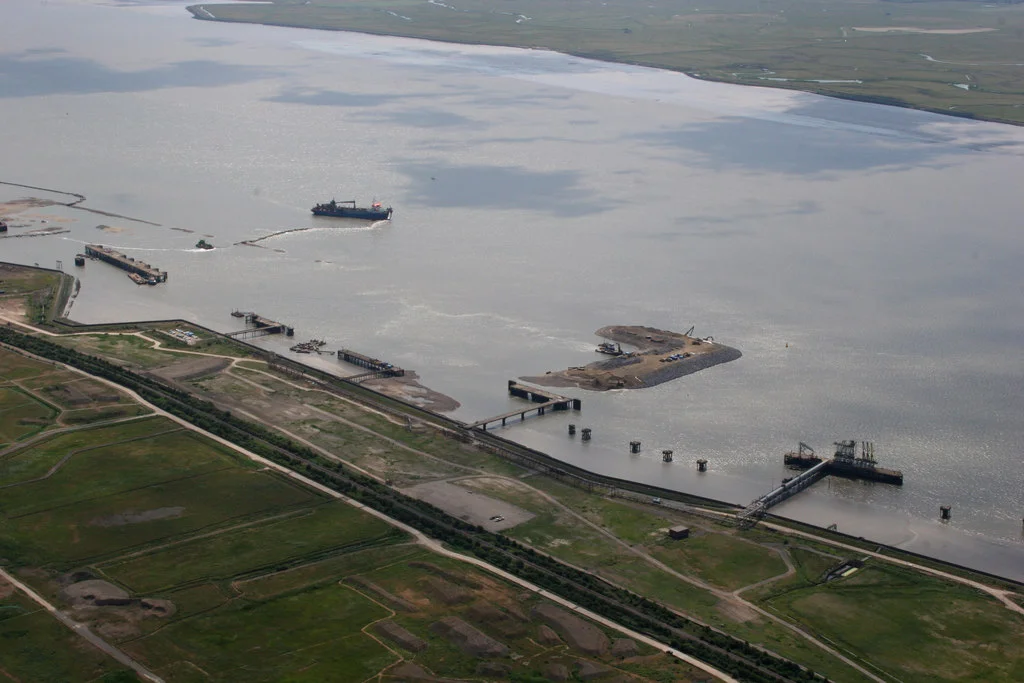

London Gateway
The cranes are taller than the London Eye. They came across the world on ships - 1,848-tonne quayside machines built in Shanghai, with booms 138 metres high - and they sit now on the north shore of the Thames, lifting boxes off vessels four football fields long. Until 1999 this same stretch of riverbank was Shell Haven, one of the largest oil refineries in Britain. Where the storage tanks once stood, 16 quay cranes wait for ships that carry as much cargo as the entire Royal Navy of Nelson's day.
From Shell Haven to Container Port
The land has 1,500 acres of industrial history. Shell first opened a refinery here in 1916. For most of the twentieth century, this corner of Thurrock was where crude oil arrived from Persia and Venezuela and the North Sea, was cracked into petrol and diesel, and was distributed across southeast England. The refinery closed in 1999 as Britain's refining capacity shifted, and for a decade the site sat empty. Then in May 2006, Prime Minister Gordon Brown identified the Shell Haven site as one of four economic hubs needed to regenerate the Thames Gateway corridor east of London. DP World, the Dubai-based ports operator, took on the project. The 2008 financial crisis nearly killed it - Moody's downgraded DP World's debt to junk in December 2009 - but construction had already begun in February 2010, and the financing held.
Dredging an Ocean Lane
Before any cranes could land, contractors had to make the river deep enough. The first stage of construction was a £400 million dredging and reclamation programme led by Laing O'Rourke and Dredging International, scraping a 17-metre channel up the shifting sands of the outer Thames. The largest container ships in the world now arrive here, sometimes 400 metres long and 60 metres wide. They anchor off the Suffolk coast and wait for a pilot vessel from Harwich to escort them up the estuary, through sandbanks that change shape with every tide. The MOL Caledon was first to dock, on 6 November 2013, carrying 58,000 tonnes of South African fruit and wine. The port was officially open. Most of its customers had to be talked into using it - the global shipping alliances had been calling at Felixstowe and Southampton for decades.
Robots on the Quayside
The yard behind the quay is a strange landscape. Containers are stacked, retrieved and shuffled by 78 automated cranes - 39 working the land side, 39 the ship side - that run on rails between rows without any operator on board. Software from Kalmar and Cargotec choreographs the moves. Hauliers book slots through an online system and meet their containers at automated gates. The human operators are upstairs, in a control room overlooking the quay, driving the 16 manual ship-to-shore cranes by remote camera. Each crane can lift four 20-foot containers in a single move, up to 80 tonnes at once. The boom of one of these machines, fully raised, is taller than the London Eye. Because there is no one walking among the stacks, the port is safer than traditional terminals. It also barely closes for weather - five hours in three and a half years, by the operator's own count, while other UK deep-sea ports lose days to wind.
The Breakthrough Year
For three years after opening, London Gateway struggled. The big shipping alliances had committed slots at older ports and saw no reason to move. Then in March 2017, THE Alliance - a consortium of Hapag-Lloyd, NYK Line, K-Line, Mitsui-OSK and Yang Ming - announced it would use London Gateway as its UK port of call on the Asia-Europe trade. Around 17 percent of all UK imports come from Asia, and that single announcement turned the port into a major node in the global supply chain. The first rail freight service from the UK to China left this terminal on 10 April 2017, bound for Yiwu in Zhejiang province by way of France, Belgium, Germany, Poland, Belarus, Russia and Kazakhstan. The journey took 19 days. Lidl opened its first UK warehouse on the logistics park in 2017. UPS opened a 32,000-square-metre sorting hub in 2018 - one of the firm's largest infrastructure investments outside the United States.
The Future on the Estuary
The port currently runs three deep-water berths. The plan is for six, with 24 quay cranes and 2,700 metres of quayside, giving an annual capacity of 3.5 million containers when fully built out. In 2021 it handled 1.8 million. The development order over the logistics park is the largest of its kind in the UK, designed to fast-track planning - UPS got consent in 17 days. When the port is fully operational, DP World estimates it will save 65 million heavy-goods-vehicle miles per year and remove 2,000 trucks daily from southern English roads, with cargo arriving as close to its inland destinations as the river will allow. From the air the site is unmistakable: a band of pastel-blue and rust-red containers stacked in geometric grids, with the white booms of the cranes leaning over the river like enormous question marks.
From the Air
DP World London Gateway sits at 51.5052 degrees North, 0.4902 East, on the north bank of the Thames in Thurrock, Essex, about 30 miles east of central London. Best viewed at 2,000 to 4,000 feet. The terminal is unmistakable from the air - massive rectangular grids of containers, sixteen tall white quay cranes along the river, and the long straight access road off the A13. London Southend Airport (EGMC) lies about 6 nautical miles east-northeast; London City (EGLC) is 15 nm west-northwest. The Thames itself widens noticeably here as it begins its run to the open sea.
Nearby Stories
- Smythe's Megalith 1.5 km away
- Killing of Mark Duggan 4.1 km away
- Kent Museum of Freemasonry 5.4 km away
- Royal Hospital School 15 km away
- Harrow Court fire 15 km away
- Tilty Abbey 15 km away
- The Carrington Event: The Solar Storm That Could Happen Again 15 km away
- Clacton Pier 23 km away