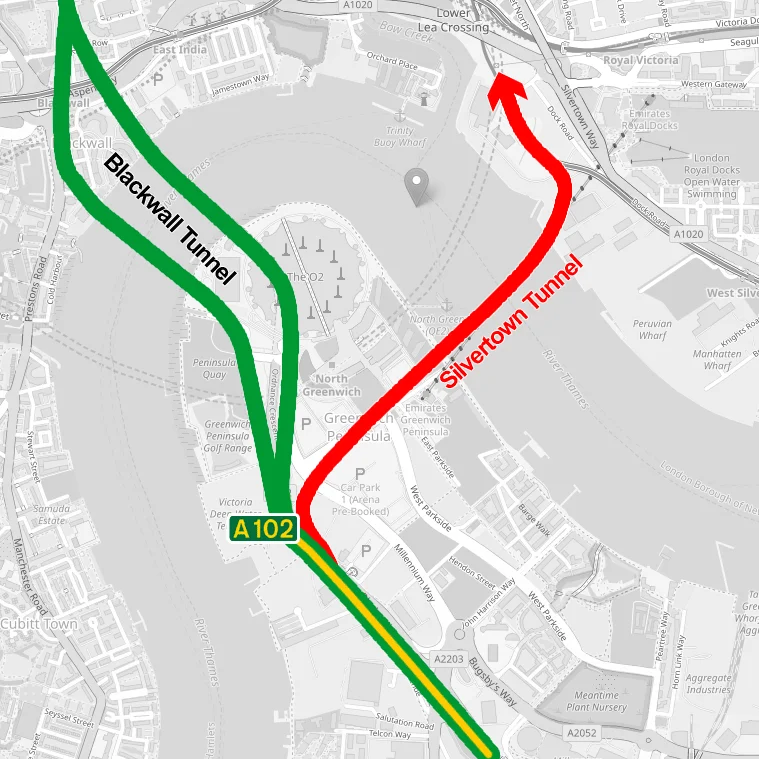

Blackwall Tunnel
The diggers found a human skeleton with a stake driven through its middle, and beside it an elephant's tusk. Neither belonged in east London, certainly not under the Thames mud in the 1890s, but the men kept digging anyway. They were sinking the Blackwall Tunnel by the new Greathead shield method, and the bones and ivory went into a curiosity drawer somewhere while the work pressed on. When the Prince of Wales opened the single bore in 1897, lit by three rows of incandescent street lights and lined with iron rings cast in Glasgow, it became the easternmost permanent crossing of the Thames in London - a place where two-fifths of the city's population finally had something other than ferries and distant bridges to choose from.
A Victorian Wonder, A Victorian Compromise
The tunnel got its odd, snaking course because the engineers had no choice. The bore had to land at Northumberland Wharf on the north bank and Ordnance Wharf on the south, and somewhere along the way it had to dodge a sewer beneath Bedford Street. So the tunnel bent. It still bends. Drivers cresting into the Victorian tube notice the curve immediately, especially the high-sided ones who must keep left to avoid scraping the iron lining. Sir Joseph Bazalgette, who had given London its sewers, was originally supposed to oversee the project for the Metropolitan Board of Works. But the board was abolished in 1889, the London County Council took over, and Bazalgette's involvement ended. To clear the south site in Greenwich, more than 600 people were rehoused. The labour came mostly from outside London - Yorkshire men by the trainload - while the iron lining was manufactured in Scotland and shipped down. The southern gateway, designed by LCC architect Thomas Blashill and known as Southern Tunnel House, still stands as a modest two-storey reminder of a time when public works were also public architecture.
Twin Bores Under the Tide
By the 1930s, with motor traffic multiplying and the East End importing and exporting through the docks, the Victorian bore was strangling. An MP for Dartford complained in 1930 that heavy lorries between Essex and Kent had nowhere downstream to cross. Parliament authorised a second tunnel in 1938 - and then the Second World War came, and the work stopped before it started. The new bore finally opened on 2 August 1967, when Greater London Council leader Desmond Plummer cut the ribbon on a 28-foot-diameter eastern tube. The transport minister had reassured the public that, unlike the Dartford Tunnel then also under construction, no tolls would apply: the route was established, free, and would remain so. The new strip lighting was praised at the time as a great improvement on the Victorian incandescents. The northbound bore became the Victorian original; the new southbound bore took the heavier modern loads. Even with two tunnels, congestion never really left.
A Bomb at 12:40
On 18 January 1979, an anonymous voice phoned the Press Association: the Provisional IRA had planted a bomb in the Blackwall Tunnel, set to go off at midnight. The Metropolitan Police were inside searching when the device detonated at 12:40 a.m. - not in the tunnel itself, as the caller had implied, but in a gas holder near the southern exit. The blast set the gas holder on fire and then ignited a second holder about an hour later. Miraculously, no one was hurt. In the Commons, Home Secretary Merlyn Rees hoped the House would join him in condemning the attack. A Belfast man was convicted in May 1983 and served seventeen and a half years; on his release, he was reported to still profess pride in his participation. The Blackwall Tunnel itself, designed for horse-carts and now hosting a generation of pirate radio listeners and white-van drivers, survived without serious damage.
The Bottleneck That Won't Quit
For decades, the Blackwall Tunnel has been one of London's most reliable sources of misery. A TfL study in 2009 found that the 1.7-kilometre approach to the northbound bore took about nineteen minutes in rush hour - roughly eleven minutes of delay per kilometre. A tidal-flow system that ran from 1978 to 2007 let northbound traffic use a lane of the eastern tube during morning peaks; ending it was controversial enough that an independent committee had to be convened to review the decision. The Victorian bore's height restriction created its own daily drama: over-tall lorries that ignored the warnings sometimes got stuck, sometimes peeled their roofs back like sardine tins. In February 2011 TfL reported the tunnel had closed 1,200 times in the previous year, totalling 157 hours of disruption. They put up an LED noticeboard counting incidents per month - part warning, part shaming.
The End of Free Crossing
On 7 April 2025, after more than 125 years of free passage, the Blackwall Tunnel started charging tolls. The newly opened Silvertown Tunnel just under a mile to the west, the long-debated reinforcement of east London's river crossings, opened on the same day and at the same prices. Charges apply between 6 a.m. and 10 p.m.; overnight remains free. Peak fees hit drivers in the obvious directions at the obvious hours. Almost immediately, the Woolwich Free Ferry two miles east reported around 1,800 extra vehicles a day - a reminder that drivers will reroute for almost nothing if the alternative is to pay. The Victorian tunnel that once carried horses, pedestrians, and the curious passengers of 1897 has become, in 2025, the centre of a quietly furious debate about whether the city should make people pay to cross its own river. The bones the diggers found are long gone. The tunnel continues.
From the Air
Blackwall Tunnel runs beneath the Thames at 51.504°N, 0.003°W, linking Tower Hamlets on the north bank with Greenwich Peninsula on the south. From the air, look for the distinctive ventilation towers at both ends, The O2 dome immediately south of the southern portal, and the parallel Silvertown Tunnel 0.9 mi to the west. Nearest airport is London City (EGLC) approximately 3 nm east. Recommended viewing altitude 1,500-3,000 ft AGL; controlled airspace begins low here, so consult VFR charts and the London City zone before approach.
Nearby Stories
- Stevenage 5.7 km away
- Malling Abbey 5.7 km away
- 1952 Farnborough Airshow Crash 7.7 km away
- Ingatestone Hall 8.2 km away
- Hellfire Caves 9.1 km away
- The Carrington Event: The Solar Storm That Could Happen Again 9.8 km away
- Bletchley Park 16 km away
- Castle Hedingham 23 km away