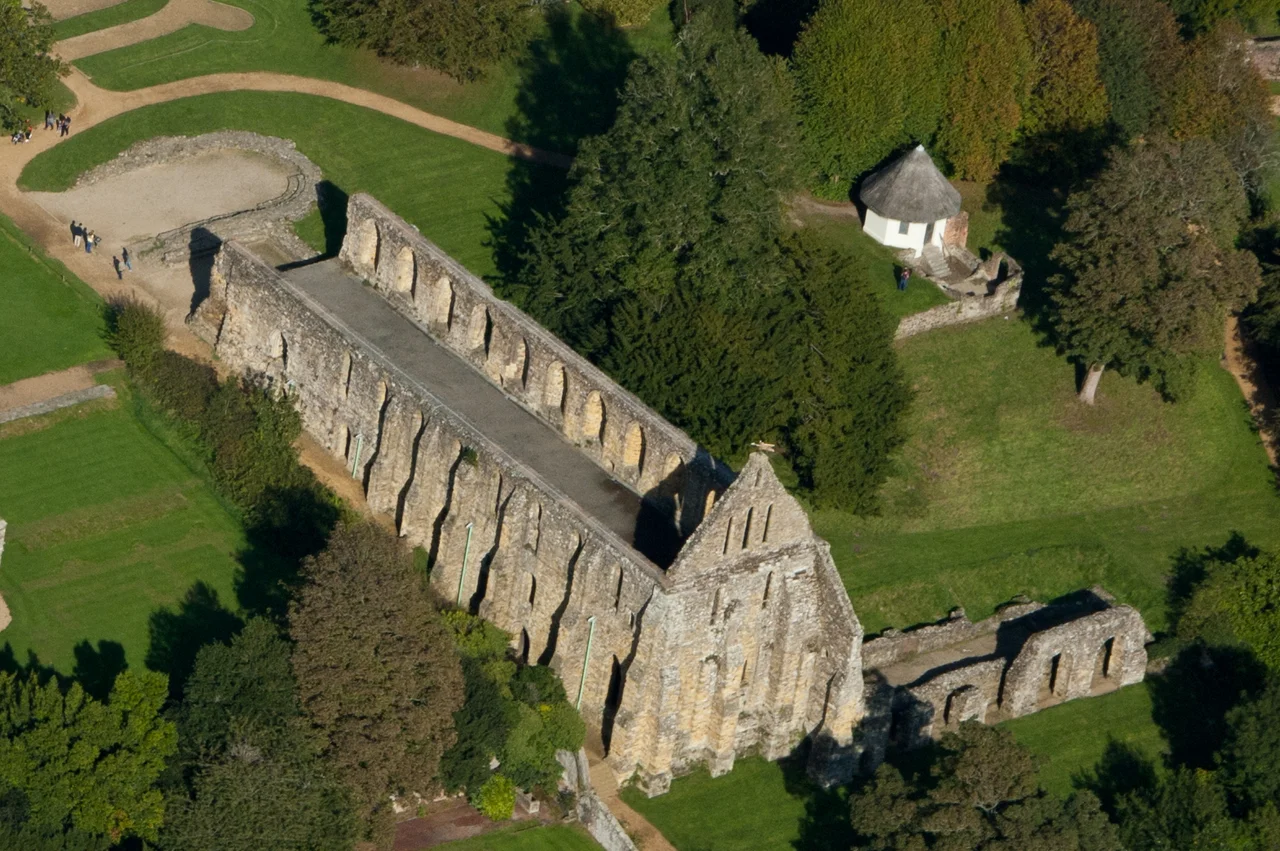

Battle Abbey
In 1070, four years after the Norman Conquest, Pope Alexander II ordered William to do penance. The new king had killed so many men in taking England that the church demanded restitution; William responded by founding an abbey on the battlefield where the killing had been heaviest. The high altar of the church was to stand on the exact spot where King Harold Godwinson had fallen. There is a stone in the grass at Battle Abbey today that marks the place. It is approximate - the original altar foundations have shifted over centuries - but it is close enough. Walk to it and you are walking to where a king of England died on a Saturday afternoon in October.
The Founder's Vow
Before the battle, according to some chroniclers, William vowed that if God granted him victory at Hastings he would build a monastery on the site. The papal command of 1070 gave a more public reason. The abbey was placed under the dedication of the Holy Trinity, St Mary and St Martin of Tours - St Martin being a soldier-turned-monk whose feast fell shortly after the battle. The first monks came from the great Benedictine abbey of Marmoutier in the Loire valley, William's wife Matilda's foundation, a place of intense reformist piety. The church was designed to hold 140 monks, though only sixty ever lived there at one time. William started the work but died in 1087 before it was finished; his son William II Rufus consecrated the completed church in about 1094 and brought his father's sword and coronation robes to lay on the altar.
Privileges of the Battle Abbots
William granted the abbey extraordinary privileges. It was exempted from all episcopal jurisdiction, like Canterbury itself, and its abbot ruled as a mitred lord with a seat in Parliament. The community enjoyed the right of sanctuary, of treasure trove, of free warren, of inquest; its inmates and tenants were exempt from secular as well as church courts. By an old custom the abbot of Battle had the curious right to pardon any criminal he met being led to execution - a power straight out of the chivalric imagination, presumably exercised seldom. Kept inside the abbey was the famous Roll of Battle Abbey, a list of all the Norman knights and lords who had crossed with William in 1066. The list grew over the centuries as later families tried to attach their ancestors to the conquest by quietly adding names; modern historians treat it sceptically, but it remained for centuries the genealogical gold standard for proving a Norman pedigree.
After the Dissolution
Battle Abbey was dissolved like every other English monastic house under Henry VIII. The abbey church was largely destroyed - though parts of the monks' dorter and gatehouse survived - and the abbot's house was converted into a country mansion. The Browne family held it through the Tudor period; in 1721 Anthony Browne, 6th Viscount Montagu, sold the estate to Sir Thomas Webster, MP. The Webster baronets held Battle for more than two centuries with one interruption. In 1857 they sold to Lord Harry Vane, who became Duke of Cleveland; in 1901, on the death of the Duchess, Sir Augustus Webster (7th baronet) bought the estate back. The 8th baronet died without heirs in 1923 and the baronetcy went extinct, though the family trustees kept the property. Canadian troops were stationed in the abbot's house during the Second World War. In 1976 the trustees sold Battle Abbey to the British government, with substantial help from American philanthropists. It is now in the care of English Heritage, opened to the public as "1066 Battle of Hastings, Abbey and Battlefield."
Walking the Battlefield
The slope you walk down today from the abbey gatehouse is the slope down which the Norman cavalry charged. From the visitor centre an audio-guided footpath leads across what was Harold's hill - then called Senlac - and the ground falls away in front of you toward the marshy stream the Normans had to cross. The English shield wall stood at the top, behind them the housecarls of the king's household guard with their two-handed axes. Halfway across the field the path passes through a small valley known still as Malfosse, where local tradition holds that pursuing Normans tumbled down a steep embankment in the closing stages of the rout. Whether any single landmark is historically accurate matters less than the topography itself, which is closely preserved. The fact that something this monumental took place on this gentle Sussex hillside on a single autumn day is one of the strange tricks of English landscape: a green slope, a few sheep, a stone in the grass.
Headless Cross and Other Echoes
Visitors today get a visitor centre with a film, audio tours of the battlefield, a children's discovery room and a café in the converted gatehouse. Reenactors gather here on the anniversary of the battle each October, the field filling with replica chainmail, dragon banners and the sound of horns. Some of the abbey buildings still serve Battle Abbey School, which sits inside the medieval enclosure. And in 1989, in a touch of late-20th-century history that the Norman monks could not have imagined, the abbey church was the principal filming location for the music video of Black Sabbath's "Headless Cross," the title track of the album of the same name. Cucullas in the cloister, electric guitars in the nave: nine and a half centuries after Harold fell, Battle Abbey is still finding new uses for its ruins.
From the Air
Located at 50.92°N, 0.49°E, immediately south of the town of Battle in East Sussex. The abbey ruins and adjoining school buildings form a clearly visible complex south of the town, with the battlefield itself extending south of the ruins down a gentle slope. The town of Battle straight to the north has its own railway station. Nearest airfield is Lydd (EGMD) about 30 km east; Deanland (EGCD) is roughly 20 km west. Best viewed at 1,500-3,000 ft AGL; the battlefield's southern slope reads clearly in low afternoon light, with the Malfosse depression visible just south-east of the field.
Nearby Stories
- Battle of Lewes 1.5 km away
- Staplehurst rail crash 4.1 km away
- Canterbury Castle 14 km away
- The Carrington Event: The Solar Storm That Could Happen Again 15 km away
- Shorncliffe Redoubt 21 km away
- Le Paradis Massacre 113 km away
- Swanage Lifeboat Station 137 km away
- Cléon 150 km away