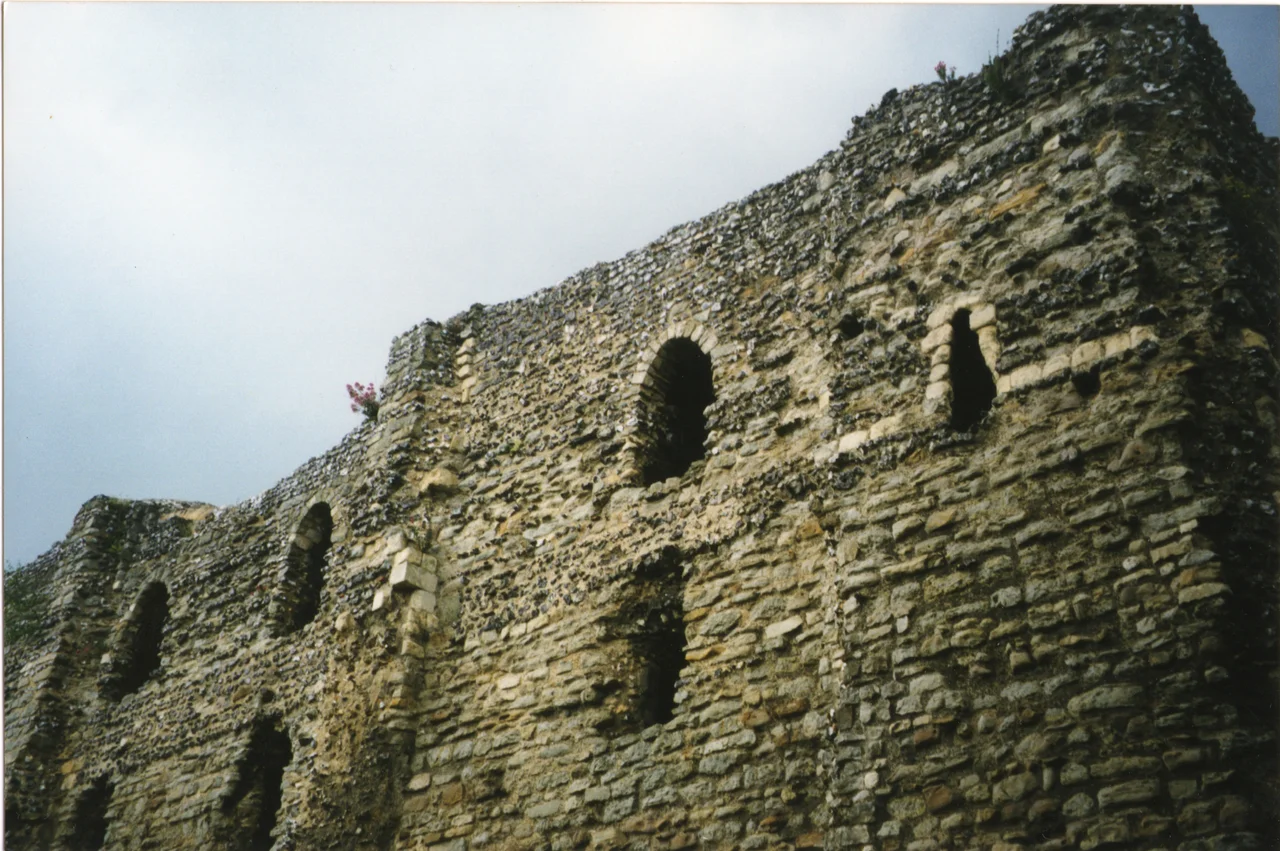

Canterbury Castle
When the Norman conquest finished at Hastings on 14 October 1066, William the Conqueror marched on London. He took the obvious route - the old Roman road from Dover through Canterbury, the same road the Romans had built when they made Britain a province. He needed castles to hold that road. So he built three of them, at Dover, at Canterbury, and at Rochester, the three royal castles of Kent, raised as the conquest was still being consolidated. The Canterbury motte-and-bailey appeared as a wooden structure on a low mound in 1066. The mound may still survive - the rise in Dane John Gardens, near the surviving stone keep, may be that original motte. Or it may be a Roman burial mound. Or both. The name Dane John itself is a corruption of donjon, the Norman word for a castle keep. Eight centuries of language drift have softened the conqueror's word into a Kentish placename.
Stone Walls, Henry I
The great stone keep was largely built in the reign of Henry I, William's youngest son, who ruled from 1100 to 1135. It's a massive structure - about 98 by 85 feet at the base externally, originally probably at least 80 feet tall, built of flint and sandstone rubble. As one of three royal castles in Kent it was a working garrison; by the thirteenth century it had also become the county jail, an awkward dual role that would persist for centuries. In 1216, during the First Barons' War - the civil war that pitted King John against the barons who had forced him to seal Magna Carta - Canterbury Castle was given up to the invading French. Louis VIII of France had been invited into England by the rebellious barons. He held London. He took Canterbury Castle without a major fight. The castle returned to royal control only after John's death and the regrouping of the royalists under his young son Henry III. In 1380 a new gate was added to the castle, the kind of upgrade an ageing fortification needed as warfare changed.
The Governors and the Jail
From the early thirteenth century onward, Canterbury Castle was administered by a series of royal governors who were also responsible for the other Kentish castles. Hubert de Burgh, 1st Earl of Kent - the great justiciar who served three kings and was perhaps the most powerful man in England in the 1220s - governed Canterbury, Dover, and Rochester simultaneously between 1216 and 1232. Stephen de Segrave followed. Then Nicholas de Moels, Robert Walerand, and William de Eschetesford. From the late thirteenth century the castle's primary function had effectively become its jail role. Prisoners were held in the keep. The castle as military fortification mattered less and less as the kingdom stabilised and the threat from France was reorganised into ports and seacoast defences rather than inland fortifications guarding the road from Dover. In 1625, at the end of the reign of King James VI and I, the castle passed out of royal hands into private ownership.
Gas Storage and Slow Decline
By the nineteenth century, Canterbury Castle was an industrial site. A gas company acquired the keep and used it for many years as a storage centre for the gas that lit the streets and houses of Victorian Canterbury. The top floor was destroyed during this period - whether by deliberate alteration to fit the gas tanks, by neglect, or by some accident that has not made it into the histories, is unclear. What had been Henry I's royal fortification became an industrial relic. In 1928, the local authority took ownership. The castle was opened as a public attraction. For decades visitors could walk up to it, climb among its battered walls, look up into the open sky where the upper floors had once been. Then in 2018, the castle was closed because of falling masonry. The chalk and flint construction, originally meant to last centuries, had been weakened by eight hundred years of weather, by Victorian industrial misuse, by patchy upkeep. Stones were coming loose. Visitors could no longer be allowed in safely.
Bats and Levelling Up
In 2023, Canterbury Council was successful in securing £19.9 million from the UK government's Levelling Up Fund - a regeneration programme aimed at investing in heritage and cultural sites - for the restoration of historic buildings including the Castle. Work on the actual restoration was delayed when a colony of bats was discovered roosting in the keep. Bats are protected under British wildlife law, and any conservation work has to be done outside breeding and hibernation periods, with mitigation for the bats' continued habitat. The bats are an unexpected legacy: an eight-hundred-year-old stone shell so neglected that the wildlife moved in. Work was scheduled to begin in 2025 and run for one year. By the time it finishes - if the timeline holds and the bats permit it - one of William the Conqueror's three Kentish castles will have been pulled back from the brink, the gas-company damage stabilised, the medieval stones secured. The motte in Dane John Gardens, possibly Roman, possibly Norman, possibly both, will still be there. The donjon will still be a donjon, even if Kent has long since softened its name into Dane John.
From the Air
Canterbury Castle sits at 51.276°N, 1.075°E in central Canterbury, Kent, just inside the line of the medieval city wall and a five-minute walk from Canterbury East station. From the air, look for the ruined stone keep with Dane John Gardens immediately to the south, where the possible Norman motte (or Roman burial mound) rises. Canterbury Cathedral - where Thomas Becket was murdered in 1170 - lies 600 metres northeast. The castle is currently closed to the public because of falling masonry and bat conservation. Nearest airport is Manston (EGMH) about 20 km east; London Ashford (Lydd) (EGMD) is 30 km southwest. Best viewed at low altitude when the medieval street layout of central Canterbury is clearly visible.
Nearby Stories
- Ringlestone Inn 3.4 km away
- Cliffs Pavilion 3.5 km away
- Citadel of Calais 6.5 km away
- 2021 English Channel Disaster 11 km away
- Stag Inn, Hastings 15 km away
- Dungeness Lighthouse 19 km away
- Clacton Pier 32 km away
- Four Days' Battle 54 km away