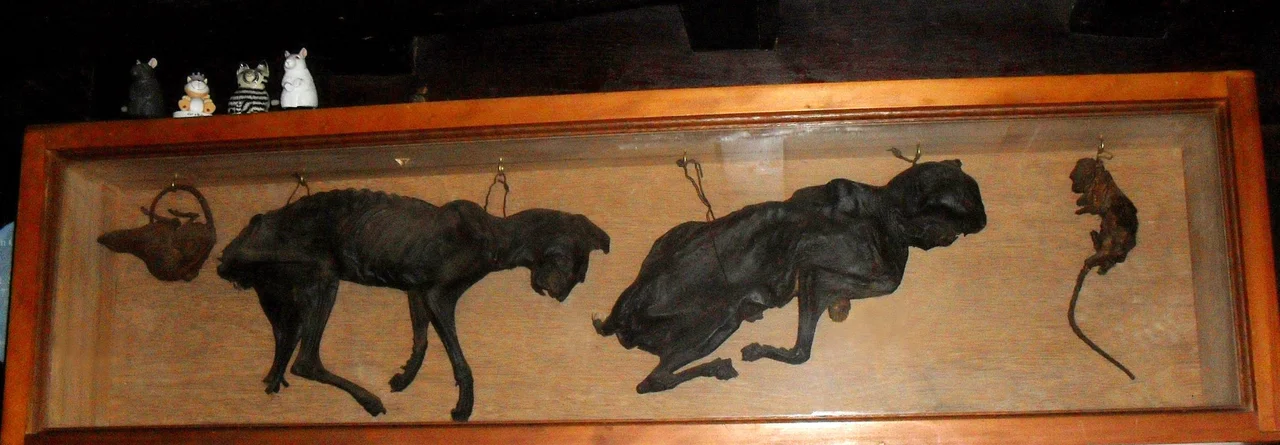

Stag Inn, Hastings
Two mummified cats have been pinned to a wall of the Stag Inn since the 19th century, blackened by centuries of fireplace smoke and still on display to anyone who orders a pint. Local guides have suggested witchcraft as an explanation for the grisly find; the more prosaic likelihood is that they were placed into a wall cavity deliberately, an old English builder's charm against vermin and bad luck. Whatever the reason, the cats fit the building. The Stag claims to be Hastings's oldest surviving pub, sits on a raised pavement above the narrow valley road of All Saints Street, and conceals an Elizabethan timber frame inside a mid-Georgian plaster face.
The Valley Town
Hastings's first documented reference dates from 928, when it was already significant enough to be named. Two streams once ran down through the valley between the East and West Hills to meet the Channel, and the town had nowhere to grow but inward along the valley floor. Two parallel streets, High Street and All Saints Street, became the spine of the Old Town. The oldest surviving buildings on All Saints Street are 15th-century, and there are more than 90 listed buildings along its length. The Stag, near the north end of the street and close to All Saints Church, was built in the Elizabethan era - a timber-framed building on what was already an ancient lane.
Smugglers and Three Ancient Inns
The *Victoria County History of Sussex* records that only three ancient inns existed in Hastings in 1657. The Stag was one of them. For centuries Hastings was a centre of Channel smuggling, and the inn was reportedly used by smugglers in its early years - a logical bolthole for men running brandy and tobacco between French luggers and the steep alleys behind the beach. The town's geography made it ideal: cliff-top lookouts, hidden coves, a tangle of narrow streets pressed up against the seafront, and a network of cellars under the Old Town houses where contraband could disappear quickly when revenue officers appeared.
A New Face on an Old Frame
In the mid-18th century the Stag was given the kind of facelift many Tudor buildings received in the Georgian era. The original upper storey jettied - hung out over the street - and the lower storey was built out to bring the elevation flush. New gables and a parapet were added to the roof, and the front was plastered. The result reads as Neo-Georgian, with a five-window range, sash windows, moulded sills and panelled twin doors reached by stone steps with iron handrails. Inside, the original Elizabethan oak frame remains, exposed beams carved with decorative mouldings and the brackets that once carried the jettied upper storey still visible to anyone who looks up from their drink.
The Cats on the Wall
Two smoke-blackened mummified cats were found during 19th-century works on the building and mounted on display. Such finds are not unique to the Stag - dried cats have been pulled out of walls and roof spaces across England and northern Europe - and the explanation usually given today is folk magic. Builders sealed cats into wall voids as protective charms, sometimes positioned as if mid-pounce on a rat or mouse, intended to ward off vermin and evil from the household. The Stag's cats may well have been original to the Elizabethan construction, preserved by smoke from generations of cooking and tobacco. The label calling them a 'grisly sight' is fair; the suggestion of witchcraft is later embellishment.
Still Pulling Pints
The Stag was listed Grade II by English Heritage on 19 January 1951, one of more than 500 Grade II buildings now protected in the borough of Hastings. It is operated as a tied house by the Shepherd Neame Brewery of Faversham, England's oldest brewer. The main bar sits at the front of the building, with a function room and beer garden behind. A long-running folk night and occasional bluegrass sessions keep live music in rotation. A hipped-roofed timber-framed wing extends to the rear, brick-walled, mostly hidden from the street. From All Saints Street, what visitors see is a small pub on a raised pavement - and, if they go inside and look up, the bones of an Elizabethan building still carrying the same trade after nearly five centuries.
From the Air
The Stag Inn sits at approximately 50.86 degrees north, 0.60 degrees east, on All Saints Street in the Old Town of Hastings, East Sussex. The Old Town occupies a steep narrow valley between the East Hill and the West Hill, on the south coast of England. From altitude, the Stag is too small to identify directly, but the dense red-roofed cluster of the Old Town stands out clearly between the two grass-topped headlands. Lydd Airport (EGMD) is about 18 miles east; London Gatwick (EGKK) is about 50 miles northwest.
Nearby Stories
- Battle of Lewes 1.5 km away
- Staplehurst rail crash 4.1 km away
- Canterbury Castle 14 km away
- The Carrington Event: The Solar Storm That Could Happen Again 15 km away
- Shorncliffe Redoubt 21 km away
- Le Paradis Massacre 113 km away
- Swanage Lifeboat Station 137 km away
- Cléon 150 km away