.jpg)
Sywell Aviation Museum
The Sywell Aviation Museum lives in five wartime Nissen huts set in a row beside the aerodrome's spotters' car park, their curved tin roofs the same ones that sheltered RAF and USAAF airmen across England in the 1940s. Three of the huts came down from RAF Bentwaters, which was a USAAF airfield in Suffolk; the other two were dismantled from a former POW camp at Snape Farm in Derbyshire and trucked here. They were re-erected by volunteers, kitted out with display cases and uniformed mannequins, and opened to the public in May 2001 by Alex Henshaw, the test pilot who had flown Wellingtons off this very field during the war. Entry has been free since the first day. Donations are encouraged. Visitors come for the Hawker Hunter outside the door and leave talking about a concrete dummy of a nuclear bomb in the back room.
What sits outside the door
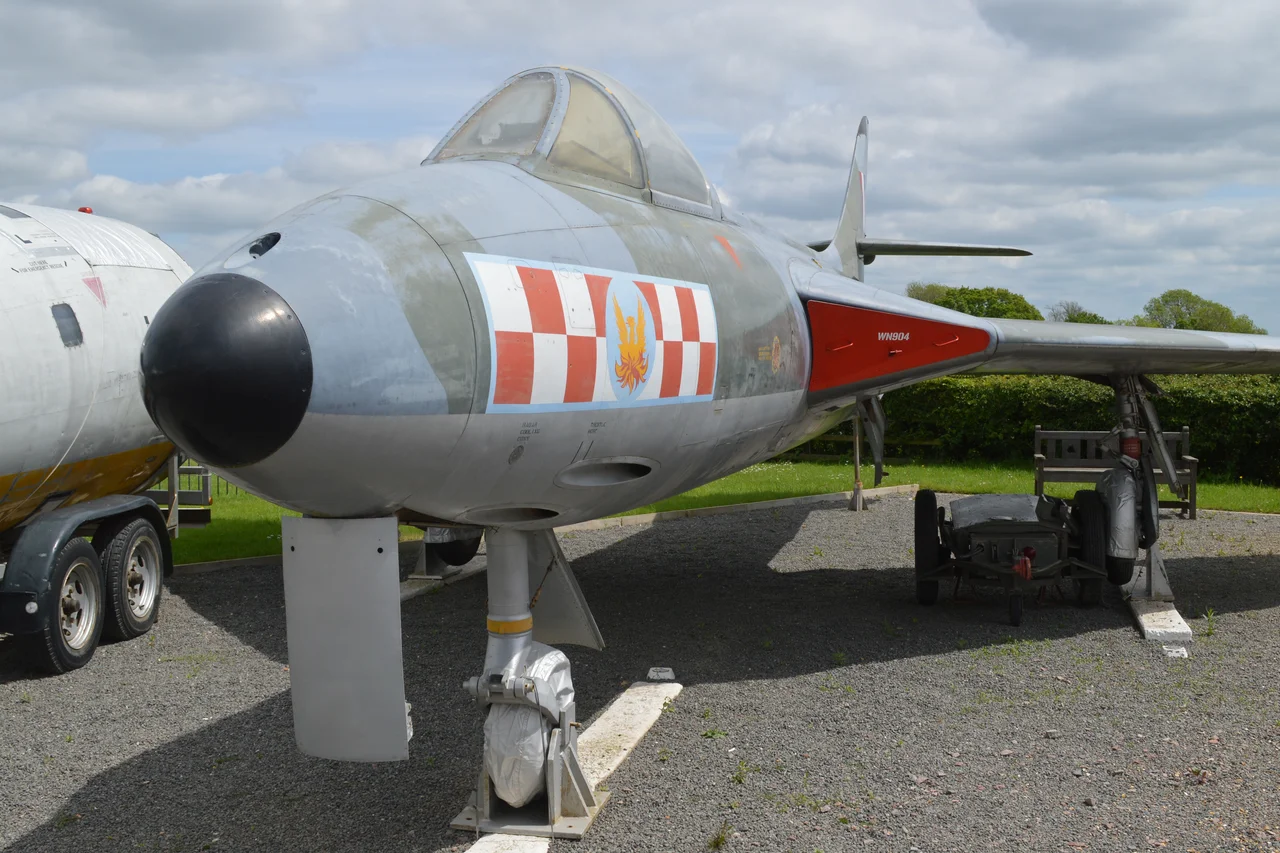
Pull up to the museum and the first thing you see is Hawker Hunter F.2 WN904, nicknamed Heidi, parked on a concrete plinth with its nose pointed at the runway. This is the only complete F.2 mark of the Hunter still in existence. The Hunter was the RAF's mainline fighter through the 1950s and 1960s and went on to serve seventeen other air forces; this particular variant, the F.2, was powered by an Armstrong Siddeley Sapphire engine rather than the more common Rolls-Royce Avon. Beside Heidi sits the museum's second complete airframe: Handley Page Jetstream 200 G-RAVL, restoration nickname Jenny. This is the same machine that won the Daily Express National Air Race from Sywell to Biggin Hill on 12 June 1971, watched on BBC television; it returned home in March 2021 from Cranfield to be restored as a classroom. In September 2024 the project won a National Transport Trust Restoration Award.
Inside the first hut
The Paul Morgan Hall, named for a local benefactor, takes visitors through the history of Sywell itself: the aerodrome's opening in 1928, the wartime training and Wellington repair work, the Lancaster assembly line that operated here from 1942 to 1943, the Jetstream years. Children climb into a de Havilland Vampire T.11 cockpit (XD599, nickname Vicky) and pretend to fly a 1950s jet trainer. There is a wartime Link Trainer, the wooden ground simulator on a pneumatic base that taught generations of new pilots their instrument scan. Photographs of the men who trained here line the walls. The Vampire, the Link, the photographs together do something specific: they remind you that for most of the people whose names are here, this airfield was the first real place they ever flew an aeroplane.
The RAF Hall and the Home Front
Step through into the RAF Hall and the focus shifts from the cockpits to the cooking pots. There is a complete RAF bomb train, the kind of low trolley that ground crews used to roll high explosive out to waiting Lancasters. There is a wartime kitchen rebuilt with the period stove, the period ration tins, the period kettle. An Anderson shelter sits in one corner, a small corrugated iron tunnel that millions of British families dug into their gardens against the chance of a German bomb. The Home Guard display has uniforms, helmets, armbands, and the small-scale weaponry the volunteer force was actually given. It is easy to laugh at the Home Guard from a 21st-century distance. It is harder once you stand in a shelter your grandparents would have crouched in while sirens sounded.
The Main Hall and the American Hall
The Main Hall holds aviation archaeology: pieces of Vickers Wellingtons and B-17 Flying Fortresses pulled out of Northamptonshire fields where they came down. There is a section on the Zeppelin raids over the county in the First World War, and a display about local ace Major Mick Mannock, the half-blind boy from Cork who became one of the most decorated British pilots of the Great War before being shot down and killed in 1918. Children can climb into a de Havilland Chipmunk cockpit and a Rapide cockpit. The American Hall concentrates on three USAAF units that flew out of Northamptonshire airfields: the 315th Troop Carrier Group at Spanhoe, the 20th Fighter Group at Kings Cliffe, and the 305th Bomb Group at Chelveston. A Packard-built Merlin engine, recovered from a 20th FG P-51 Mustang, sits on display. The operations boards from the 20th Fighter Group are originals, scratched and chalked over with mission numbers and tail letters by ground crew who could not have imagined them in a museum.
The POW and Cold War room
The last hut covers two themes a generation apart. One side deals with the 1942 Wellingborough Blitz, when German bombs killed civilians in the nearby town, and with the experience of RAF aircrew who became prisoners of war, including the escape and evasion materials sent into camps inside playing cards, gramophone records, and Monopoly sets. The other side is the Cold War: the Thor intermediate-range ballistic missiles based in Northamptonshire from 1959 to 1963 as part of the British nuclear deterrent. A concrete mockup of Britain's Blue Danube atomic bomb stands beside an Armstrong Siddeley Sapphire jet engine, the same powerplant that drove the Hunter outside. The juxtaposition is deliberate. The museum's volunteers have laid out two world wars and the long shadow they cast in five sheds at a small grass airfield, and they have done it with a clarity that bigger institutions would do well to study.
From the Air
Coordinates 52.302°N, 0.787°W, on the eastern edge of Sywell Aerodrome (EGBK) in the aircraft spotters' viewing area. Recommended viewing altitude for the aerodrome 1,500-2,500 ft AGL given proximity to the active circuit. Visual landmarks: the parked Hawker Hunter and Jetstream airframes outside the row of Nissen huts, the aerodrome runway complex to the west, the village of Sywell to the southwest. Cranfield (EGTC) lies 14 nm south for IFR diversion.
Nearby Stories
- Battle of Bosworth Field 3.6 km away
- Murder of Ross Parker 7.2 km away
- Royal Leamington Spa 8.8 km away
- Buckingham 9 km away
- St Neots 9.4 km away
- Letchworth 10 km away
- Uppingham School 11 km away
- Sudeley Castle 39 km away