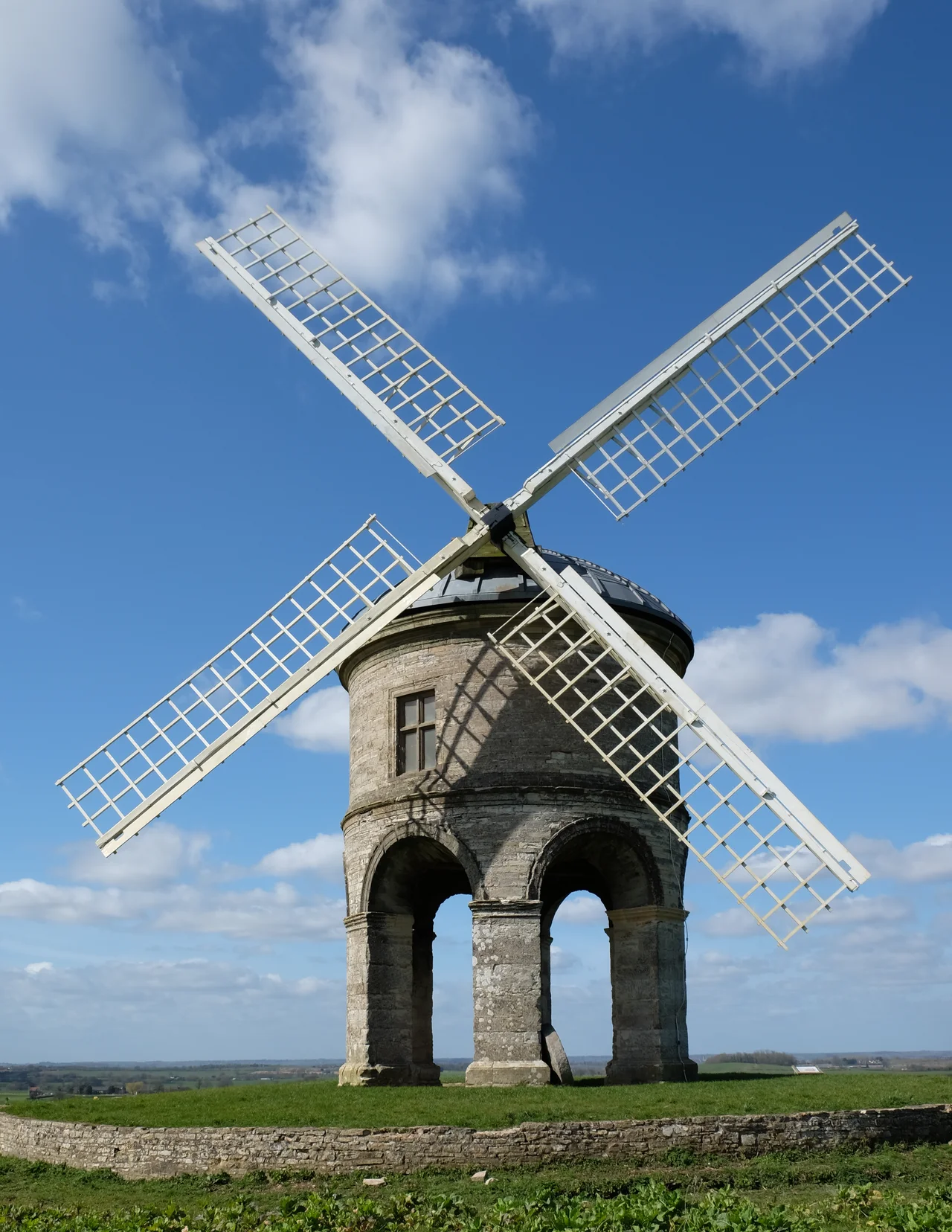

Chesterton Windmill
Look up at the silhouette of Chesterton Windmill on its Warwickshire hilltop, and the obvious question is: what is this doing in England? The cylindrical limestone tower stands on six semicircular arches like a Renaissance baldachin, the sails projecting from a shallow dome that might have been borrowed from Bramante. It looks like something Andrea Palladio sketched in a Venetian notebook and forgot to take home. The plaque set high on the tower reads simply 'E.P. 1632' -- the initials of Sir Edward Peyto of Chesterton Manor, who built the structure roughly thirty years after Shakespeare's death, in collaboration with John Stone, a pupil of Inigo Jones. The result is one of the strangest and most beautiful working windmills in the world.
Built by a Mathematician
Sir Edward Peyto, Lord of Chesterton Manor, was not a typical landowner. He was a mathematician and an astrologer -- two professions then considered closely related -- and he probably acted as his own architect for the windmill. Local legend long maintained that the structure was originally built as an observatory, with the mill machinery added later. The story is appealing but wrong: the estate accounts now preserved at the Warwickshire County Record Office show that Chesterton Windmill has always been a working windmill, from its 1632-33 construction onward. What gives the legend such persistence is the building itself. The classical arcade, the deliberate proportions, the careful sandstone string course running below the windows -- none of this is what one expects from a piece of agricultural infrastructure. Peyto was building a working machine. He was also building a statement.
Inigo Jones at One Remove
The architectural pedigree is impressive. When the windmill was begun, John Stone -- son of the master mason Nicholas Stone and a former pupil of Inigo Jones, the architect who introduced Italian classicism to England -- was already in Chesterton designing the new Manor House for Peyto. Stone almost certainly helped with the mill as well. The arcade of six semicircular arches, the proportions, the way the classical detail dissolves into a functional cylindrical tower -- all of it carries the unmistakable Inigo Jones lineage. Yet the result is unique. There is no other windmill anywhere in the world that looks remotely like this. It is, in effect, an Italian Renaissance pavilion that happens to grind wheat.
How the Mill Worked
The engineering inside is as careful as the architecture outside. The tower is twenty-two feet across, on a seventy-one-foot platform of hard local limestone, with sandstone detailing. Inside there are two working floors above the arched ground level. The stone floor holds the millstones, the great spur wheel, the hurst frame supporting the gearing, and the trap for the sack hoist. The upper floor carries the brake wheel, the main wallower gear, and the sack hoist pulley. The windshaft itself sits inside the shallow cap dome, with the wind direction indicator on the roof transmitting position to a small repeater inside, so the miller could orient the sails without leaving his work. The cap rotates on a system of roller bearings -- a refinement most contemporary windmills lacked. The sails are lattice type, sixty feet across, rotating counter-clockwise when seen from outside, which is the opposite direction from almost every other windmill on Earth. The whole machine still works. It has been the earliest tower mill in England to retain any of its working parts.
Abandoned, Restored, Restored Again
By 1910 the winding gear had failed. William Haynes, the last miller, could no longer turn the cap to face the sails into the wind. He gave up Chesterton Windmill and moved a mile east to the tower mill at Harbury. The mill stood idle for decades. Occasional repairs in the 1930s allowed brief milling during favourable conditions, but the structure decayed steadily. In the early 1950s one sail broke off. In 1969 Warwickshire County Council took control and began a major reconstruction. By 1971 the mill was working again, and was opened to the public on a handful of days each summer, staffed by volunteers from nearby villages. In 1975 the restoration won a Civic Trust Heritage Award. In 2006, during an open day, a sail unexpectedly fell off, injuring a visitor. The sails were removed for strengthening and replaced in late 2007.
The Newport Connection
Across the Atlantic, in Newport, Rhode Island, sits an enigmatic stone tower that looks remarkably like Chesterton Windmill. It has eight round pillars instead of six arches, but the family resemblance is striking. For most of the past three centuries, the Newport Tower has attracted theories ranging from sober to spectacular: that it was built by Vikings, by Portuguese explorers, by medieval Templars, by Chinese sailors. The most prosaic explanation -- now the accepted one -- is that Benedict Arnold (the seventeenth-century colonial governor, not the later traitor) built it around 1676 as a windmill, after his previous wooden mill blew down in 1675. The Arnold family came from either Leamington Spa or Ilchester in Somerset before emigrating to Rhode Island in 1635. Either origin places them within a generation of having seen the new Chesterton Windmill. Arnold's will refers to the structure as his mill. Documentary, archaeological, and architectural evidence now all point to Chesterton as the source. A working Warwickshire windmill became, by transatlantic improvisation, one of America's most argued-over monuments.
From the Air
Located at 52.2313N, 1.49092W on a hilltop near Chesterton village in south-east Warwickshire, roughly five miles south-east of Warwick on a ridge near the line of the Roman Fosse Way. The windmill stands clear of other buildings on open ground and is one of the most distinctive aerial landmarks in the county -- a small cylindrical stone tower on six arches with lattice sails. Nearest airports: EGBE (Coventry, 8nm N), EGBB (Birmingham, 20nm NW). Best viewed at 1,500-2,500 ft AGL.
Nearby Stories
- Stowe House 2.5 km away
- Wolverhampton 3 km away
- Althorp 3.9 km away
- Droitwich Spa 4.3 km away
- Tewkesbury 5.4 km away
- Tamworth Castle 11 km away
- Uppingham School 23 km away
- Woodstock Palace 26 km away