
EastEnders
Thirty million people watched the Christmas Day episode in 1986. That is, very nearly, half the population of the United Kingdom at the time. They were watching Den Watts, the landlord of the Queen Victoria pub in fictional Albert Square, hand divorce papers to his wife Angie - a scene that has been replayed at every retrospective for the last forty years and remains the single most-watched episode of any drama in British television history. EastEnders launched on the BBC on 19 February 1985, the brainchild of producer Julia Smith and script editor Tony Holland, and it was supposed to be the BBC's answer to Coronation Street. Within eight months it was the most popular show in Britain. Forty years later it is still on, broadcasting four nights a week from a permanent outdoor set in Hertfordshire that has been demolished and rebuilt around the same fictional square.
The Square that Never Was
Albert Square does not exist. It was invented by Smith and Holland, who wanted a fictional Victorian terrace in a fictional borough they called Walford - a portmanteau of Walthamstow and Stratford. The design of the square itself was modelled on Fassett Square in Dalston, a real London E8 square that visitors still occasionally drift past looking for the Queen Vic. The Queen Vic itself was modelled on the College Park Hotel pub in Willesden, a few miles west. The railway bridge that crosses the corner of the square was modelled on one near BBC Television Centre that carries the Hammersmith and City line over Wood Lane. The postcode E8 was at one point a working title for the show. Walford East, the fictional Underground station, was supposed to be on the District Line. None of these places quite line up with real London geography, but the show has been broadcast at this fictional address every week since 1985, and after four decades it almost feels real.
Filmed in a Field
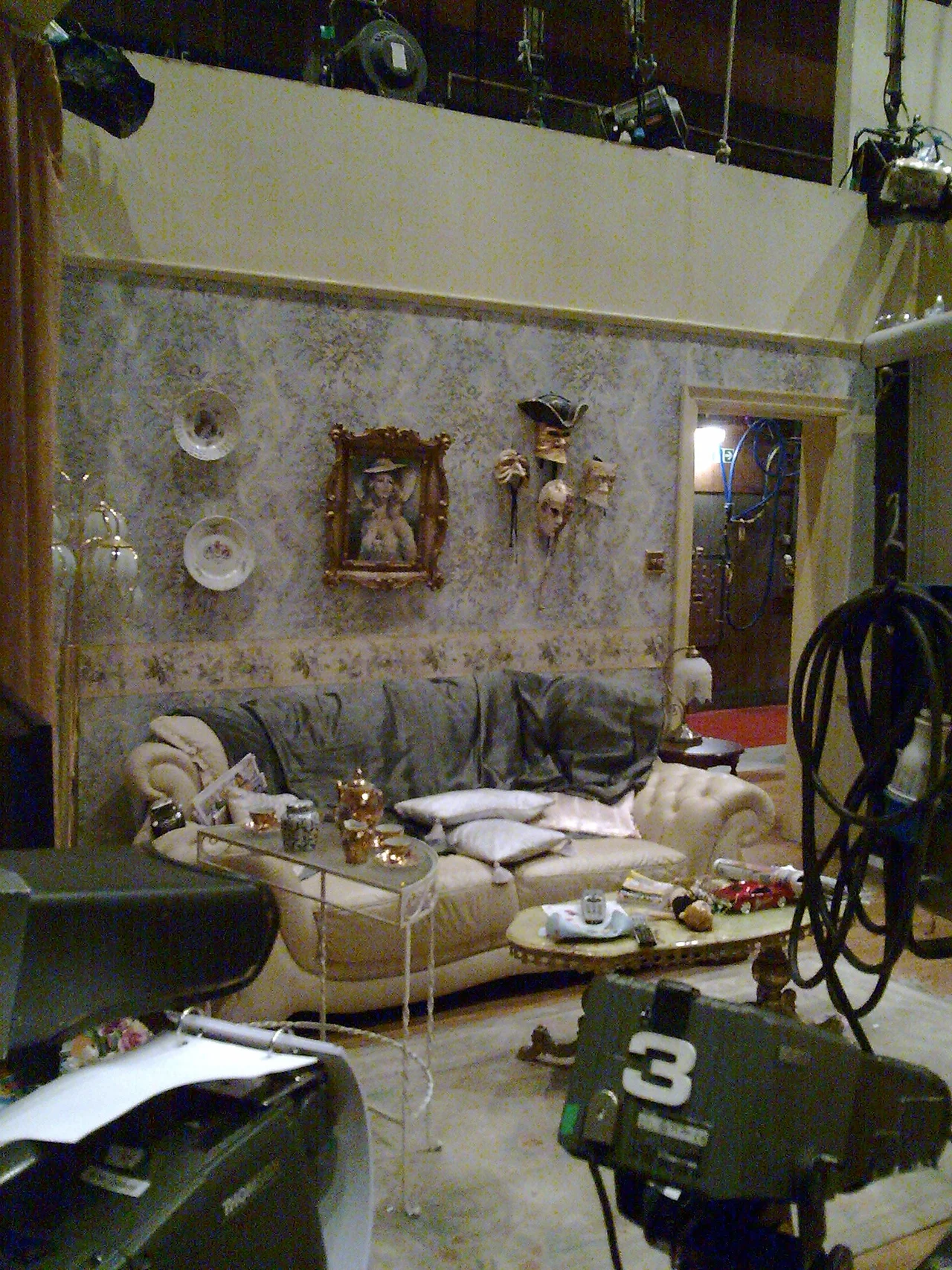
The actual set has been built and rebuilt on an open lot at the BBC Elstree Centre in Borehamwood, Hertfordshire - twelve miles north-west of the East End it depicts. The location was chosen because the BBC already owned the studio complex, and because filming a soap opera continuously requires a controllable outdoor space where you can rebuild a Victorian terrace and weather it convincingly. The original 1985 set, made mostly of plywood faced with painted brick, lasted for thirty-seven years. By the 2010s it was structurally tired and looked it on high-definition television. In January 2022 the production began filming on a brand-new set built nearby, with proper foundations and bricks that should last another generation. The old set was demolished in November 2022. Filming continued throughout the construction, with episodes carefully shot to avoid both sets being visible at the same time.
The Families
Tony Holland was from a large East End family, and he wanted his soap built around the idea of strong, complicated, brawling families. The Beales and the Fowlers were there from the very first episode in 1985. The Watts - Den and Angie and their adopted daughter Sharon - dominated the 1980s. The Mitchells - Phil, Grant, and the formidable Peggy - became central in the 1990s. The Slaters arrived in 2000 and changed the tone. The Brannings, Masoods, Moons, Carters and Taylors have all had their decade-defining storylines since. The show became famous for tackling subjects that British soaps had previously avoided - AIDS, mental illness, sexual assault, racism, addiction, child abuse - and equally famous for letting things go badly wrong with high theatrical flair. Phil Mitchell was shot in 2001 in the Who Shot Phil storyline that gripped the country for a month; the answer turned out to be his sister-in-law Lisa, and 22 million people watched the reveal.
Drumroll, Drumroll
The theme tune is one of the most recognisable in British television - a brassy, slightly minor-key, four-note hook composed by Simon May, followed by a swirling aerial shot of the Thames that pans across the East End of London at a thousand feet. The original title sequence was assembled by Alan Jeapes from approximately eight hundred photographs taken from a light aircraft over the actual East End in 1984. The image was redone in 1993 and again in 1999 and again in 2010, each time keeping the same essential shape - the bend of the Thames, the Isle of Dogs, the impossibly compressed map of London E1 to E14. The doof-doof-doof-doof drumbeat at the end of each cliffhanger has become a national in-joke. EastEnders runs on it - one cliffhanger every twenty-eight minutes, four nights a week, fifty weeks a year, for forty years and counting.
Why It Persists
British soaps in 2026 are not what they were in 1986. Audiences have fragmented, streaming has cannibalised appointment television, viewing figures have collapsed across the board. EastEnders no longer pulls thirty million; it pulls, on a good night, around three. But it is still one of the most-watched scripted shows in the country, it still anchors BBC One's evening schedule, and it still has the strange capacity, four decades in, to produce moments of genuine drama that send the next day's tabloids into a spin. The show employs hundreds of people, pays dozens of regular actors enough to live on, and has launched the careers of a strikingly large number of British actors who eventually crossed over into Hollywood. It is filmed, still, in a Hertfordshire field, twelve miles from the streets it pretends to be. The Queen Vic is repainted every year. The drumbeat plays. The next storyline begins.
From the Air
EastEnders is filmed at the BBC Elstree Centre in Borehamwood, Hertfordshire, at 51.66 degrees N, 0.28 degrees W - about 12 nautical miles north-west of the East End of London the show depicts. From the air the BBC Elstree complex is a recognisable cluster of large studio sheds with a permanent outdoor lot to the south. Nearest airports: EGSS (Stansted) about 22 nautical miles east, EGGW (Luton) about 11 nautical miles north, EGLL (Heathrow) about 14 nautical miles south. The site is near the busy Heathrow approach paths and is best viewed at 3,000-5,000 feet in clear weather. The real East End of London, which the show is set in, lies further south-east along the Thames.
Nearby Stories
- Stevenage 5.7 km away
- Malling Abbey 5.7 km away
- 1952 Farnborough Airshow Crash 7.7 km away
- Ingatestone Hall 8.2 km away
- Hellfire Caves 9.1 km away
- The Carrington Event: The Solar Storm That Could Happen Again 9.8 km away
- Bletchley Park 16 km away
- Castle Hedingham 23 km away