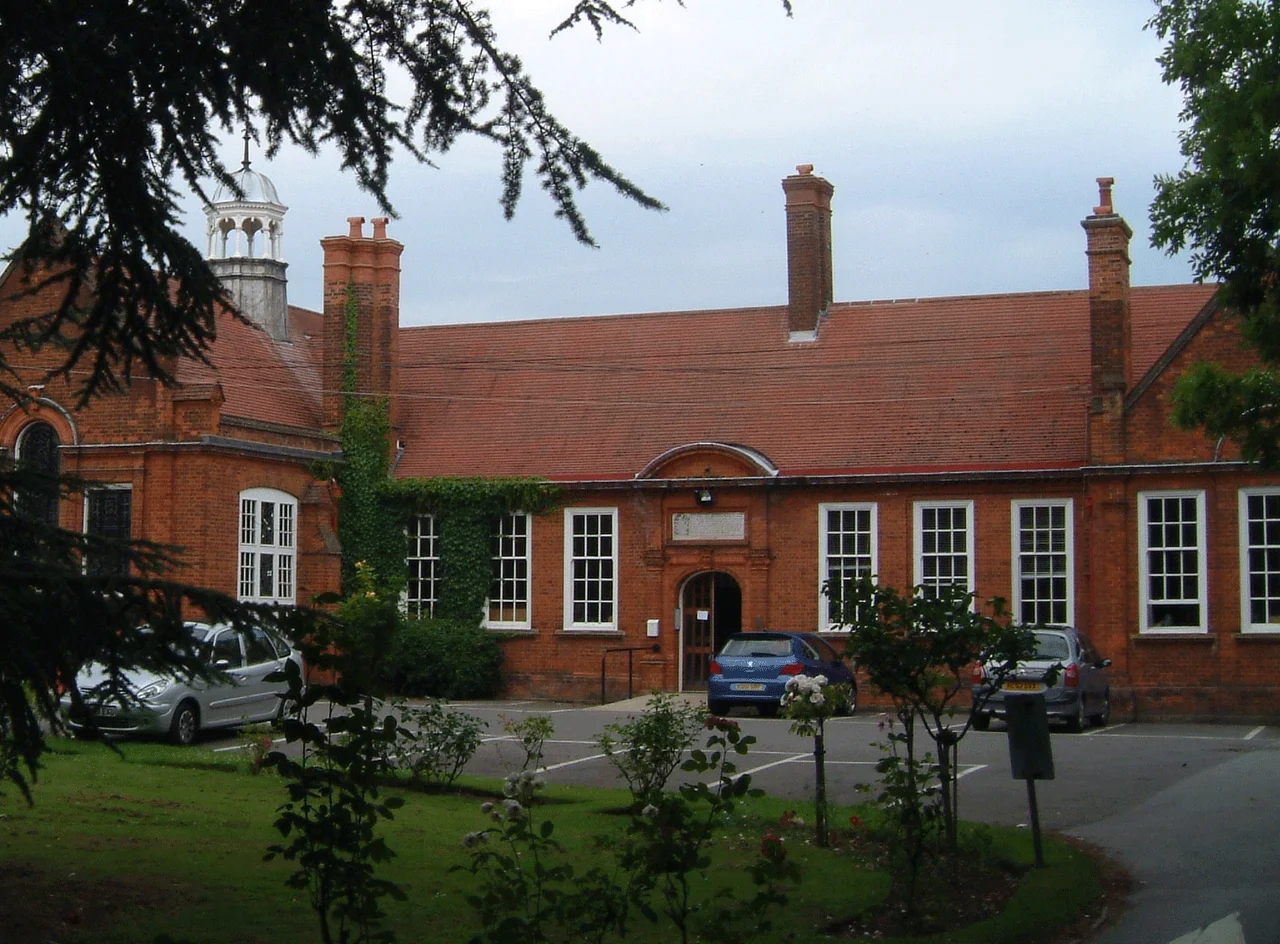

Hitchin Boys' School
John Mattocke had no children of his own when he founded a school in Hitchin in 1632, on a piece of land at the edge of the medieval market town. He provided for the wages of a master and the education of boys whose families could not afford private tutors. The Old Free School opened on 25 July of that year. Charles I had ten years left on the throne. Within a generation, the boys of Hitchin would interrupt their Latin lessons to watch Oliver Cromwell ride through town on his way to wherever the New Model Army was needed next. Nearly four hundred years later, the school still teaches roughly 1,500 boys, and the present site is mostly built on land that once belonged to John Mattocke.
The Free and Easy School
Thomas Heyndy was the first headmaster. His successor William Patricke, who took over in 1664, was famous for relaxing the rules. He let the boys read English texts instead of grinding through original Latin, allowed simpler Latin grammars, and called the place the "Free and Easy School," a phrase that the trustees were not entirely sure about. After Patricke's death in 1691 the headmastership descended into farce. Sir Ralph Radcliffe of nearby Hitchin Priory hired Thomas Cheyney, who restored discipline; then Cheyney's successor Thomas Harris died in 1709 and Radcliffe and another trustee appointed a new master named James Lawrence without consulting the rest of the board. The other trustees summoned the Reverend Richard Finch from London. When Lawrence and his backers arrived to find Finch already installed in the master's chair, the matter went to a Chancery suit. The defence lost. The school was insolvent for years afterwards.
Niblock and Discipline
The Reverend Joseph Niblock arrived as headmaster in 1819. He stayed at Hitchin for only eleven of his twenty-five years in teaching, but those eleven years are legendary in the school's records. Niblock was, by reputation, one of the best Greek scholars in England; he wrote a Greek grammar book that became standard at Eton. He was also a man of extreme discipline. School days began at nine in the morning and on Thursday and Saturday ran until three in the afternoon, with public prayers at St Mary's on Wednesdays and Fridays. Boys were ranked in four conduct classes. Reports went regularly to the trustees. When something serious happened, the headmaster's study became a courtroom, witnesses were called to swear evidence, and verdicts of "affrontery" or worse could end a boy's schooling for good. In 1835 a new board of trustees decided that any incoming headmaster had to pay £500 into a bond as insurance against discharge or death. Niblock could not afford it. He resigned and died seven years later.
The Rebirth of 1889
By 1872 the Old Free School was failing. The vicar of Hitchin found only four boys studying Latin at the school's twice-yearly examinations. The last Free School headmaster, John Sugars, had a mental breakdown in 1876 and the trustees closed the doors. Twelve years later, the Hitchin reformer Frederic Seebohm, a Quaker banker and amateur historian, drew up a scheme for two new schools in the town: a girls' school and a boys' school, both fee-paying, both modelled on the new ideas of secondary education emerging from late Victorian England. The new Hitchin Boys' School opened on the Woodlands estate in Bancroft on 1 May 1889. The land turned out, to nobody's particular surprise, to have once belonged to John Mattocke. Joseph Edward Little of Lincoln College, Oxford was the first headmaster. The school had thirty boys.
Jabez King
Jabez King arrived as headmaster in January 1898 to find a school of twenty-four boys, a balance sheet in the red, and full discretion from the trustees to do whatever was needed. King was a Classics and English graduate of Oxford and a fearless climber, and he is remembered for placing a traditional chamber pot on one of the school's spires (the only reliable way of getting it down was to break it). He set up a junior preparatory school for younger boys in 1908, opened a tuck shop in 1910, and used a megaphone he had brought back from Oxford to summon the school groundsman across the playing fields. On Tuesdays he often disappeared to the Hitchin Farmers' Market, leaving the running of the school to his deputy. By the time he retired in 1926, after twenty-eight years, the school had 265 boys.
Twentieth Century, Two World Wars
Letters from old boys at the Front were printed in the school chronicle through 1914 to 1918. A prefect system was introduced in 1915. School allotments were planted for the war effort, and during the 1926 General Strike, automatic detentions were issued for any boy who arrived late to morning lessons. In the Second World War the arches in North Court were sandbagged, food rationing changed the school dinners (a compulsory non-meat meal called spaghetti cheese became a regular feature), and the names of dead old boys were read at morning assembly. The school's trees were felled to provide wood for the war effort. In 1944 the most important change of all happened: under the Education Act of that year, fees were abolished and entry to the grammar school was decided by examination. Hitchin Boys' became a grammar school in the new postwar mould. It stayed one until 1974, when reorganisation made it comprehensive.
Old Boys
Walk the corridors of HBS today and the school photographs and honours boards run nearly four centuries deep. The notable old boys are an unusually varied bunch for a market-town secondary school. The publisher Frederic Chapman, the South East Asia historian D.G.E. Hall, and the molecular biologist Robin Holliday all started here. So did the baroque violinist John Holloway, the comedian Robert Newman, the actor Paul Jesson, and the BBC newsreader Richard Whitmore. In more recent years, the school has produced the rugby international Joe Worsley, the footballer Kevin Phillips, the golfer Ian Poulter, the actor Ben Hull, and the singer-songwriter James Bay. Sir Peter Bonfield, who ran BT through the dotcom years, was a pupil. So was the Trinidadian writer Alfred Mendes. The school still occupies the Woodlands site on Bancroft, with a 2019 performing arts block at one end and the 1931 main building at the other, and the bones of John Mattocke's original 1632 endowment still inside.
From the Air
Hitchin Boys' School is on Grammar School Walk in Bancroft, Hitchin, Hertfordshire, at approximately 51.9511°N, 0.27851°W, in the north of the county. Hitchin sits in a gentle valley at the foot of the Chiltern Hills, about 32 miles north of central London. Recommended viewing altitude is 2,000 to 3,000 feet for the town centre, which retains an unusual concentration of medieval and Tudor buildings around the market square and St Mary's parish church. The school grounds spread across the Bancroft area in the northwest of the town. Nearest airports: Luton (EGGW) 8 miles southwest, Old Warden (EGTH) 13 miles north, Stansted (EGSS) 32 miles east. Cranfield (EGTC) lies 19 miles to the northwest for general aviation. Letchworth Garden City sits 3 miles north of Hitchin and Stevenage 5 miles to the south.
Nearby Stories
- Battle of Barnet: The Fog That Decided a Dynasty 2 km away
- Ingatestone Hall 3.3 km away
- National Horseracing Museum 5.4 km away
- St Neots 6.6 km away
- Bletchley Park 6.6 km away
- Hellfire Caves 7.8 km away
- Sywell Aviation Museum 12 km away
- Pleshey Castle 16 km away