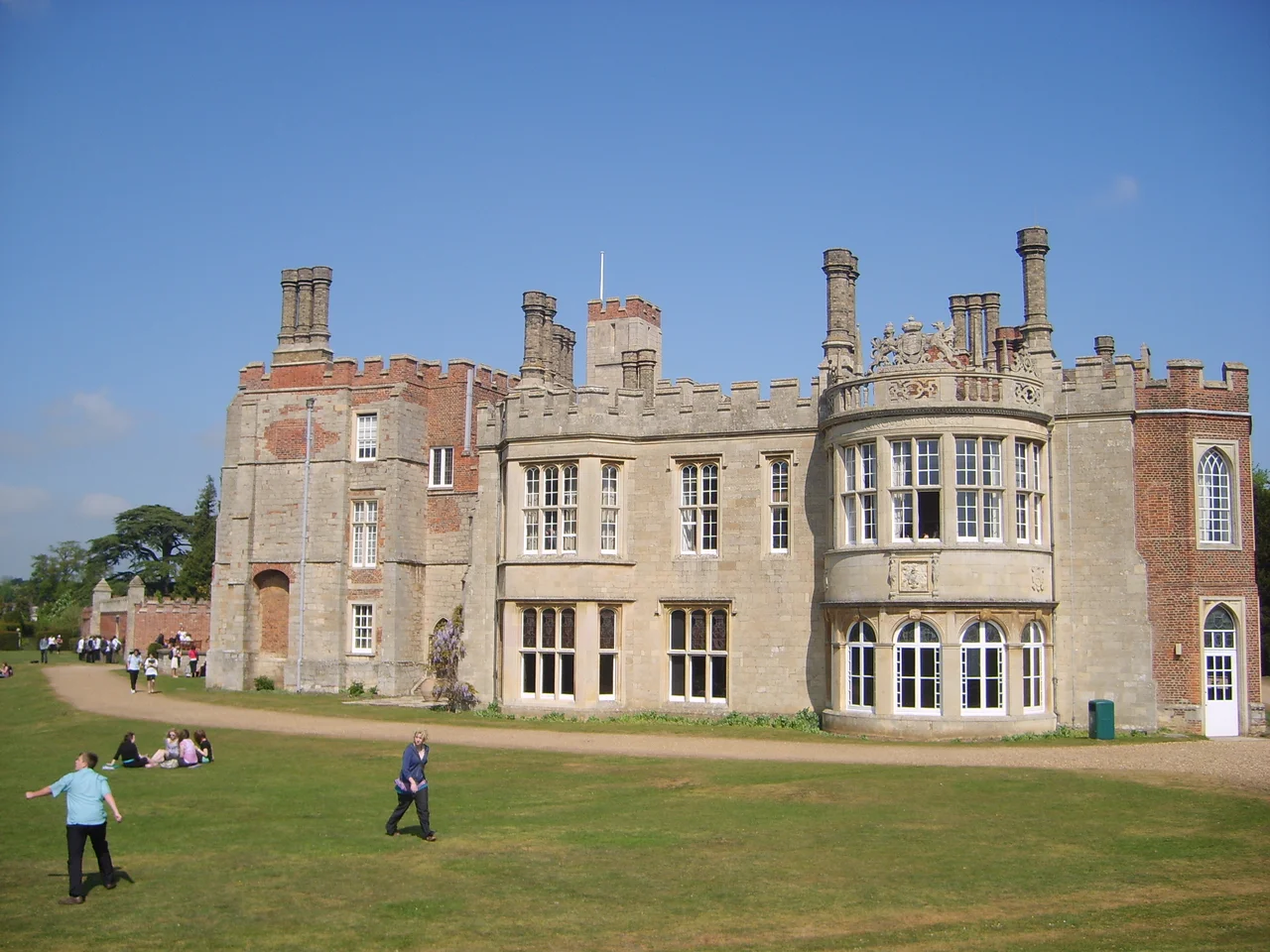

Hinchingbrooke House
On 27 April 1603, King James I rode up the gravel drive of Hinchingbrooke House and was greeted by Sir Oliver Cromwell - not the Lord Protector, who was a small child at the time, but his lavish, spendthrift uncle. Sir Oliver presented the new king with hawks, horses, hounds and a gold cup, in the manner of a host determined to overspend his way into royal favour. He largely succeeded. He also bankrupted himself. Within a generation the family would be selling Hinchingbrooke to recover, and a teenage Oliver Cromwell would grow up watching his uncle's grand estate slip away. The house has spent four centuries swallowing such reversals and producing more of them. Today, sixth-formers walk corridors where Queen Elizabeth slept in 1564.
A Nunnery Acquired at a Discount
The bones of Hinchingbrooke are Benedictine. An 11th-century nunnery stood here, quiet and self-sufficient, until the dissolution of the monasteries swept through England in the 1530s. On 8 March 1538, Richard Williams - nephew of Thomas Cromwell, the architect of the dissolution - acquired the nunnery for £19.9s.2d. He was officially a Visitor overseeing the closures, which meant he was helping himself at clearance prices. Williams used the alias Cromwell after his uncle, and his descendants kept it. A fireplace in the building still bears his initials. His son Henry expanded the house substantially, and Henry's grandson, born in Huntingdon in 1599, would become the Oliver Cromwell history remembers. The Cromwells of Hinchingbrooke were not poor relations - they were the family branch with the seat, the visitors, the royal favour. The Huntingdon Oliver was the younger, lower-status nephew. He stayed at Hinchingbrooke as a young man; he did not own it.
Kings and a Sandwich
Elizabeth I came in August 1564 after the entertainments at Cambridge University. James I came in 1603, 1610, and sent Prince Henry in 1612. After the Cromwells went broke, the Montagu family - eventually the Earls of Sandwich - took possession. The most famous of them was John Montagu, the 4th Earl of Sandwich, who lived here in the 18th century and gave his title to the small invention that bears his name. The story usually told is that he ordered meat between two slices of bread to keep his hands clean at the gaming table; the more sympathetic version is that he was a workaholic First Lord of the Admiralty who needed to eat at his desk. Either way, the Earls of Sandwich shaped Hinchingbrooke for nearly four centuries. In 1962 the 10th Earl sold the house; his son, the 11th Earl, had been born and raised in its rooms.
Fire and Rebuilding
A serious fire in 1830 gutted much of the interior, and the architect Edward Blore - the same man who completed Buckingham Palace for Queen Victoria - rebuilt and restored it in the Gothic style then in fashion. Further restorations followed in 1894 and again in the 1960s. The most recent work uncovered the entrance to the medieval chapter house, hidden for centuries; otherwise, little of the original nunnery is visible to a visitor today. What remains is largely Tudor and Victorian fabric, layered over Norman foundations. According to the 18th-century writer Mark Noble, the nuns' old cells were still used in his day as lodging rooms for servants, and the kitchen had once been the convent's common room. Coffins of stone, he reported, had been turned up under the floor.
The Stately Home That Became a Sixth-Form College
In 1970 Hinchingbrooke House became part of Hinchingbrooke School, housing the sixth form. The school itself is the modern descendant of Huntingdon Grammar School - the same grammar school that Oliver Cromwell and Samuel Pepys attended, whose original building now houses the Cromwell Museum on Huntingdon High Street. Around 1,900 pupils now attend. Every October the house turns into a critically acclaimed Halloween attraction called The Horror at Hinchingbrooke House, where the building's nun-and-monk ghost stories meet a paying audience. The house also hosts weddings, conferences, and dinner dances; it is Grade I listed and open for tours on summer Sunday afternoons. From silent Benedictine prayer to GCSE revision in the same rooms, by way of kings, sandwiches, ghosts, and a Halloween scare attraction - few English country houses have stretched themselves quite so thoroughly across the centuries.
From the Air
Hinchingbrooke House lies at 52.3286N, 0.2014W on the western edge of Huntingdon, set within parkland with mature trees and visible lawns. The house's pale-stone Tudor facade and surrounding playing fields make it recognisable from 1,500-3,000 ft AGL. Nearest airfields: RAF Wyton (EGUY) about three miles north-east, Conington (EGSF) about nine miles north, Cambridge Airport (EGSC) some 19 miles south-east. The A14 passes immediately south; the Great Ouse meanders past about a mile east.
Nearby Stories
- Red Bull Racing 1.3 km away
- Flag Fen 2 km away
- Denver Windmill 3.1 km away
- Uppingham School 3.6 km away
- Sywell Aviation Museum 5.8 km away
- Newmarket, Suffolk 6.8 km away
- Letchworth 6.9 km away
- Castle Hedingham 18 km away