
Newmarket, Suffolk
James I came to Newmarket in February 1605 and called it a "poor little village." He also saw, in its flat heathland, exactly what he was looking for: ideal ground for hare coursing and, before long, horse racing. Within a year he had started building a palace. Within a decade he had made Newmarket a royal resort and transformed the small Suffolk market town into something that would become, over the following four centuries, the undisputed global headquarters of thoroughbred horse racing. The town has more racehorses than it has children. One in every three local jobs is tied to the racing industry. The chalk downland around it is laced with 50 miles of turf gallops, developed over hundreds of years of patient maintenance into some of the finest training ground in the world. Newmarket did not grow into this role. It was shaped for it, deliberately, from the start.
Racing Since 1174
Racing at Newmarket can be dated as far back as 1174, making it the earliest known racing venue of post-classical times. James I greatly expanded the sport's popularity from the early seventeenth century onwards. His son Charles I inaugurated the first cup race in 1634. Charles II was a regular presence and an enthusiast — he rode in races himself, earning the nickname "Old Rowley" after a celebrated stallion, a name now borne by the Rowley Mile racecourse. The Jockey Club, the governing body of British flat racing, has its clubhouse in Newmarket, though administration operates from London. The town's two racecourses — the Rowley Mile and the July Course — are separated by the Devil's Dyke, a remarkable Anglo-Saxon earthwork that runs for over seven miles across the chalk downland, beginning in Woodditton and ending in Reach.
The Training Grounds
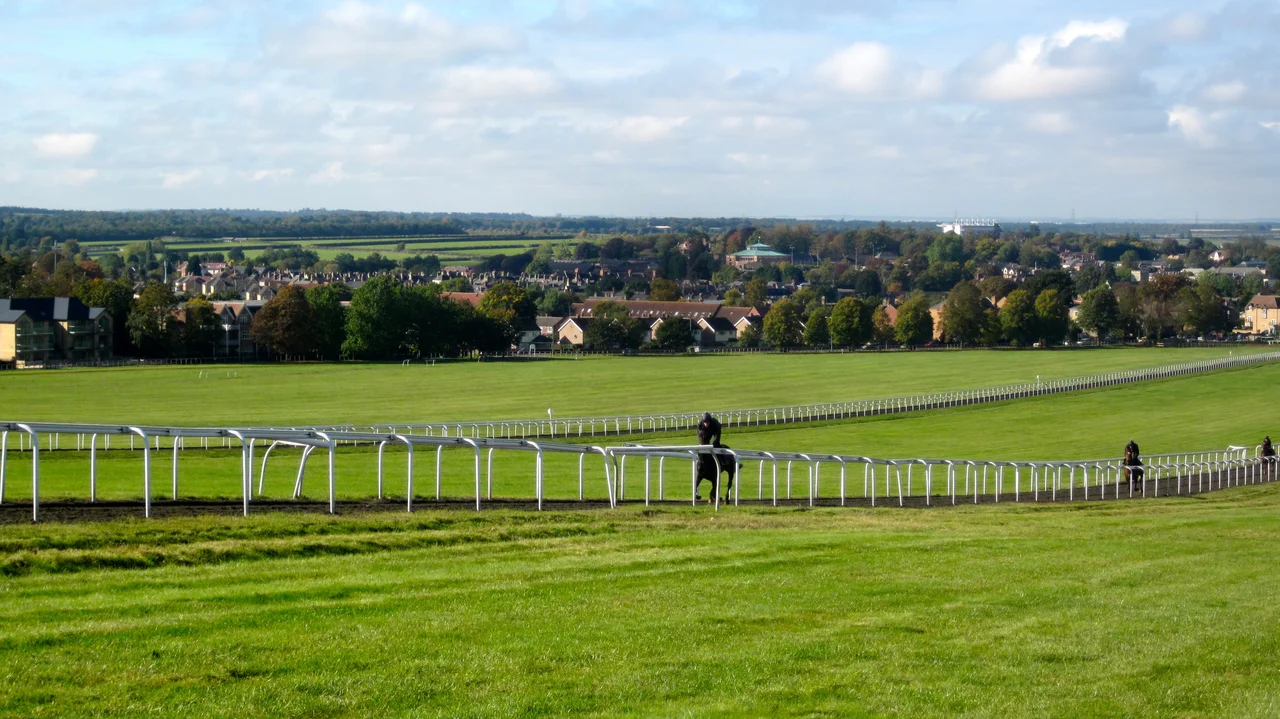
Around 3,000 racehorses are stabled in and around Newmarket at any given time, trained by approximately 70 licensed trainers. The training grounds have three main areas: Racecourse Side, adjacent to the Rowley Mile; Warren Hill, which overlooks the town and includes three all-weather canters and numerous grass canters; and Bury Side, near the Bury Road and the railway line. All three areas are chalk downland, and the grassland has been cultivated over centuries to its current extraordinary quality. Special horse routes thread through the town so that horses can reach the gallops safely from their stables. Some of the world's most successful trainers are based here — Sir Michael Stoute, John Gosden, Saeed bin Suroor, Charlie Appleby — and the horses they train are worth, in many cases, between £5 million and £50 million each. The landscape around the town is dominated by over sixty thoroughbred breeding studs, including major global operations owned by Darley, Shadwell, and Juddmonte.
Royal Connections and Civil War
The history of Newmarket is wound tightly around English political history. In 1642, Charles I met a parliamentary deputation here that demanded his surrender of the armed forces. "By God not for an hour," Charles replied. "You have asked such of me that was never asked of a King!" The exchange effectively started the English Civil War. In June 1647, Charles was captured and brought to Newmarket as a prisoner, the whole of Cromwell's New Model Army keeping guard over the town. Newmarket had consistently Royalist sympathies. In 1648 there was serious fighting in the market place as the town attempted to rise for the King in the Second English Civil War. The palace James I built was largely demolished at the start of the nineteenth century — but a section survives and is now called Palace House, home to the National Horseracing Museum and Heritage Centre.
A Town of Horses
The statistics accumulate into something that reads almost like satire. Newmarket has a human population of around 16,000 and a racehorse population of around 3,500. Its two equine hospitals — the Newmarket Equine Hospital and Rossdales — are among the most advanced in the world. Its twin towns include Lexington, Kentucky, and Maisons-Laffitte in France — both of them also horse-racing centres. The town is the birthplace of William Thomas Tutte, a mathematician and World War II codebreaker; Thomas Elsdon Ashford, who won the Victoria Cross in the Second Anglo-Afghan War; and Dina Carroll, winner of a Brit Award. Newmarket sausages — produced here since the 1880s — hold a Protected Geographic Indication, and are given as a prize at the annual Newmarket Town Plate. The sport and the sausages are, in their own way, equally serious business here.
From the Air
Newmarket is located at 52.245°N, 0.411°E in west Suffolk, 14 miles northeast of Cambridge. From altitude, the two racecourses — the Rowley Mile curving to the northwest and the July Course to the south — are immediately identifiable as long, swept tracks of turf on the open heath. The town's training grounds sprawl across Warren Hill to the north. Nearest airport: Cambridge (EGSC), approximately 14 miles southwest.
Nearby Stories
- Wymondham Abbey 3.8 km away
- St Ives Bridge 6 km away
- RAF Eye 6.6 km away
- Castle Hedingham 6.9 km away
- Royal Hospital School 9.2 km away
- RAF Downham Market 9.9 km away
- Flag Fen 13 km away
- Letchworth 17 km away