
Denver Windmill
On 4 October 2011, while Denver Windmill was freewheeling in the wind, one of its steel stocks sheared near the canister. The break spread on three sides, the bottom folded, and a sail crashed into the one below it, scattering debris across the site. At that moment, the mill yard was full of diners. A group of children from Clenchwarton Primary School were in the middle of a visit — some inside the windmill, others eating lunch in the Tea Garden. The staff stopped the mill immediately and moved everyone to safety. No one was hurt. The windmill that had been milling grain in the Norfolk Fens since 1835 survived to mill again.
Built for John Porter
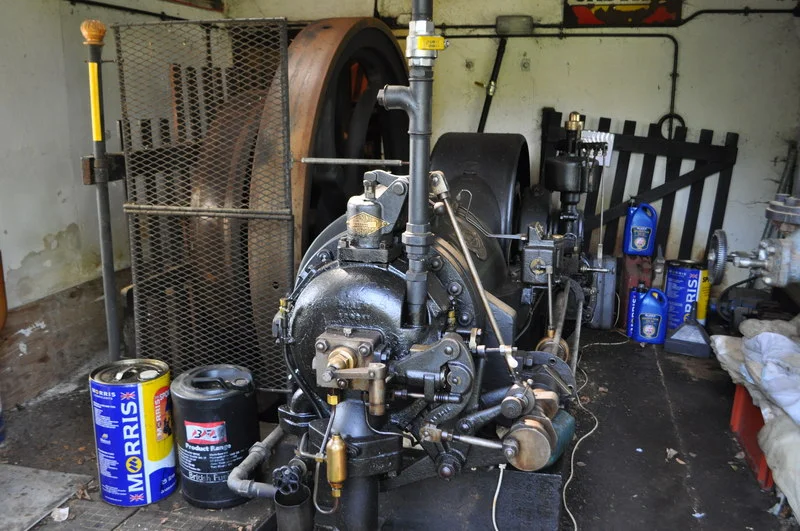
Denver Windmill was built in 1835 for John Porter, replacing an earlier post mill that had been recorded on the 1824 Ordnance Survey map. The tower bears a datestone reading JMP 1835. It is a six-storey tower mill with a stage at third-floor level; the tower stands 59 feet high to the curb. The ogee cap carries a gallery and is turned to face the wind by a fantail, one of the mechanical innovations that made 19th-century tower mills more efficient than their predecessors. The mill drives three pairs of overdrift millstones. By 1863, a steam engine of 12 horsepower had been added on the site, driving another three pairs of millstones — the mill and the engine working in parallel, depending on weather conditions.
A Century of Millers
The mill passed through a small number of hands across nearly a century and a half. John Porter ran it from 1835 to 1853; John Gleaves took over until 1873, then James Gleaves until 1896; Thomas Edward Harris then Thomas Edwin Harris between them covered 1896 to 1969. James Gleaves made a Deed of Assignment in 1896 and the mill was offered for auction at the Crown Hotel in Downham Market, but withdrawn from sale. The last miller, Thomas Edwin Harris, worked the mill until 1969, after which it fell dormant. Norfolk County Council eventually acquired it and began restoration work in 1991, removing and replacing the cap; further sail work followed in 1992. By 1995, with restoration incomplete, the council sold the mill and the adjacent house to the Norfolk Historic Buildings Trust.
A Million Pounds to Grind Again
Restoring Denver Windmill to full working order cost over £1 million. The funding came from multiple sources: the European Regional Development Fund, the Heritage Lottery Fund, Norfolk County Council, the Rural Development Commission, and a loan from the Architectural Heritage Fund. The restored mill opened to the public in March 2000 — the last working windmill in Norfolk, grinding grain as it had done 165 years earlier. In 2008, the Abel family took over the operation as Denver Mill Ltd, with the explicit aim of making the mill commercially sustainable without continued public subsidy. Stone-ground flour production resumed. A bakery and tearoom showcased the products on-site. A Bakery Training School taught craft baking techniques. The windmill had become not just a museum piece but a working food business.
Screen Time and Stone Ground
Denver Windmill appeared in the 1992 filming of an episode of 'Allo 'Allo! titled "Fighting with Windmills." In 2012 it featured in the BBC2 series Alex Polizzi: The Fixer, which followed the management consultant as she attempted to turn around struggling family businesses. The mill and tearoom, facing the sustainability challenges that confront most heritage attractions, were among those she tackled. The windmill's Grade II* listed status — a designation reserved for particularly important buildings — reflects its significance. In 2010, only 5.5% of listed buildings nationally carried that designation, and fewer still the Grade I status above it. Denver Windmill, turning again in the flat Norfolk sky, milling local grain into flour that ends up in bread baked on the premises, represents something genuinely rare: heritage that works.
From the Air
Denver Windmill is located at approximately 52.59°N, 0.37°E in the village of Denver, Norfolk, near Downham Market. The six-storey tower and fantail are distinctive landmarks visible from the air across the flat Fenland. The mill sits near Denver Sluice, a major water control structure on the Great Ouse, which is also visible from altitude. Nearest airports: Cambridge (CBG) approximately 30 miles south, Norwich (NWI) approximately 45 miles east.
Nearby Stories
- RAF Mildenhall 3.7 km away
- Hunstanton 3.9 km away
- Cley Marshes 5.4 km away
- RAF Attlebridge 6.8 km away
- Boston Guildhall 7.5 km away
- RAF Eye 7.5 km away
- St Ives, Cambridgeshire 7.8 km away
- Crowland Abbey 12 km away