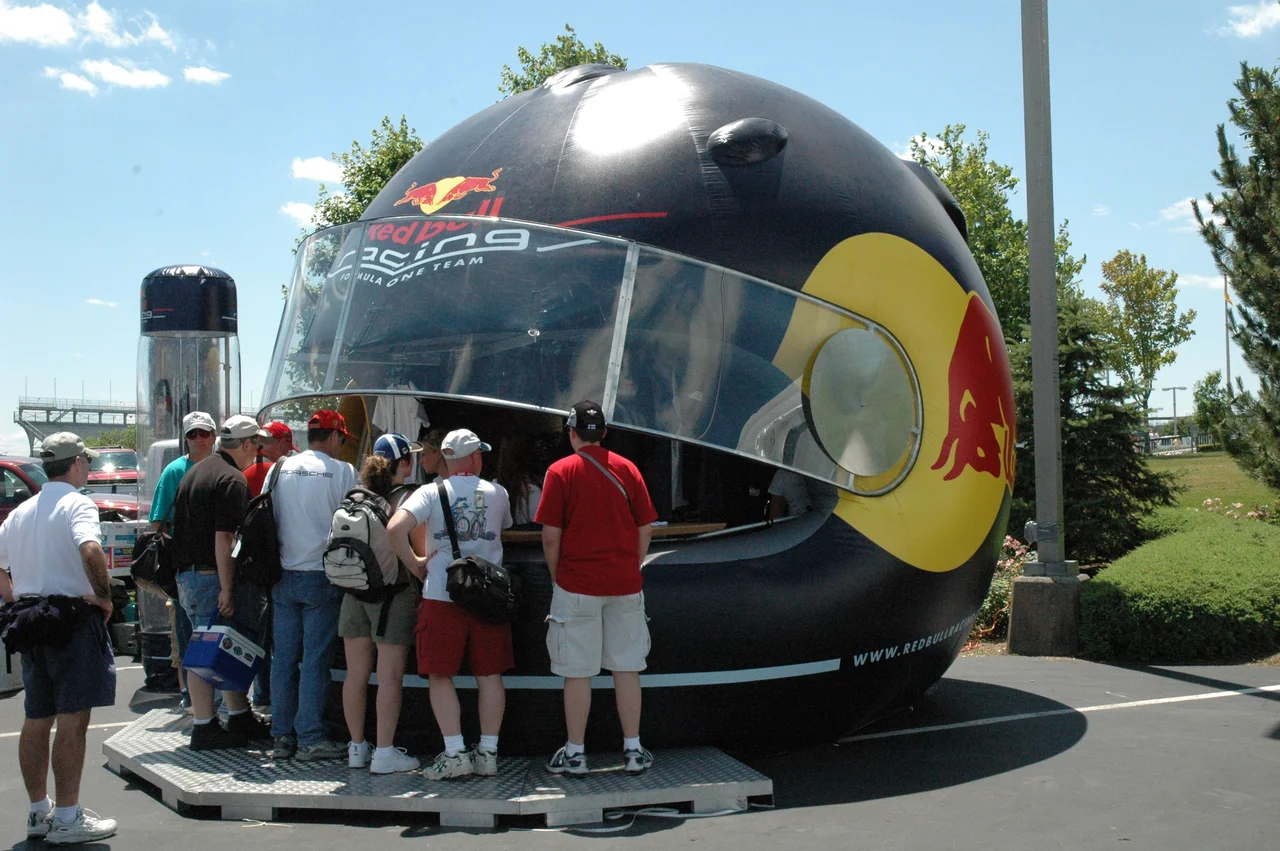

Red Bull Racing
On 15 November 2004, the Ford Motor Company sold its Formula One team for one US dollar. The buyer was Red Bull, an Austrian energy drink company, and the price came with the condition that Red Bull pour roughly $400 million into the operation over three seasons. The team being sold was Jaguar Racing, the latest unsuccessful incarnation of what had started as Stewart Grand Prix, a small British outfit founded by the three-time world champion Jackie Stewart. The factory was a low-slung building on a business park in Milton Keynes. Nobody at the time thought what was about to happen there would happen.
From Stewart to Jaguar to Red Bull
Jackie Stewart had sold his team to Ford in 1999. As Jaguar Racing, the team spent five years finishing in the lower reaches of the constructors' championship and burning through money. When Ford decided in 2004 that it could "no longer make a compelling business case" for staying in F1, the factory and everything in it went up for sale. Red Bull's owner Dietrich Mateschitz had been involved in motorsport for years. Red Bull had sponsored Sauber from 1995 to 2004 and Gerhard Berger before that, dating back to 1989. Buying Jaguar gave Mateschitz his own team for the price of a Vienna coffee. The 2005 season produced one immediate surprise: under former McLaren driver David Coulthard, Red Bull scored more points in its first year than Jaguar had in two.
Adrian Newey and the Design Office
The real turning point came on 8 November 2005, when Red Bull announced it had signed Adrian Newey away from McLaren. Newey was already the most successful designer in the modern history of the sport, the architect of championship-winning cars at Williams and McLaren going back to the early 1990s. He was also famously old-school. He still drew his concepts in pencil on a drawing board, then handed them over to engineers to render in CAD. He spent the next several years quietly building Red Bull a design office that took on his obsessive habits: low ride heights, aggressive rake angles, exhaust-blown diffusers, sidepods sculpted to chase every last molecule of airflow. The first car he designed at Red Bull, the RB5, took its maiden win at the 2009 Chinese Grand Prix with Sebastian Vettel at the wheel.
Vettel and the First Era
Sebastian Vettel was 22 years old when he won that first race. The young German had moved up from Toro Rosso, Red Bull's junior team, and what followed broke records that had stood for a generation. From 2010 to 2013, Vettel and Red Bull won four consecutive Drivers' and Constructors' Championships. In 2011 alone he took 15 pole positions, eclipsing a mark Nigel Mansell had held since 1992. In 2013, the team won the last nine races of the season, a streak that ended only when new regulations for 2014 reset the field around hybrid engines and Mercedes' superior Power Unit took over the front of the grid. Red Bull's relationship with engine supplier Renault publicly soured during the lean years that followed. The team rebadged the Renault engines as TAG Heuer through 2018, then switched to Honda.
Verstappen, Abu Dhabi, and 2021
Max Verstappen made his Formula One debut at 17, the youngest driver ever to start a race, and won his first Grand Prix at the 2016 Spanish event aged 18, also a record. The era of his dominance arrived in 2021, in one of the most controversial championship finales the sport has ever produced. Verstappen and Lewis Hamilton went into the last race at Abu Dhabi level on points. A late safety car bunched the field. The race director ordered a contested set of lapped-car procedures that allowed Verstappen to challenge Hamilton on fresh tyres on the last lap. Verstappen passed him into Turn 5. Mercedes protested, the result stood, and Verstappen took his first world championship. He kept winning: 2022, 2023, and 2024 followed, four titles in a row. In 2023 alone the team won 21 of 22 races, the most dominant season in the sport's history.
The Milton Keynes Factory
Drive past Bradbourne Drive in Milton Keynes today and the Red Bull factory does not look like a place where world championships are forged. It is glass, white panels, energy-drink branding. Inside, around 1,500 people work on building two cars at a time, plus a third programme: Red Bull Powertrains. Honda left F1 officially after 2021 but agreed to continue supplying engines to the team until 2025, after which Red Bull's own engine division will partner with Ford for the 2026 regulations. A new wind tunnel is under construction, due to come online in 2026. Adrian Newey himself left the team in 2024 after almost 19 years. Christian Horner, who had run the team since its founding in 2005, departed in 2025 and was succeeded by Laurent Mekies. The era of original architects has ended; what they built carries on.
Beating the Italians
The most striking thing about Red Bull's record is not just the trophies, which are remarkable. It is the simple geography of it. Ferrari has been racing in Formula One since 1950, building cars in Maranello, and the team carries the gravity of Italian motorsport history with it. McLaren and Mercedes operate from sprawling campuses in Surrey and the Cotswolds. Red Bull, by comparison, is barely two decades old, run out of an unfashionable English new town from a factory that started life building Jaguars and never quite shook off the corner-shop feel. Eight Drivers' Championships, six Constructors' Championships, and counting. Mateschitz did not live to see most of it; he died in 2022. The energy drink stayed.
From the Air
Red Bull Racing's factory is at Bradbourne Drive, Tilbrook, Milton Keynes, England, at approximately 52.0192°N, 0.7037°W, about 55 miles northwest of central London. The complex sits within the broader Milton Keynes urban grid, recognisable from the air by its rectilinear street layout and abundance of roundabouts. Recommended viewing altitude is 3,000 to 5,000 feet for the factory itself, set against the flat farmland of north Buckinghamshire. The Silverstone Circuit, home of the British Grand Prix and Red Bull's nearest racing venue, lies 22 miles to the west. Nearest airports: London Luton (EGGW) 19 miles southeast, Cranfield (EGTC) 8 miles east, Old Warden (EGTH) 13 miles northeast, Stansted (EGSS) 47 miles east. Note that Milton Keynes itself has no commercial airport; the area is served by Luton.
Nearby Stories
- Epping Forest 4.1 km away
- Girton College, Cambridge 6.2 km away
- Hunt family murders 11 km away
- Death of Harry Dunn 11 km away
- Waytemore Castle 14 km away
- Wellingborough 15 km away
- Abingdon-on-Thames 15 km away
- Chesterton Windmill 30 km away