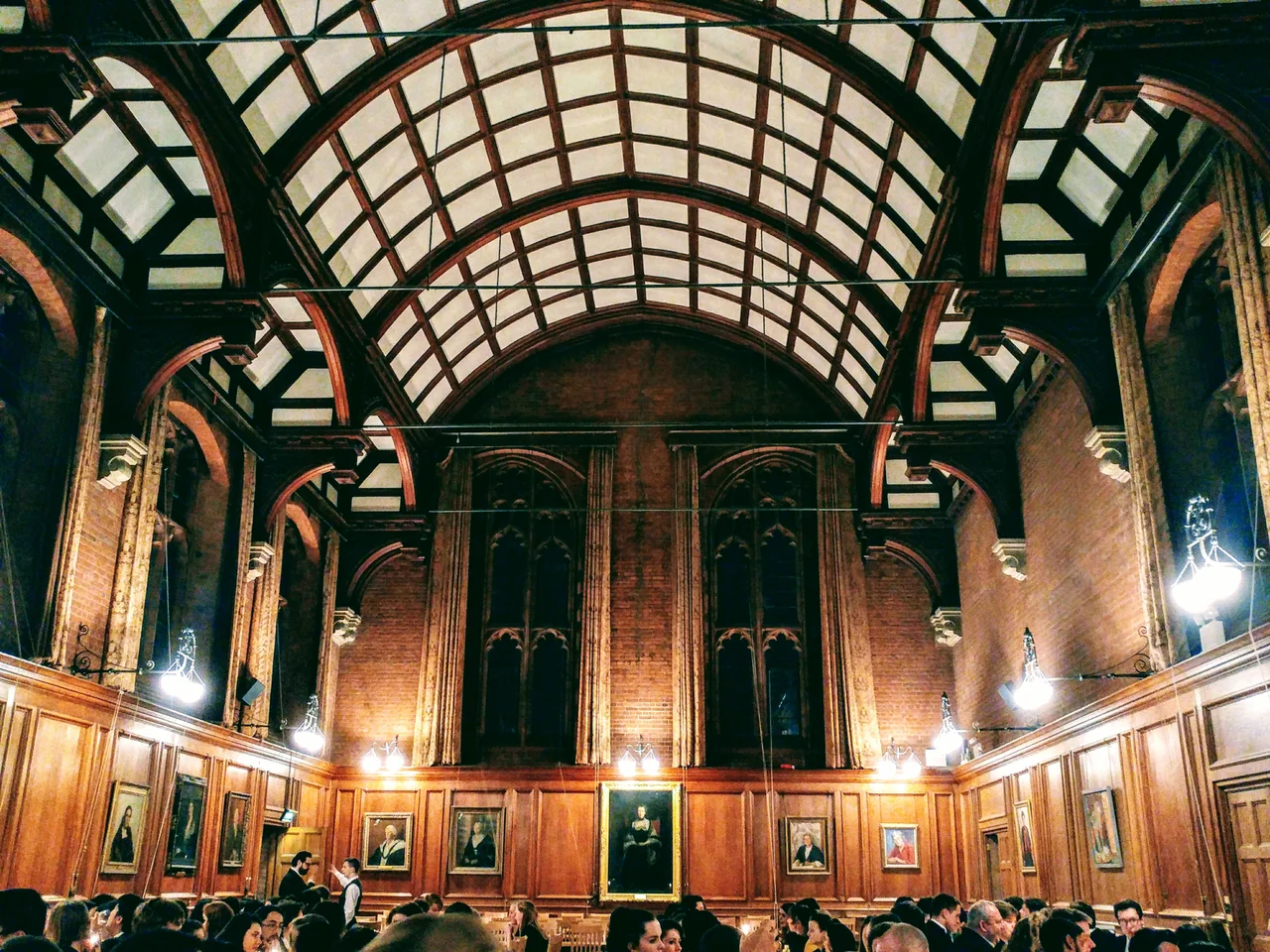

Girton College, Cambridge
They thought it safer to locate it away from Cambridge. In 1869, when Emily Davies and Barbara Bodichon opened the College for Women at Benslow House in Hitchin, Hertfordshire, the choice of a town 25 miles from Cambridge was not accidental. The founders believed that women studying at a university would be less controversial if they weren't actually near one. The college moved closer — to the edge of Girton village, about two miles northwest of Cambridge — in 1873. But that instinct to keep a distance, to make the claim quietly and then expand it, shaped everything that followed. Girton spent the next century steadily advancing the argument that women belonged at Cambridge, until Cambridge eventually agreed.
Five Women, One October
The first term began on 16 October 1869, when five students started their studies: Emily Gibson, Anna Lloyd, Louisa Lumsden, Isabella Townshend, and Sarah Woodhead. Admission to the Cambridge Local Examinations — a small concession granted four years earlier — had met little resistance. Actually living and studying toward the same Tripos examinations as men was another matter entirely. In Lent Term 1873, three of the college's students — Rachel Cook, Louisa Lumsden, and Sarah Woodhead — unofficially sat the Tripos examinations. They were known as "The Pioneers." They were not awarded Cambridge degrees, because Cambridge did not award degrees to women. They would not be, for another 75 years. Emily Davies fought the university's alternative women's examination, insisting her students sit the same Tripos as men. This was not a symbolic preference. Davies understood that a separate examination would produce a separate — and lesser — credential.
The Victorian Brick That Built a College
The red-brick buildings of Girton's main site were designed by Alfred Waterhouse between 1873 and 1887. Waterhouse was already one of England's most prominent architects — he built Manchester Town Hall and the Natural History Museum in London. The English bond brickwork, the steeply pitched roofs with crested tiles, and the terracotta detailing of the eaves and doorways give Girton a character quite different from Cambridge's older stone colleges. The grounds grew along with the buildings: a pond dating from 1884, excavated during construction of the Stanley Library and Orchard Wing; gardens that by 1983 recorded sixty species of birds; and, occasionally, the rare black squirrels for which the college's grounds are noted. The indoor swimming pool, installed in 1900, is Grade II-listed — a Victorian amenity so well-built it has outlasted the era that created it.
The Long Wait, Then the Vote
On 27 April 1948, Cambridge finally admitted women to full university membership, and Girton received the official status it had functionally held for decades. Twenty-eight years later, Girton made another first: in November 1976, the Governing Body voted to admit men, making Girton the first Cambridge women's college to become coeducational. The first male fellows arrived in January 1977. Male undergraduates followed in October 1979. Some found the change uncomfortable; a small number of women students initially objected. But the logic was pragmatic as well as principled. The first Cambridge colleges to admit women — Churchill, King's, and Clare in 1972 — immediately rose in the academic league tables. Bright students, given a choice, preferred coeducational environments. Girton, ever practical, adapted.
The Pioneers' Song
Girton's college grace, written in 1950 and sung to the tune of "The British Grenadiers," opens with a roll call of the original students. The first stanza begins: "Some talk of Senior Wranglers / And some of Double Firsts / And truly of their species / These are not the worst / But of all the Cambridge heroes / There's none that can compare / With Woodhead, Cook and Lumsden / The Girton Pioneers." The names are not forgotten. Neither is the tradition they represent — a college that put women at the center of serious intellectual life at a time when the university itself refused to. Among Girton's later alumni: Margrethe II of Denmark, Lady Brenda Hale (former President of the UK Supreme Court), Arianna Huffington, and Sandi Toksvig. The college that was kept at arm's length from Cambridge eventually sent its graduates to the highest positions in law, politics, media, and monarchy.
A Living Place
Today Girton sits on 33 acres at the edge of the village, connected to Cambridge by a two-mile cycle path many students use daily. The main site offers 348 undergraduate rooms, all rented at the same price regardless of grade — Girton and Newnham are the only Cambridge colleges to maintain this policy of equal rents. The college museum, the Lawrence Room, houses Anglo-Saxon, Egyptian, and Mediterranean collections. The chapel, completed in 1901, contains a Harrison and Harrison organ dating from 1910. A second organ was added in 2002. Student social life centers on the "Schlub" — the college's Social Hub — and its cellar bar, the "Deep Schlub," reopened after renovation in 2023. The Spring Ball, tracing its origins to a dance in 1883, remains one of Cambridge's distinctive end-of-term celebrations. Girton's distance from the city center, once a mark of its provisional status, has become simply a feature of the place — a campus with space to breathe, surrounded by the flat Cambridgeshire landscape, and aware of its own history.
From the Air
Girton College lies approximately 2 miles northwest of central Cambridge at 52.229°N, 0.084°E. From the air it is identifiable as a substantial red-brick Victorian complex set apart from the city, north of the A14. Cambridge City Airport (EGSC) is about 5 miles to the east-southeast. Flying at 2,000 feet over the A14 corridor gives a clear view of the college's distinctive buildings and extensive grounds against the Cambridgeshire fenland.
Nearby Stories
- Walden Abbey 4.6 km away
- Bury St Edmunds 5.5 km away
- RAF North Pickenham 8.1 km away
- Ampthill 9.5 km away
- RAF Wittering 10 km away
- Murder of Una Crown 12 km away
- Colchester Community Stadium 18 km away
- John Bunyan Museum 19 km away