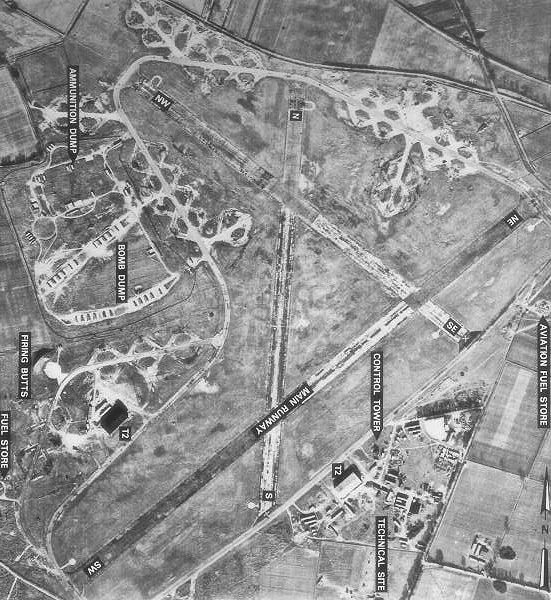

RAF North Pickenham
In the words of one veteran of the 492nd Bombardment Group, 'the whole group was wiped out.' He was speaking, with the bluntness of a man who had been there, about the summer of 1944 at RAF North Pickenham. In three months of operations from May to August, the 492nd flew 64 missions and lost 51 of its B-24 Liberators to enemy action, plus six more to other causes. The unit was so badly broken that the survivors were transferred to other B-24 groups and the 492nd itself was reassigned to RAF Harrington for special operations duty. By the time North Pickenham closed for good in 1967, the airfield's runways had hosted bomber crews, Thor nuclear missiles, and the experimental Hawker P.1127 that would evolve into the Harrier jump jet.
Class A Heavy Bomber Station
North Pickenham was built in 1942 and 1943 as a Class A heavy bomber station, with the standard three-runway pattern, T2 hangars, dispersal points, and accommodation for thousands of personnel. It was handed to the USAAF Eighth Air Force in April 1944 and designated Station 143. Geographically it sat 3 miles east of Swaffham, in the gentle agricultural country of central Norfolk. The 492nd Bombardment Group (Heavy) arrived from Alamogordo Army Air Field, New Mexico, on 18 April 1944, painting a Circle U tail code on their Liberators.
The Group That Was Wiped Out
The 492nd's brief operational life was one of the war's most catastrophic. Its squadrons, the 856th, 857th, 858th, and 859th, entered combat in May 1944 and were essentially destroyed by August. The factors that piled up against B-24 groups in the spring of 1944 included intensifying Luftwaffe fighter opposition, the bomb-laden Liberator's limited combat ceiling compared to the B-17, and the strategic targeting of synthetic oil facilities that brought concentrated German defenses into action. Whatever the precise combination, the 492nd's loss rate became unsustainable. On 5 August 1944 the group was transferred without personnel or equipment to RAF Harrington to fly classified special operations missions, the surviving 492nd airmen scattered to other Liberator units.
Circle Z Takes Over
The 491st Bombardment Group (Heavy), Circle Z tail code, moved in from RAF Metfield in August 1944 to occupy the suddenly empty hardstands. Their target list ran across Germany's industrial map: Berlin, Hamburg, Kassel, Cologne, Gelsenkirchen, Bielefeld, Hanover, Magdeburg. Once they attacked the German General Staff headquarters at Zossen. On 26 November 1944, on a mission against the oil refinery at Misburg, the 491st was hit by large numbers of enemy fighters. Roughly half their bombers were destroyed in the air. The remainder fought off the interceptors, bombed the refinery accurately, and came home. The group earned a Distinguished Unit Citation for the action. The 491st returned to McChord Army Air Field in Washington state on 17 July 1945.
Thor Missiles and the Cold War
After the USAAF evacuated in August 1945, North Pickenham passed through a series of RAF Maintenance Command roles. Then, on 1 December 1958, it was reopened for a very different mission. The newly reformed No. 220 Squadron RAF arrived equipped with Thor intermediate-range ballistic missiles, American-built nuclear weapons stationed on British soil as part of NATO deterrence during the Cold War. The Thors stood on their launchers for almost five years, gantry-style structures rising above the flat Norfolk fields. The squadron was deactivated and the missiles removed in October 1963 as the Thor program ended.
Harrier Tests and Turkey Sheds
The runways still had one more chapter. In the mid-1960s, North Pickenham was used for testing the Hawker P.1127, an experimental vertical takeoff aircraft that would evolve into the Hawker Siddeley Harrier, the jump jet that would become one of the most distinctive aircraft of the late 20th century. The site was finally sold in 1967. Most of the runways became the base of a large turkey farm, with sheds built directly along the old concrete. A karting circuit appeared on part of the perimeter track. A T2 hangar and a few bomb stores still remain. The villagers of North Pickenham received a quartz clock from the 492nd Bombardment Group in November 1990; it hangs in the sanctuary of their parish church. A memorial bench beside the village sign honors the 491st.
From the Air
RAF North Pickenham sits at 52.629 degrees north, 0.732 degrees east, 3 miles east of Swaffham in central Norfolk. Nearby aviation: RAF Marham (EGYM), still active, is roughly 8 nautical miles northwest; Norwich Airport (EGSH) lies 20 nautical miles east; RAF Honington (EGXH) is 16 nautical miles southwest. Recommended viewing altitude is 2,500 to 4,500 feet AGL to identify the remaining T2 hangar, the turkey-shed-lined runways, and the memorial features near the village.
Nearby Stories
- Binham Priory 4.7 km away
- Thelnetham Windmill 5.3 km away
- Soham Rail Disaster 5.6 km away
- Ranworth 6.6 km away
- Wisbech & Fenland Museum 13 km away
- Dunwich 19 km away
- Batemans Brewery 23 km away
- SM U-97 130 km away