
Thelnetham Windmill
The mill was set to work on Christmas Day, 1819 — millwright George Bloomfield's gift to William Button and to the grain-growing country around Thelnetham. A four-storey brick tower mill with patent sails and a fantail to face it into the wind, it drove two pairs of millstones with the power of the Suffolk air. For more than a century it ground wheat into flour. Then, one by one, its sails came down, until by 1924 it was working on just two. After that, dereliction. The wind still blew, but the mill had stopped listening.
A Mill Built for William Button
There had been a windmill at Thelnetham before: a post mill shown on Joseph Hodgkinson's map of Suffolk of 1778. In 1818 that post mill was moved to Sandy Lane in Diss, Norfolk, clearing the way for what Bloomfield would build. The new tower mill began production on Christmas Day 1819, and in 1832 it was modernised — fitted with a cast-iron windshaft, patent sails, and a fantail made by J Aickman, the King's Lynn millwright, weighing one and three-quarter tons. This mechanism allowed the mill to rotate automatically into the wind without human intervention, a significant improvement. The mill changed hands over the following century; by the time Alphonso Vincent died in 1932, his son George inherited it. George lived at the site in an old lorry until his own death in 1973.
Five People and a Project
In November 1979, five members of the Suffolk Mills Group purchased Thelnetham Windmill. The mill was open to the sky, the floors rotting, the machinery seized. The consortium's first priority was to make it weathertight — polythene sheets spread across the dust floor, the structure surveyed and recorded before anything was removed. In spring 1980 the dust floor partially collapsed and had to be taken out. The following years involved systematic reconstruction: new oak joists, repaired beams, a new cap built by volunteers during annual working holidays, Death Watch beetle damage addressed post by post, millstone machinery restored. Some of the pitch pine used in the restoration came from the Eastbridge Windpump, which had collapsed in February 1977. By the late 1980s, after eight years of collective effort, the mill was working again.
A Living Mill
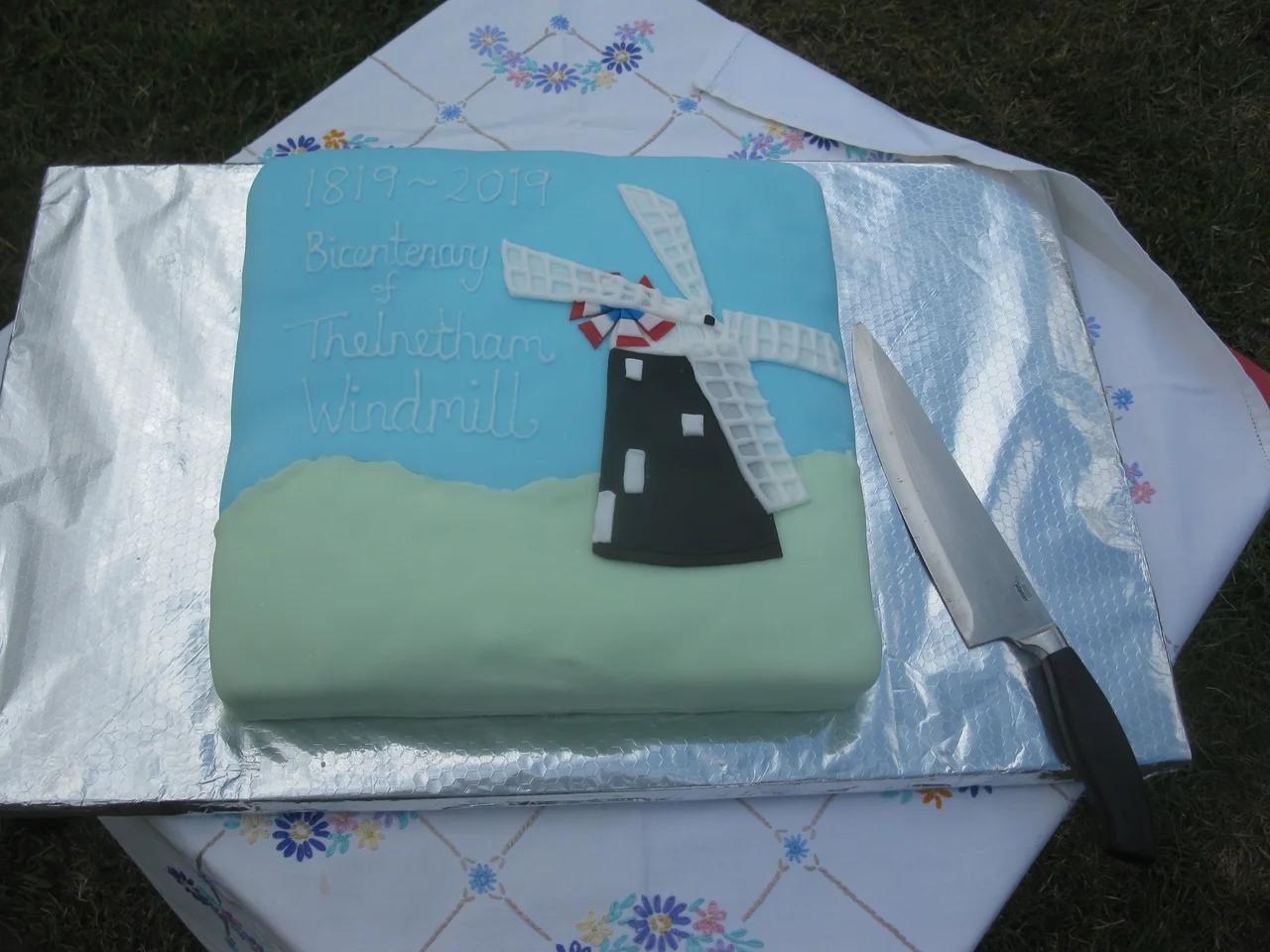
Today the mill is open to the public, and the flour ground within it can be bought on site. In 2013, ownership was transferred to the Suffolk Building Preservation Trust, which also manages Pakenham Watermill nearby. The bicentenary in 2019 was celebrated on 14 July, and among the objects present was the Locomobile lorry that George Vincent had lived in for four decades — restored to its original army condition. That same year, the mill served an unusual purpose: with Thelnetham Village Hall closed for refurbishment, the windmill became a polling station for both the European Parliament election in May and the General Election in December. Votes were cast in a building that had been grinding wheat since the year after the Battle of Waterloo.
Grade II* and Going
The mill carries a Grade II* listed building designation, placing it in the upper tier of England's protected structures — a recognition of architectural and historic significance beyond the ordinary. Its four-storey brick tower, patent sails, and fantail mechanism represent a particular moment in milling technology that largely passed by the time the First World War ended. What makes Thelnetham unusual is not just its survival but its condition: working millstones, a functional fantail, an auxiliary diesel engine for windless days. The mill's flour is still made the way it was made in 1819, from grain grown in the same flat, wheat-productive Suffolk landscape that made the mill worth building in the first place.
From the Air
Located at 52.37°N, 0.96°E in the village of Thelnetham, Suffolk, near the Norfolk border. The brick tower mill is visible from the air as a distinct cylindrical structure in flat agricultural land. Nearest airports: Norwich Airport (EGSH), approximately 28 miles northeast. Recommended viewing altitude 1,000–2,000 feet for the mill and its surroundings. The nearby Redgrave and Lopham Fens nature reserve lies to the northeast.
Nearby Stories
- Wicken Fen 4.5 km away
- Walden Abbey 7.6 km away
- Saxmundham 10 km away
- East Bergholt 11 km away
- RAF North Pickenham 13 km away
- Acle 13 km away
- Maunsell Forts 16 km away
- Wisbech & Fenland Museum 17 km away