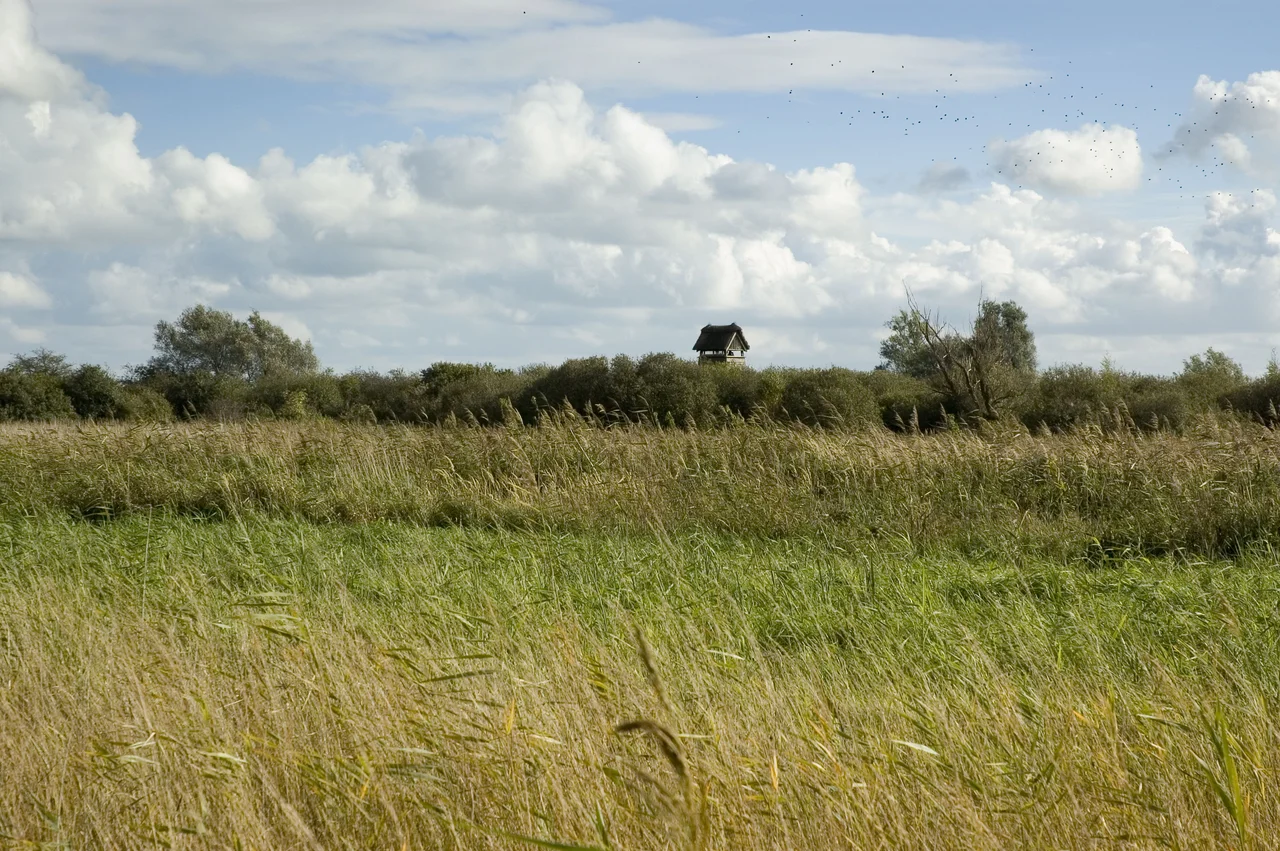

Wicken Fen
In 1899, the National Trust purchased two acres of Cambridgeshire fenland for £10. That transaction — modest enough to record in a single ledger line — marked the beginning of something that has grown for over a century into one of Britain's most remarkable conservation stories. Wicken Fen was the first property the National Trust ever cared for. Today it encompasses more than 800 acres of fen, reedbed, and marsh, and is home to over 10,000 recorded species. Of those, more than 125 appear in the national Red Data Book of rare invertebrates. The place was extraordinary before anyone called it a nature reserve. It remains extraordinary now.
A Fragment of a Lost World
The fens of East Anglia were once enormous — a vast, waterlogged basin covering much of Cambridgeshire and Norfolk. Agriculture drained nearly all of it. Today, only four wild fens remain in the Great Fen Basin area, and Wicken is one of them. The difference between the fen and its surroundings is immediately visible: the farmland outside has sunk as the drained peat compresses and oxidises, leaving the reserve elevated above the surrounding fields like a natural island. Wicken Fen's peat has been preserved by the water, and with it an entire ecosystem that elsewhere vanished over centuries of agricultural improvement. Walking along the boardwalk over the Mere, with sedge on either side and a reed warbler calling from somewhere invisible, gives a reasonable impression of what this landscape looked like in the medieval period — perhaps further back.
Cut Since 1414
What makes Wicken Fen unusual among nature reserves is that it requires active management to stay wild. The sedge plant, Cladium mariscus, has been harvested here every year since at least 1414, when the first recorded sedge cutting took place. That harvest continues today, and the cuttings are sold for thatching roofs — the same use they served six hundred years ago. This matters ecologically: hundreds of species at the Fen depend on regular sedge clearance to maintain their habitat. Stop cutting, and the ecology shifts. The management of Wicken Fen is thus less about leaving nature alone than about recreating the ancient human practices that shaped it. Fen-working, peat-cutting, sedge harvesting — these are not just historical footnotes but conservation tools. The reserve is, in a specific sense, a collaboration between its present caretakers and everyone who worked the land before them.
Darwin's Beetles, Tansley's Ecology
Charles Darwin collected beetles here in the 1820s, before he sailed on the Beagle. He was a Cambridge student at the time, drawn to the fen as naturalists had been for generations. In the twentieth century, Sir Arthur Tansley and Sir Harry Godwin — the founders of modern ecology as a scientific discipline — used Wicken Fen as an outdoor laboratory from the 1920s onwards. Godwin's long-running research plots, known as the Godwin Plots, continue at the fen to this day. They are among the world's longest-running ecological experiments. Many hundreds of research papers have been published about this 254-hectare site over more than a century. The swallowtail butterfly, once present at Wicken, declined and was lost in the 1950s despite attempts to reintroduce it — a cautionary data point embedded in the fen's scientific record.
A Hundred-Year Vision
In 1999, marking the centenary of that first two-acre purchase, the National Trust launched the Wicken Fen Vision: a plan to expand the protected area to 56 square kilometres over one hundred years. New acquisitions have since added thousands of acres of former farmland, including Burwell Fen Farm, Tubney Fen, and St Edmunds Fen. The results are measurable. Populations of skylarks, snipe, widgeon and teal have grown. Buzzards, marsh harriers and hen harriers have returned. Bitterns began breeding at the fen in 2009 — the first time since the 1930s. Barn owls and short-eared owls have increased significantly. The Lodes Way, a 9-mile cycling and walking route opened with Sustrans, now connects Wicken to Anglesey Abbey and Bottisham, threading through the expanding landscape. The fen that was once two acres, purchased for £10, is becoming something much larger.
From the Air
Wicken Fen is located at 52.311°N, 0.291°E, approximately 9 miles northeast of Cambridge. From altitude, the reserve is identifiable by its distinctive water-rich landscape — darker, more varied terrain than the surrounding flat agricultural fields. The Wicken Lode waterway bisects the site. Nearest airport: Cambridge (EGSC), approximately 10 miles southwest.
Nearby Stories
- Walden Abbey 4.6 km away
- Bury St Edmunds 5.5 km away
- RAF North Pickenham 8.1 km away
- Ampthill 9.5 km away
- RAF Wittering 10 km away
- Murder of Una Crown 12 km away
- Colchester Community Stadium 18 km away
- John Bunyan Museum 19 km away