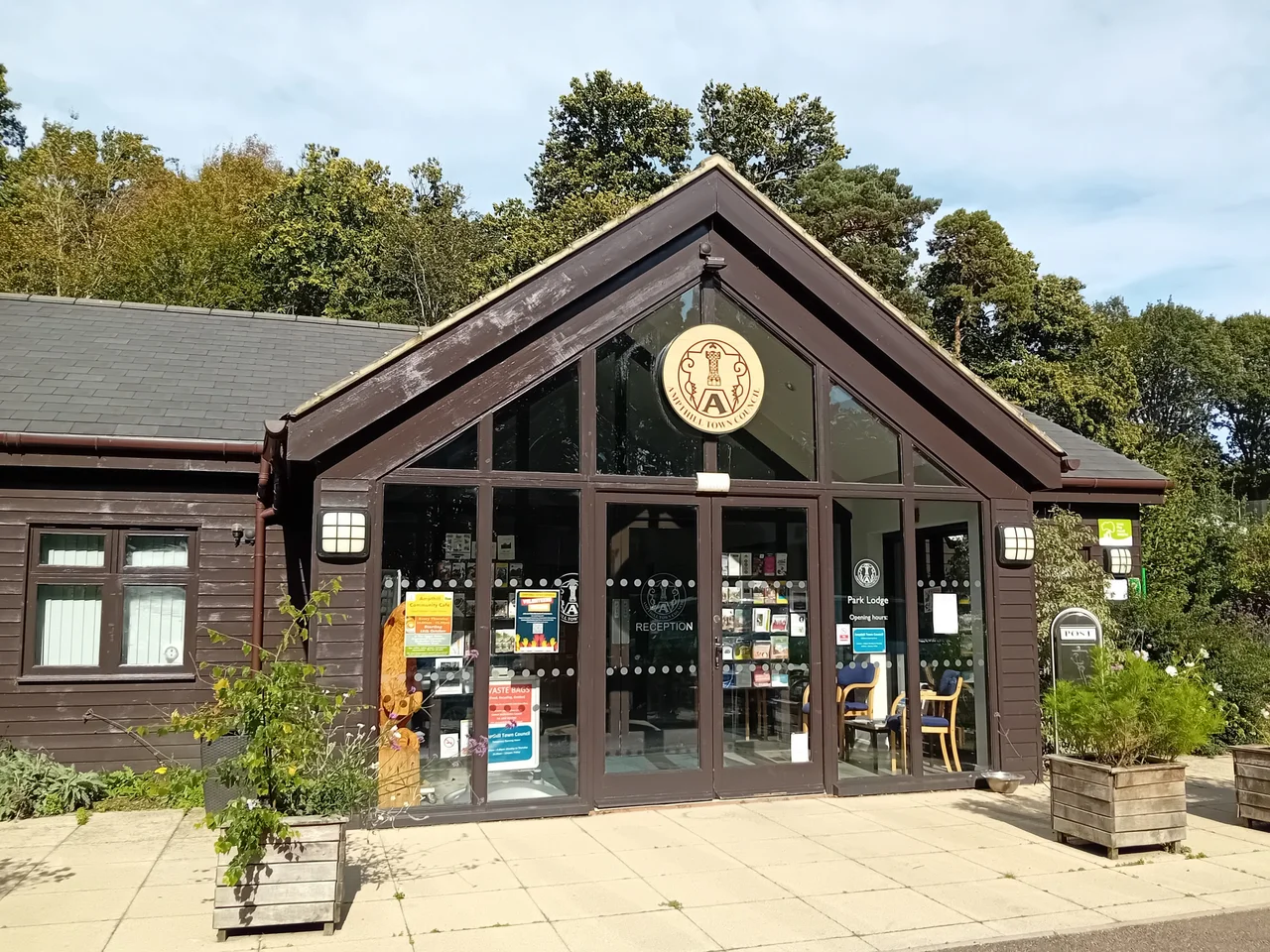

Ampthill
The town's name is, almost embarrassingly, Anglo-Saxon for "anthill" - or perhaps "ant-infested hill," depending on which etymologist you believe. The original settlement, Æmethyll, sat on a sandstone rise that even today gives Ampthill its slightly elevated character above the surrounding Bedfordshire farmland. From the high ground at Ampthill Great Park you can see all the way to the Chiltern Hills on a clear day. A weekly market has been held in the town since 1219, when Henry III granted the charter; the market celebrated its eight-hundredth anniversary in 2019. The population at the 2021 census was 8,825 - small enough for everyone to know roughly everyone, large enough to support a high street with independent shops, several pubs, a Waitrose, and a Rugby Football Union Championship club that punches dramatically above its weight.
Catherine of Aragon's Last Court
The single largest historical fact about Ampthill is no longer visible. Ampthill Castle, built in the early fifteenth century by Sir John Cornwall (later Lord Fanhope) from the ransoms he had collected as a captain at Agincourt, became one of Henry VIII's favourite hunting lodges in the 1520s. The deer park around it suited him. The castle suited him less. In 1531, Henry banished his first wife Catherine of Aragon to Ampthill, where she lived for two years while he pressed his case for annulment through Cardinal Wolsey, Thomas Cranmer, and finally a clean break with Rome. It was at Ampthill in May 1533 that Catherine received the news that Cranmer's ecclesiastical court at Dunstable Priory had declared her marriage to Henry void from the beginning. She refused to accept the ruling. She continued, until her death three years later, to sign herself the queen of England. The castle was demolished sometime in the seventeenth century. In the 1770s, John Fitzpatrick, the 2nd Earl of Upper Ossory, erected a stone cross on its site with an inscription written by Horace Walpole: "In days of old here Ampthill's towers were seen / The mournful refuge of an injured queen."
Capability, Holland, and Alameda
Ampthill Great Park - the deer park around the lost castle - was redesigned in the mid-eighteenth century by Lancelot "Capability" Brown, the most influential English landscape architect of the period. He took the formal seventeenth-century park and softened it into Brown's signature rolling pastoral idiom: scattered clumps of trees, a sweeping prospect, a serpentine line where formal alleys had been. When the Earl of Upper Ossory died in 1818, the park passed to Lord Holland, whose Holland House in Kensington became the most famous Whig political salon of the early nineteenth century - the salon at which Macaulay, Sydney Smith, Byron, and a generation of Reform-era politicians argued and ate. Lady Holland planted an avenue of trees at Ampthill that she called the Alameda, inspired by the Almeida promenade in Madrid. The Alameda still runs through the southern part of the park. Lord Upper Ossory had also commissioned a set of thatched cottages on Woburn Street between 1812 and 1816 to house estate workers; they are still occupied. The town also has the unusual feature of a llama on its bowls club emblem - a tribute to founder Sir Anthony Wingfield, who kept a small private zoo on the edge of Ampthill in the early twentieth century.
Treasure, Avengers, and the New Amsterdam Governor
Ampthill turns up in unexpected places. Richard Nicolls, born in Ampthill in 1624, was the English officer who in 1664 accepted the surrender of the Dutch town of New Amsterdam on behalf of the Duke of York; the city was renamed New York after the Duke, and Nicolls became its first English governor. He died eight years later when a Dutch cannonball struck him at the Battle of Solebay, and the cannonball itself is still preserved on his tomb in St Andrew's Church in the town centre. In 1979, the author and illustrator Kit Williams published Masquerade, a puzzle book whose solution led readers to a buried golden hare. The hare was buried at the foot of Catherine of Aragon's memorial cross in Ampthill Great Park, at the precise spot touched by the tip of the cross's shadow at noon on the spring or autumn equinox. Hundreds of treasure-hunters dug holes across the park before the puzzle was solved in 1982. And from 1968, the British TV producer Brian Clemens lived at Park Farm in Ampthill; an episode of The Avengers ("Noon Doomsday," featuring Steed and Mrs Peel under a high noon countdown) was filmed in the town in July 1968. Ben Chilwell - the Chelsea and England footballer - was raised here. So was Lewis Ludlow of Gloucester Rugby. Sir Albert Richardson, perhaps the leading classical architect of his generation, lived at Avenue House on Church Street from 1919 until his death in 1964 and is buried in the town.
From the Air
Ampthill sits at 52.026 degrees north, 0.491 degrees west, in Central Bedfordshire, on a sandstone ridge between Bedford to the north and Luton to the south. Ampthill Great Park is the most obvious landmark from the air - a large green expanse to the north of the town with the cross-shaped Catherine of Aragon memorial near its centre. The London Luton Airport (EGGW) lies about ten nautical miles south-southeast and is the closest commercial airfield. Cranfield Airport (EGTC) is about ten nautical miles northeast. The Ampthill Tunnel of the Midland Main Line cuts through the western edge of the ridge. Recommended viewing altitude 1,500 to 2,500 feet to see the park, the town centre, and the Greensand Ridge running east-west through the landscape.
Nearby Stories
- Epping Forest 4.1 km away
- Girton College, Cambridge 6.2 km away
- Hunt family murders 11 km away
- Death of Harry Dunn 11 km away
- Waytemore Castle 14 km away
- Wellingborough 15 km away
- Abingdon-on-Thames 15 km away
- Chesterton Windmill 30 km away