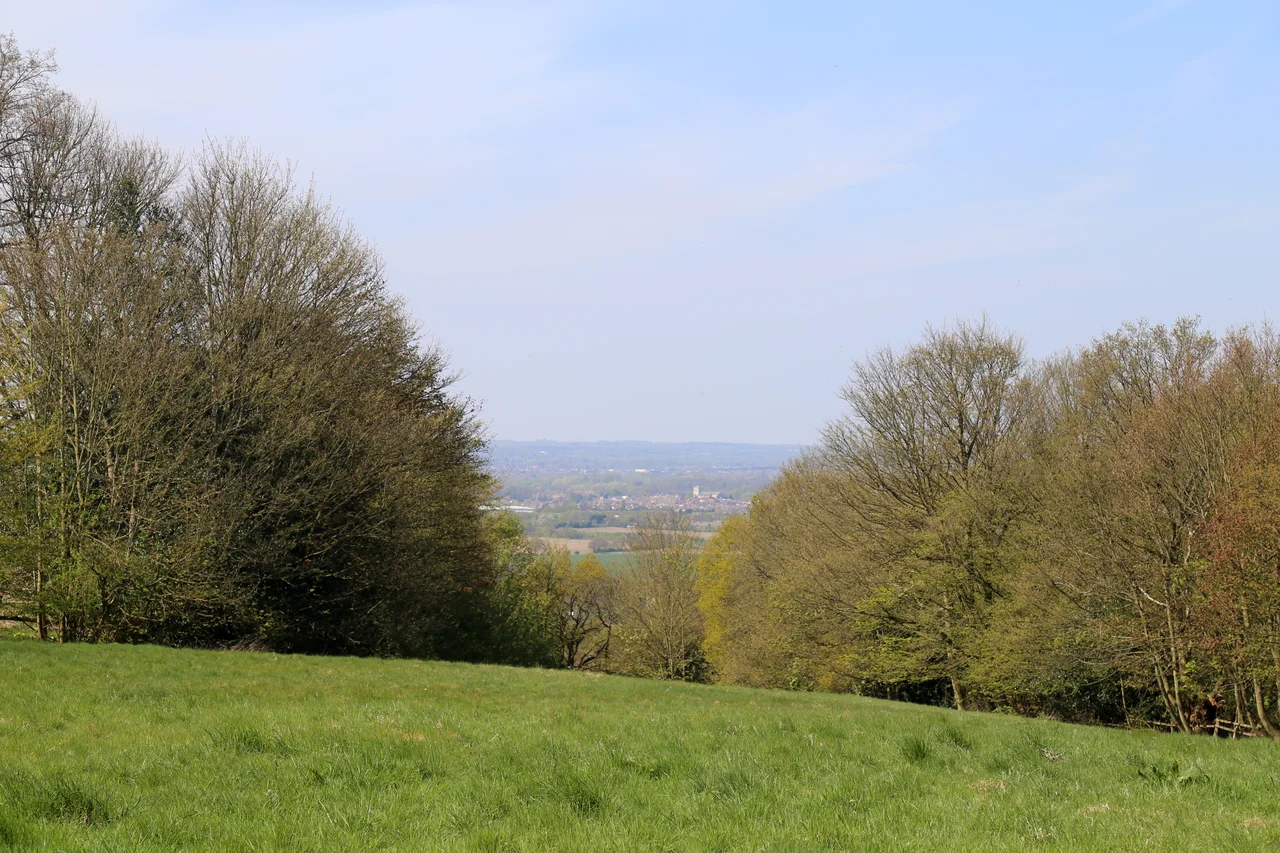

Epping Forest
Six thousand years ago, hunters in Neolithic England walked through these trees. The forest has been continuously wooded ever since. In the late nineteenth century landowners were eating it from every side - 3,000 acres enclosed in the early 1800s, more swallowed up year on year, and the same fate threatening that had finished off the neighbouring Hainault Forest in 1851. By 1870 only 3,500 acres remained. Then a Loughton commoner named Thomas Willingale refused to stop lopping his trees, the City of London Corporation took up the cause, and what is now Epping Forest - 2,400 hectares of ancient woodland and grassland straddling the border of Essex and Greater London - was saved.
Six Thousand Years of Trees
Epping Forest has been continuously wooded since Neolithic times. Pollen profiles taken from peat bogs in and around the forest show that even the Iron Age occupation - whose embankments survive at Loughton Camp and Ambresbury Banks, both visible if you know where to look - had no significant effect on the forest cover. The species mix has shifted over the millennia. Once this was small-leaved lime, a tree now scarce in Britain. The selective cutting of trees during the Anglo-Saxon period gradually changed the canopy to the beech-birch and oak-hornbeam dominance you see today. Henry II is thought to have given the area legal status as a royal forest in the twelfth century, then part of the much larger Forest of Essex which covered almost the whole county. 'Forest' was a legal term: it meant only the king could hunt deer there. It did not necessarily mean the land was wooded.
Thomas Willingale and the Right to Lop
By 1870 the unenclosed forest had shrunk to 3,500 acres. One landowner, Reverend John Whitaker Maitland, had enclosed 1,100 acres in his manor of Loughton. A local commoner called Thomas Willingale insisted on his ancient right to lop trees in the forest for firewood, despite increasing pressure on him to stop. The dispute became a test case. The Lord Warden, William Long-Wellesley, had been letting enclosures slip through. The Commissioners of Woods, Forests and Land Revenues had been selling off freeholds. The London public, alarmed by what had happened to Hainault Forest, was watching closely. The City of London Corporation - which had legal standing through ownership of commoners' grazing rights in the southern part of the forest - took up the legal fight. After years of litigation the courts upheld the commoners' rights, the Corporation bought up the contested land, and Parliament passed the Epping Forest Act of 1878. The forest was saved. It was the first major success of the environmental movement in Europe. The Corporation still owns and manages it today.
The Pollards That Were Never Cut
Epping Forest contains 55,000 ancient trees, more than any other single site in the United Kingdom. Many of them are pollards - trees that were cut back to a permanent base, the bolling, every thirteen years or so, just above the height where deer and cattle could browse the new shoots. That pollarding stopped when the Epping Forest Act passed in 1878. For 150 years since, the pollarded trees have grown unchecked, building enormous crowns of thick branches as big as ordinary tree trunks, balanced on the squat ancient bases. The weight is often more than the parent tree can hold. The forest is full of fallen branches and standing deadwood, which means it is also one of the richest sites in the country for rare fungi and invertebrates that depend on rotting wood. The Pedunculate oak, European beech, hornbeam, silver birch, and European holly that dominate today are descendants of trees first cut centuries ago.
Painters, Poets, and a Plague Year
Epping Forest has been the setting for an unusually wide cast of writers, painters, and musicians. Elizabethan poets George Gascoigne and Thomas Lodge lived in and around it. Lady Mary Wroth, the seventeenth-century poet and prose romancer, lived at Loughton Hall. Ben Jonson was a frequent visitor with George Chapman. In Daniel Defoe's A Journal of the Plague Year of 1722, the Londoners who try to escape the 1665 plague settle around Epping Forest. Mary Wollstonecraft - the same Mary Wollstonecraft who later wrote A Vindication of the Rights of Woman - spent the first five years of her life growing up here. In 1829 Thomas Hood published The Epping Hunt, satirising the rowdy annual Easter Monday hunt that was for centuries a notorious cockney institution. The sculptor Jacob Epstein lived on the forest's edge at Baldwins Hill in Loughton for twenty-five years, and exhibited a hundred paintings of the forest in 1933.
The Forest at the Edge of the City
The forest runs roughly nineteen kilometres north to south, but is never more than four kilometres wide. The main body stretches from Epping in the north to Chingford on the edge of the London built-up area. South of Chingford it narrows to a green corridor that pushes deep into east London, as far as Forest Gate. The southern Wanstead Flats are the southernmost point now, though the forest once extended further to Romford Road. Three visitor centres operate: Epping Forest Visitor Centre at High Beach, Epping Forest Gateway at Chingford, and The Temple in Wanstead Park. London Underground Central line stations between Leytonstone and Epping put millions of people within a short walk of ancient woodland that has stood here continuously since people in the Stone Age first walked through it. The forest absorbs the strain. The challenge of the next century is the same as the one of 1878: balancing the right of millions to use it with the survival of what makes it worth using.
From the Air
Epping Forest extends roughly from 51.55 degrees N to 51.70 degrees N along a narrow north-south corridor centred near 0.05 degrees E, straddling the boundary of Greater London and Essex. Stansted (EGSS) lies about 20 km north of the forest's northern tip. London City Airport (EGLC) is roughly 15 km south of the forest's southern end at Wanstead Flats. The M25 motorway crosses the forest's northern section in a tunnel under Bell Common.
Nearby Stories
- Waytemore Castle 2 km away
- Prittlewell Royal Anglo-Saxon Burial 4.2 km away
- Sevenoaks 5.6 km away
- Central line (London Underground) 6.4 km away
- River Lea 9.7 km away
- Surrey 11 km away
- Mercury Theatre, Colchester 14 km away
- Faversham Munitions Explosion Memorial 14 km away